LC Waikiki Brand Guidelines
A 1988 Paris wholesale label turned Istanbul retailer.
Aa
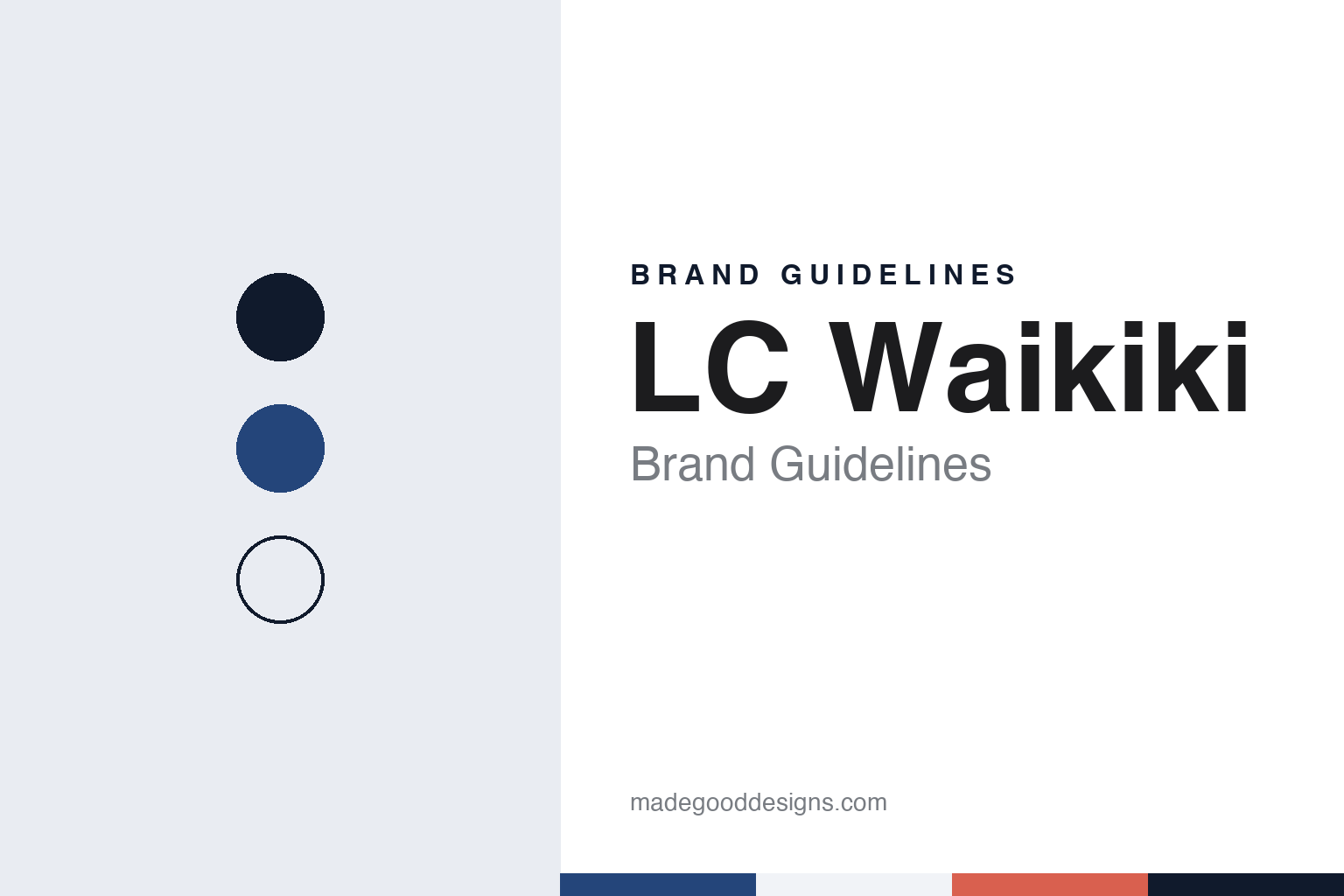
Two constants: an LC Waikiki ink blue and coral palette and a Plain retail sans register. Abstract homage — not an LC Waikiki product or mark; no logo, mascot or garment is reproduced.
Les Copains
A French wholesale label bought by an Istanbul textile firm.
LC Waikiki is now an Istanbul retailer, but it did not start in Türkiye. According to the Greek business paper Naftemporiki in January 2025, the label was set up in 1988 by three partners of French origin and began life as a wholesale brand. A peer-reviewed study in the Turkish journal Yeni Medya in spring 2022 places the founding in Paris and says the label first drew attention with its T-shirt and sweatshirt designs. InvestChile, the Chilean government’s foreign-investment agency, named one of the founders as George Amouyal in November 2024 and said he still held a minority stake; Turkish Wikipedia gives 1985 rather than 1988 in its summary box.
The name joins two ideas. Both English and Turkish Wikipedia say “LC” stands for Les Copains, French for “the friends,” and that “Waikiki” refers to the beach in Hawaii. English Wikipedia says the name is stylised as LCW.
The turn came in 1997. That year, InvestChile and Naftemporiki both reported, the brand was bought by Tema Tekstil, an Istanbul company belonging to the Taha Group; Yeni Medya says Tema Tekstil acquired the brand’s rights worldwide. Tema Tekstil was later renamed after the brand, as LC Waikiki Mağazacılık, or LC Waikiki Retailing Services, and InvestChile says the business then moved its focus to fashion retail in the affordable segment. Naftemporiki named Mustafa Küçük as the main shareholder since 2000, and Perú Retail reported in July 2021 that the group was controlled by the Küçük and Dizdar families. In December 2024, Daily Sabah named Vahap Küçük as chair of the executive board.
Colour
Romania first, then the Balkans, Africa and Latin America.
The international chain is younger than the brand. Its first store outside Türkiye opened in Romania in 2009, according to both FashionUnited in January 2021 and Daily Sabah in December 2024, and in December 2024 the company held a news conference in Belgrade to mark fifteen years abroad.
The store counts have moved quickly and should be read with their dates. In January 2021, FashionUnited reported more than 1,000 stores in 47 countries and nearly 47,700 staff. In November 2024, InvestChile gave more than 1,200 stores in over 60 countries. At the Belgrade news conference in December 2024, Vahap Küçük said the brand operated 1,300 stores in 61 countries on five continents, Daily Sabah reported, and he said the group had three main logistics centres, with another under construction in Kazakhstan.
The openings themselves are well documented in local trade press. Naftemporiki reported that the first store in Greece opened in 2018 in the Flamingo shopping centre in Xanthi, and that the Greek network had reached 13 stores by 2023. In December 2020 the company opened its first store in Uganda, in Acacia Mall in Kampala, marking it with a fashion show in front of the shop, FashionUnited reported. Perú Retail reported on 9 July 2021 that the chain was opening its first store in Latin America the next day, in the Plaza Norte centre in Lima.
Chile followed. InvestChile named Mallplaza Oeste, in the Cerrillos district of Santiago, as the site of the first Chilean store in November 2024, and listed Costa Rica, Panama, Ecuador, Peru, Venezuela, Curaçao and the Dominican Republic as existing Latin American markets. Daily Sabah said that in 2024 the brand entered Chile, Guatemala, Ivory Coast, Somalia and Mongolia. Each of the first stores reported in these four countries was placed in a shopping centre.
Typography
How the chains present themselves.
Turkish fashion, denim and footwear chains are mostly met in person, in shopping centres. Trade reports on these companies’ expansion abroad tend to describe the same kind of opening: a new unit in a regional mall, the brand name across the fascia, and a launch event at the door. For a design reader, the store front is where the identity is fixed, and the shopping bag is the version of it that leaves the building.
The names are short and usually written as plain lettering. Some of these chains use a word or an abbreviation rather than a symbol, and where a mascot or emblem once existed, published histories describe it being folded into a typographic logo. Campaign imagery, rather than the logo, carries most of the season-to-season change: model-led photography, designer collaborations and named collections are how the companies present each range.
Collection and store naming is generally descriptive. Sub-brands and formats tend to add a plain word to the parent name, such as Home, Outlet or Baby, so the parent name stays visible on every sign. In this guide we describe those ranges by the names the companies publish, without judging one against another.
The corporate side matters too. Some of these businesses began as small family shops or wholesale labels in Istanbul and later became large groups, some of them listed on Borsa Istanbul. Their corporate pages on founders, owners, board members and listings are part of the brand’s public face, and the guides in this series draw on those pages alongside dated independent reporting. The palettes shown are our own unofficial interpretations, not company colour standards.
Aa
A plain retail sans — the typographic logo that replaced the 1990s monkey. (Specimen set in Archivo, a sans STAND-IN; NOT the LC Waikiki logo.)
LCW
From a monkey mascot to a typographic mark.
The most documented part of LC Waikiki’s identity is a character it gave up. The 2022 Yeni Medya study, by Burçe Akcan and Arzu Kazaz, says the brand was known in the 1990s for a monkey mascot. Its early logo placed the brand name beneath the monkey; over time, the authors write, the logo became purely typographic, and the monkey also disappeared from the T-shirts and sweatshirts where it had appeared in different guises.
The monkey came back as a campaign rather than a logo. In the last quarter of 2021, the study says, the company opened an area of its website called WaikikiLand, announcing that the LCW monkey had returned. It was laid out like a theme-park map, with a monkey statue at its centre recalling the old logo, and it led to a playable game called Maymun Macerada, roughly “The Monkey on an Adventure,” together with a limited LCW monkey collection. The authors read it as aimed at adults who had been children in the 1990s and now shop for their own children. The same study describes an earlier online campaign that registered dozens of long, playful web addresses, each leading to the shop with a discount code.
The rest of the system is plainer. English Wikipedia lists XSIDE and LCW Home among the company’s brands, and Turkish Wikipedia lists store formats such as LC Waikiki Home, LC Waikiki Outlet and LC Waikiki Baby, each carrying the parent name. In the study’s account, the monkey survives as nostalgia and as a campaign device, while the shop sign and the website carry only the lettering.
For a design guide, LC Waikiki shows how a borrowed name and a dropped mascot can still carry a brand’s memory into a plain retail mark. Compare Koton, another Istanbul fashion chain from 1988, and DeFacto. For this guide we use an ink blue and a coral with a sans, an unofficial interpretation; no product or logo is reproduced.
Explore & save
Keep LC Waikiki’s identity on hand — save it to a board in the Made Good inspiration library.
LC Waikiki identity set
Pin the LC Waikiki ink blue and coral palette and the Plain retail sans register to your own board.
Source & notes
Frequently Asked Questions
What font can I use to match the LC Waikiki look?
This guide describes LC Waikiki’s type as “A plain retail sans — the typographic logo that replaced the 1990s monkey”. Its type specimen is set in Archivo from Google Fonts as a stand-in; Archivo is not LC Waikiki’s own lettering.
What colours are in the LC Waikiki palette?
This guide’s LC Waikiki palette is Ink blue #24457A, Night #101A2C, Cloud white #F1F3F7, Coral #D9604F and Paper #F8F9FB. The tones are the guide’s own unofficial interpretation, not official LC Waikiki hex codes.
When was LC Waikiki founded?
LC Waikiki was founded in 1988, in Paris, France. This guide gives Istanbul, Türkiye as where LC Waikiki is based.
Where is LC Waikiki based?
LC Waikiki is based in Istanbul, Türkiye. This guide dates LC Waikiki to 1988, in Paris, France.