Italac Brand Guidelines
The Teixeira brothers’ Corumbaíba dairy, from mozzarella to Nilza.
Aa
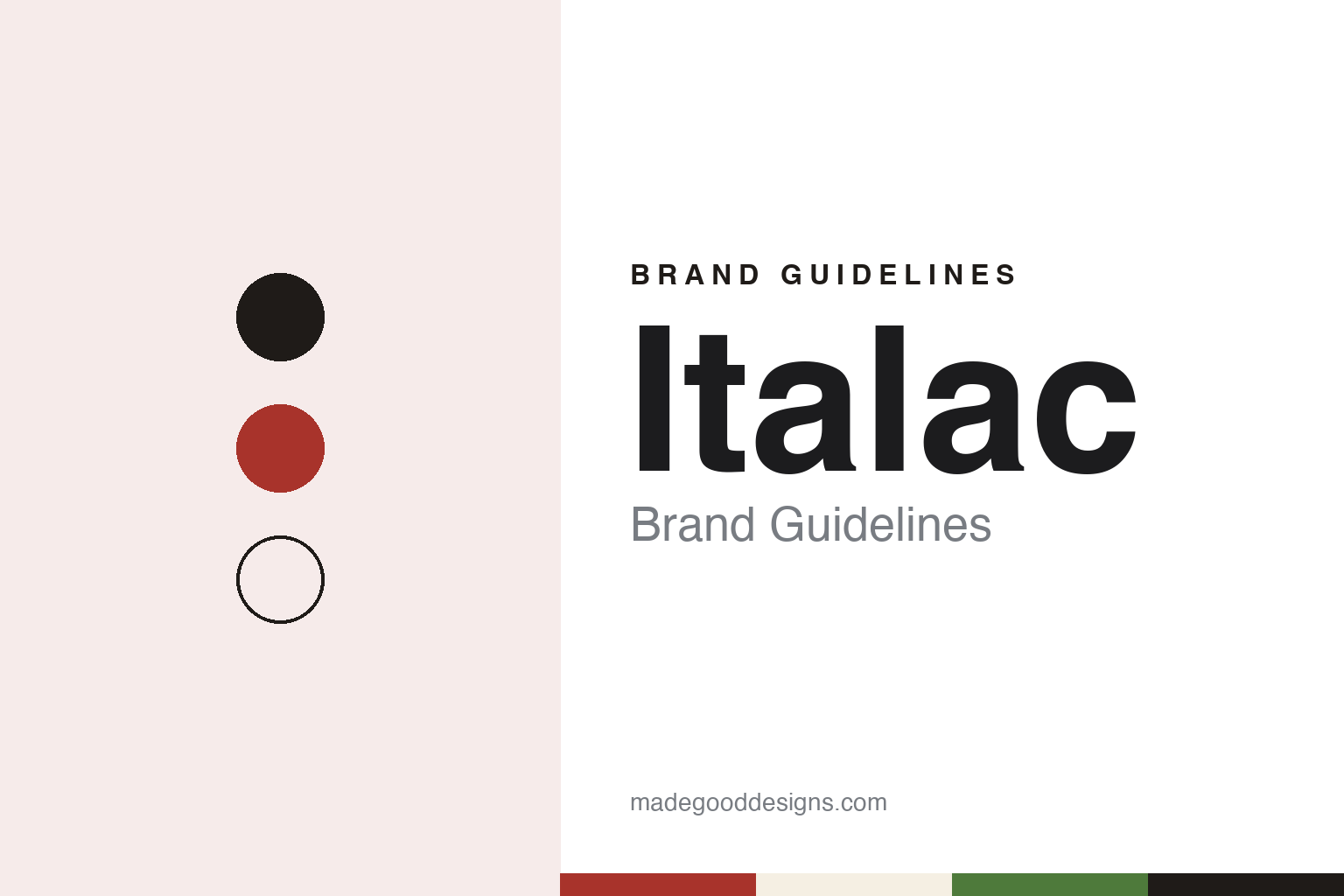
Two constants: a brick red, cream and pasture green palette and a bold geometric sans register. Abstract homage — not an Italac product or mark; no carton, logo or pack is reproduced.
Goiasminas
Five brothers and a mozzarella plant.
Italac is the brand of Goiasminas Indústria de Laticínios, a dairy company from Corumbaíba, in southern Goiás. Portuguese Wikipedia, citing the company, says Goiasminas was founded in January 1996 by the brothers Claudio, Márcio, Jerônimo, Sérgio and Alexandre Teixeira, and that its first plant, in Corumbaíba, made mozzarella cheese, which the company still sells. In October 2018 Valor Econômico described the business as belonging to the five Teixeira brothers, and as a limited company that does not publish its financial statements.
The company marked 30 years on 4 August 2026, the retail title SA+ reported that month; the Belo Horizonte paper Diário do Comércio likewise described Goiasminas in August 2026 as founded 30 years earlier, with its origin in Corumbaíba.
Within a few years of the cheese plant, according to Portuguese Wikipedia, the company added long-life (UHT) milk in whole, semi-skimmed and skimmed versions. In October 2009 it opened a UHT plant at Passo Fundo, in Rio Grande do Sul, to supply the South and South-East; the same article, citing a local report from that month, says the plant raised the company’s processing capacity by 17 per cent, to 4.1 million litres of milk a day. By 2015, Globo Rural reported, the company could take in more than seven million litres a day, and Diário do Comércio gave a production capacity above seven million litres a day in 2026.
Colour
Plants in six states, then more.
By June 2015 Goiasminas had eight plants in Goiás, Minas Gerais, Rio Grande do Sul, São Paulo, Rondônia and Pará, the farm magazine Globo Rural reported. It processed milk from more than 17,500 farmers and reached about 20,000 points of sale among retailers, wholesalers and distributors. In August 2026 Diário do Comércio listed plants in Minas Gerais, Rio Grande do Sul, São Paulo, Rondônia, Pará and Paraná as well as Goiás, more than 15,000 rural milk suppliers and a portfolio of more than 150 products sold in every region of Brazil.
The range, as SA+ described it in August 2026, takes in dairy drinks in 200 ml and one-litre packs, cream, doce de leite, condensed milk, powdered milk and UHT milk.
Italac has also grown by buying brands with a past. After the bankruptcy of Indústria e Alimentos Nilza and a court auction in November 2014, a court authorised the sale of the Nilza brand to Goiasminas in January 2015, Globo Rural reported. In June 2015 the company brought Nilza, an established long-life milk brand from São Paulo state, back to market with whole, semi-skimmed, skimmed and lactose-free milk, plus cream, condensed milk, powdered milk and a chocolate dairy drink. The relaunch ran under the line “Chega de saudades: o sabor de Nilza está de volta” (roughly, “No more longing: the taste of Nilza is back”), and the magazine noted that Nilza would share supermarket shelves with Italac itself. The same auction left the Nilza company’s plant at Campo Belo, in Minas Gerais, with another dairy business, the magazine added, so Goiasminas took the brand rather than the factory.
Typography
Packaging, names and owners.
The food brands in this group sit on supermarket shelves across Brazil, Colombia and Argentina: milk, cheese, biscuits, coffee, sauces and other pantry staples bought week after week. Their identities are built for that setting. Cartons, tins, jars and packets carry the brand name in large type, named ranges sit under one master brand, and television campaigns often put a well-known face beside the pack, as Piracanjuba did with the singer Ivete Sangalo, according to the O Povo advertising column in 2020.
Many of these names began as small regional firms and took the name of a town, a region or a family. Piracanjuba is named after the Goiás town where it began as a butter maker in 1955, and that town’s name comes from a Tupi-Guarani word for a fish of the cerrado. A single company can also own several brands at once, some built from scratch and some bought in, as Grupo Piracanjuba does with Piracanjuba, LeitBom and Emana, according to Exame and the company.
Ownership takes several forms. Some brands belong to family-owned companies that do not publish accounts; others belong to listed food groups or to multinationals; and brands also move between owners through purchases, licences and court-supervised sales. Valor Econômico reported in 2019 that Nestlé licensed its Ninho and Molico milk brands to the company behind Piracanjuba, and Globo Rural reported in 2015 that Italac’s owner bought the Nilza brand after its former company’s bankruptcy.
This guide sets out what can be checked about each brand: who founded it, who owns it today, where it makes its products and how its range and campaigns are presented. Ownership changes are given with their dates, and anything that rests only on a company’s own corporate pages is attributed to the company.
Aa
A bold geometric sans for a pantry dairy range. (Specimen set in Rubik, a sans STAND-IN; NOT the Italac logo.)
Líder and Tânia
Two older brands join in 2026.
A larger purchase followed in 2026. On 14 August 2026 Italac announced a contract to buy operating assets of A.R.C. Logística e Alimentos, including the Líder milk brand and the Tânia cheese brand, Diário do Comércio reported; the company made the announcement in a statement on LinkedIn. Líder already had a history of changing hands: in October 2018 Valor Econômico reported that it had belonged to LBR – Lácteos Brasil, which entered judicial recovery and sold several assets in 2014, when the Líder assets passed to the A.R.C. group. The 2026 deal covered plants in Presidente Prudente and Guaraçaí, in São Paulo state, and Lobato, in Paraná, plus milk-collection points in Paraná, São Paulo, Santa Catarina and Mato Grosso do Sul. SA+ gave Líder’s founding year as 1980, with a range of UHT milk, dairy drinks, cream, butter and requeijão, and Tânia’s as 1950, known for cheeses, requeijão and butter.
On 2 September 2026 Globo Rural reported that CADE, Brazil’s competition authority, had approved the acquisition without restrictions under its summary procedure. The authority had looked at markets from raw-milk collection to UHT milk, dairy drinks, cream, butter, cheese and powdered milk, and found the companies’ combined share below the levels that would point to a significant competition risk. The Shefa and Gold brands stayed with A.R.C. and were not part of the sale.
Italac shares its home state with a much older neighbour: the agribusiness site AgFeed noted in April 2025 that Goiás is home to large dairy companies such as Piracanjuba and Italac. Where Piracanjuba grew from a 1950s butter maker, Italac is a 1990s company that has expanded through new plants in several states and through older brands bought in.
For a design guide, Italac shows how a family-owned dairy can build one national brand while keeping acquired names such as Nilza alive beside it. Compare Piracanjuba, the other large Goiás dairy, and Tirolez, another Brazilian dairy. For this guide we use brick red, cream and a pasture green with a sans, an unofficial interpretation; no product or logo is reproduced.
Explore & save
Keep Italac’s identity on hand — save it to a board in the Made Good inspiration library.
Italac identity set
Pin the Italac brick red, cream and pasture green palette and the bold geometric sans register to your own board.
Source & notes
Frequently Asked Questions
What font can I use to match the Italac look?
This guide describes Italac’s type as “A bold geometric sans for a pantry dairy range”. Its type specimen is set in Rubik from Google Fonts as a stand-in; Rubik is not Italac’s own lettering.
What colours are in the Italac palette?
This guide’s Italac palette is Brick red #A8332B, Dark roast #1F1B18, Cream #F5EFE3, Pasture green #4E7A3B and Mozzarella white #FBF8F1. The tones are the guide’s own unofficial interpretation, not official Italac hex codes.
When was Italac founded?
Italac was founded in January 1996, in Corumbaíba, Goiás, Brazil.
Who founded Italac?
Italac was founded by Claudio, Márcio, Jerônimo, Sérgio and Alexandre Teixeira in January 1996.