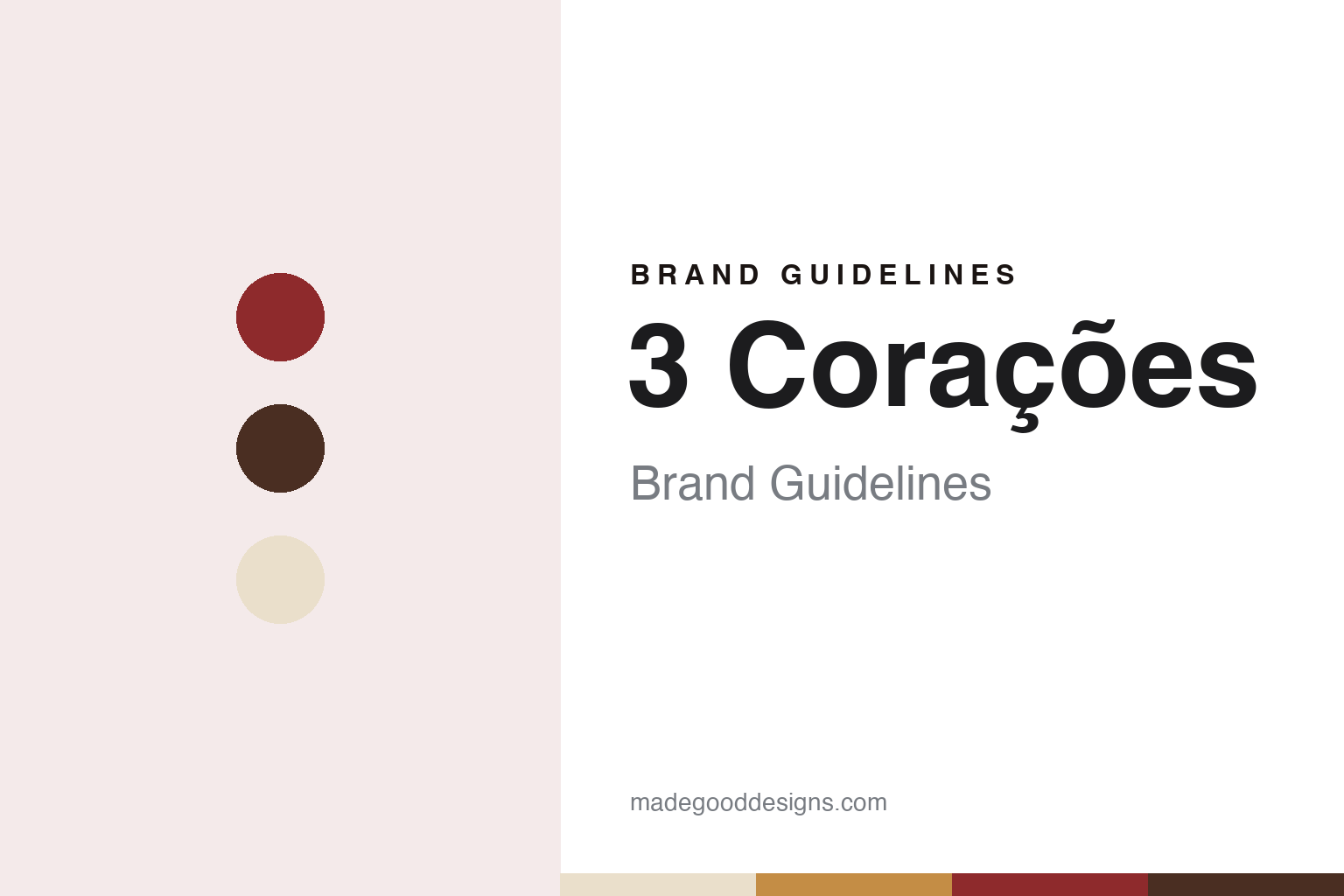
3 Corações Brand Guidelines
A 1959 coffee trade from Rio Grande do Norte under a three-heart name.
Aa
Two constants: a heart red, dark roast and crema palette and a warm coffee sans register. Abstract homage — not a 3 Corações asset; no logo, pack, capsule or machine is reproduced.
Two roots
A coffee trade in Rio Grande do Norte and a roaster in Minas Gerais.
The group now called 3corações has two roots, and the older one is not in Minas Gerais. Portuguese Wikipedia and the company’s own timeline say João Alves de Lima, known as João Rufino, began the business in 1959 by selling green coffee in São Miguel, a town in Rio Grande do Norte. In 1961, Portuguese Wikipedia says, he bought a mill and began roasting and grinding, under the name Café Nossa Senhora de Fátima; in 1973 he became one of the founding members of ABIC, the Brazilian coffee industry association, according to both sources.
In 1984 he handed the business to his sons Pedro, Paulo and Vicente Lima, Portuguese Wikipedia says, and in 1985 the coffee was renamed Santa Clara; the company adds that it was given new packaging at the same time. A sales branch opened in Mossoró in 1988, and in 1989 a factory opened in Eusébio, in the Fortaleza metropolitan area of Ceará, which the company says started its expansion across the north and north-east. In 1993 a mill in Mossoró began making corn products under the Dona Clara name, and in 1996 the group took over the Kimimo coffee brand. In 1999 the family created São Miguel Holding e Investimentos to manage its businesses, and in 2003 the purchase of Pimpinela, a Rio de Janeiro coffee, took the group into the south-east, according to Portuguese Wikipedia.
The second root is the brand that gave the group its name. Portuguese Wikipedia says three brothers, Mauro Alves, Jan Sérgio de Oliveira and Pedro Basílio, founded Café Três Corações in 1970 in Santa Luzia, in the Belo Horizonte metropolitan area of Minas Gerais, as a small roaster and distributor selling 3 Corações coffee. In the early 1980s, it says, the regional business was sold to the coffee grower Aprígio Tavares and restructured, and in 2000 the Israeli group Strauss-Elite bought the company that owned the 3 Corações brand.
Colour
Two families, one venture and a run of regional coffees.
The two roots met in December 2005. Portuguese Wikipedia says São Miguel and Strauss-Elite announced a joint venture, Santa Clara Participações e Empreendimentos, that brought the 3 Corações coffee and cappuccino brand into the Santa Clara group, with each side holding 50%. The company’s timeline describes it as two families joining in one company. Daily Coffee News, in February 2020, described the group as jointly owned by Israel’s Strauss Coffee and Brazil’s São Miguel FIP equity fund, and the company’s timeline also records a renewal of the shareholders’ agreement between São Miguel and Strauss Coffee.
The group then grew by buying regional names. In 2009, Portuguese Wikipedia says, it bought Café Letícia, from the north of Minas Gerais, and the powdered drink brands Frisco and Tornado from Unilever. In 2010 it changed its corporate brand to 3corações, written as one word, with the legal name Três Corações Alimentos; the company says the change came with an update of its organisational identity. Daily Coffee News listed later purchases as Fino Grão in 2012, Itamaraty in 2014, Cia Iguaçu in 2016, bringing the Iguaçu, Cruzeiro and Amigo brands, and Manaus in 2019.
In February 2020, Daily Coffee News reported, the group agreed to buy Mitsui Alimentos, the coffee business of Japan’s Mitsui & Co., whose leading brand, Café Brasileiro, had been launched by a family of Japanese immigrants in 1959 and bought by Mitsui in 1974; Mitsui’s green-coffee export business stayed with its parent. The company’s timeline lists the purchase of Mitsui Alimentos’ roast and ground coffee operation with its brands and assets.
The group also moved into machines. The company says it joined the Italian coffee-machine specialist Caffitaly to create the TRES capsule system, its entry into small appliances and single-serve coffee, and later formed a joint venture with Caffitaly System to build a capsule factory, 3Caffi, at Montes Claros in Minas Gerais. In 2016, Portuguese Wikipedia says, it agreed to supply 3 Corações coffee to the Rio 2016 Olympic and Paralympic Games.
Typography
How Latin American dairy, coffee and pantry brands present themselves.
The food brands in this group sit on supermarket shelves across Brazil, Colombia and Argentina: milk, cheese, biscuits, coffee, sauces and other pantry staples bought week after week. Their identities are built for that setting. Cartons, tins, jars and packets carry the brand name in large type, named ranges sit under one master brand, and television campaigns often put a well-known face beside the pack, as Piracanjuba did with the singer Ivete Sangalo, according to the O Povo advertising column in 2020.
Many of these names began as small regional firms and took the name of a town, a region or a family. Piracanjuba is named after the Goiás town where it began as a butter maker in 1955, and that town’s name comes from a Tupi-Guarani word for a fish of the cerrado. A single company can also own several brands at once, some built from scratch and some bought in, as Grupo Piracanjuba does with Piracanjuba, LeitBom and Emana, according to Exame and the company.
Ownership takes several forms. Some brands belong to family-owned companies that do not publish accounts; others belong to listed food groups or to multinationals; and brands also move between owners through purchases, licences and court-supervised sales. Valor Econômico reported in 2019 that Nestlé licensed its Ninho and Molico milk brands to the company behind Piracanjuba, and Globo Rural reported in 2015 that Italac’s owner bought the Nilza brand after its former company’s bankruptcy.
This guide sets out what can be checked about each brand: who founded it, who owns it today, where it makes its products and how its range and campaigns are presented. Ownership changes are given with their dates, and anything that rests only on a company’s own corporate pages is attributed to the company.
Aa
A warm, sturdy sans for a coffee group’s many names. (Specimen set in DM Sans, a sans STAND-IN; NOT the 3 Corações logo.)
3 Corações
A three-part mark, Yoki and Kitano.
The group’s portfolio is wide. In July 2023, Portuguese Wikipedia says, its coffees included 3 Corações, Santa Clara, Pimpinela and Café Iguaçu among some thirty names, alongside the Chocolatto chocolate drink, the TRES machine, the Frisco and Tornado drinks, the Mercafé online shop and the Dona Clara corn and seasoning products. The company’s website says the group is present in six South American countries.
In March 2026, Mercado & Consumo reported, Grupo 3corações agreed to buy the Brazilian operations of General Mills, including the Yoki and Kitano brands, adding staple foods, snacks and seasonings to its coffee business; both brands were to be kept, and the deal still needed regulatory approval. On 3 September 2026 the same publication reported that the group had completed the purchase, which included distribution centres in Pouso Alegre and Campo Novo do Parecis. Mercado & Consumo quoted Pedro Lima, the group’s president, on both occasions, and the company’s website also names him as president.
The name and mark carry their own story. The coffee brand is written 3 Corações, “three hearts,” while the corporate name since 2010 runs together as 3corações. The company says the triad that inspires its logo stands for the coexistence of the forces and pleasures of flavour, knowledge and living, and it offers the logo for download on its corporate pages. Its timeline also records a corporate tower named after João Alves de Lima in Eusébio, housing its shared services centre, and a Santa Clara café opened in São Miguel in the building that was the company’s first headquarters.
For a design guide, 3 Corações shows how a three-part mark can hold together a group built from dozens of regional coffee names and a family venture with a foreign partner. Compare Nestlé, another food group whose house mark sits above many brands, and Vitarella, a brand from Brazil’s north-east. For this guide we use a heart red, a dark roast brown and a crema with a sans, an unofficial interpretation; no product or logo is reproduced.
Explore & save
Keep 3 Corações’s identity on hand — save it to a board in the Made Good inspiration library.
3 Corações identity set
Pin the 3 Corações heart red, dark roast and crema palette and the warm coffee sans register to your own board.
Source & notes
Frequently Asked Questions
What font can I use to match the 3 Corações look?
This guide describes 3 Corações’ type as “A warm, sturdy sans for a coffee group’s many names”. Its type specimen is set in DM Sans from Google Fonts as a stand-in; DM Sans is not 3 Corações’ own lettering.
What colours are in the 3 Corações palette?
This guide’s 3 Corações palette is Heart red #8E2A2C, Dark roast #4A2E22, Golden grain #C48D45, Crema #EADFCB and Ink #1A1412. The tones are the guide’s own unofficial interpretation, not official 3 Corações hex codes.
Who founded 3 Corações?
3 Corações was founded by João Alves de Lima in 1959 (as a green-coffee trade).
Who owns 3 Corações?
3 Corações is owned by São Miguel (Lima family) and Strauss, 50/50 since 2005.