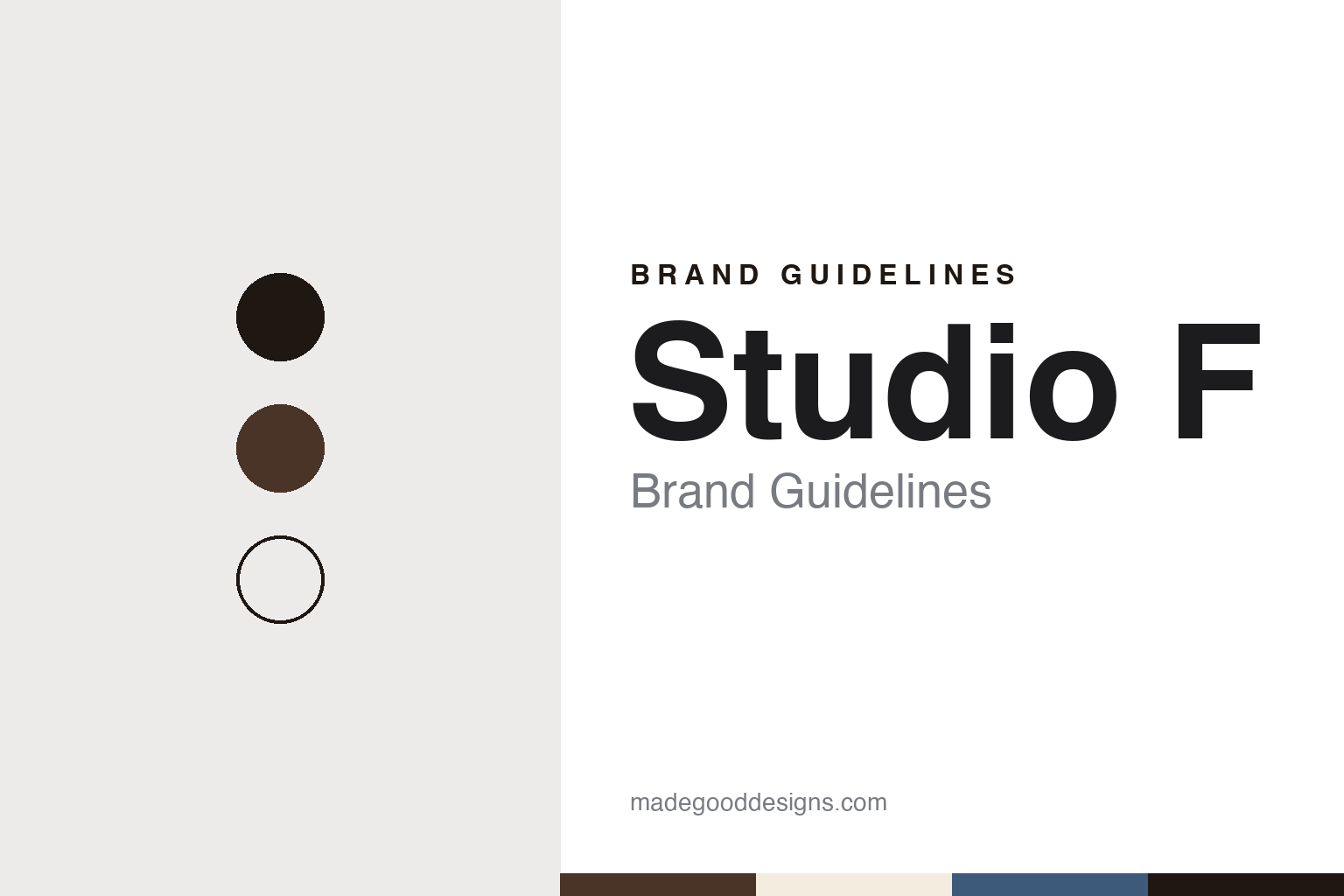
Studio F Brand Guidelines
A Cali family shop that became a multi-brand fashion group.
Aa
Two constants: a Studio F mocha, cream and denim palette and a Geometric sans register. Abstract homage — not a Studio F product or mark; no garment, logo or label is reproduced.
Faride Fashion
A family shop in Cali.
Studio F is a women’s fashion brand from Cali, in Colombia’s Valle del Cauca, owned by STF Group. Its roots are in a family shop. Pulzo reported in August 2023 that the business was started by Carmen Faride Hazzi in the 1970s as a small shop in Cali called Faride Fashion, and that in 1994 her son Carlos Alberto Acosta Hazzi took charge and turned it into Studio F. Forbes Colombia also dates the company to 1994, describing it in September 2023 as a firm founded that year.
Later coverage credits both generations. In February 2026 El País of Cali called Faride Hazzi the creator of Studio F, while Portafolio described Carlos Alberto Acosta Hazzi as the group’s founder and president and credited STF Group with more than six decades in the fashion trade, a span that reaches back before the Studio F name.
According to Pulzo, the holding company, STF Group, was created in 2002, during a period of expansion. Its brands now include Studio F; ELA, which Forbes Colombia described in 2023 as the group’s lower-priced line; and Studio F Man, its men’s label. Pulzo also listed a fourth name, Top One. ELA and Studio F were close in size in Colombia in 2023: Forbes Colombia counted about 170 ELA shops and 150 Studio F shops in the country.
The Colombian network changed shape in those years. Forbes Colombia reported in July 2023 that the group had shifted from a strategy centred on large cities and shopping malls to opening shops in town centres and intermediate cities, and that its Colombian store count had risen from 270 to 330 over the previous three years.
Colour
From Panama to Madrid.
Studio F went abroad early. Forbes Colombia reported in July 2023 that the company opened its first shops in Panama in 2000, during the economic downturn at the end of the 1990s, and had been in Mexico for about 14 years, where it then had its second most important market, with about 70 points of sale. It reached Puerto Rico in 2022. At that time the group ran its shops directly in Mexico, Chile and Puerto Rico, while partners ran franchises in Peru, Ecuador and Guatemala, and it counted 520 stores in eight countries, 330 of them in Colombia.
The figures have moved since. As of February 2026, Portafolio reported, STF Group operated more than 450 stores in 11 countries — Colombia, Mexico, Panama, Chile, Puerto Rico, Guatemala, Ecuador, Venezuela, Peru, Honduras and Curaçao — plus 103 Studio F corners in Liverpool department stores in Mexico and a presence in Falabella stores in Colombia. The same report put the group’s direct staff at more than 4,500 people across Latin America.
Production is split between countries. Forbes Colombia reported in 2023 that production for the Mexican business was entirely local, and Pulzo reported the same year that 80 to 90 per cent of output came from the group’s own plants in Colombia and Mexico, with the rest imported from Asia and Europe.
Typography
Design and documentation.
Colombia’s clothing, bag, leather and underwear brands are mostly home-grown companies, and several still carry the name of the person who started them. Some began as very small workshops: Vélez with belts cut by hand in Medellín in the 1980s, and Totto in a Bogotá leather factory taken over in 1987, according to Portafolio. Both grew into chains with shops across Latin America.
Much of their identity is built in the shop. Store fronts, windows and tags carry the brand as much as any advertisement does: when Totto redrew its logo in 2021, Forbes Colombia reported, the new look went to its stores, signs, shop windows and product tags. Larger-format stores and remodelled shop interiors appear in the companies’ own accounts of how they present themselves, alongside the names of their collections and of the designers, artists and athletes they work with.
Campaigns often draw on Colombian references. Totto has dressed the national Olympic delegation since 2004, Portafolio reported, and Vélez built a 2026 collection with J Balvin around the Antioquian muleteer, the arriero. Regional crafts, rural dress and the national colours recur in the way these brands show themselves at home and abroad, and the companies say so in their own campaign material.
Ownership is usually easy to trace. Several of the groups in this guide are founder-led or family-owned, and their corporate pages set out who founded them, who runs them and which export markets they serve, commonly Central and South America first, then Spain or the United States. This guide keeps to what those pages and dated press reports show, describes family-owned groups plainly, and marks the companies’ own claims as theirs.
Aa
A geometric sans — one word and one letter. (Specimen set in Jost, a sans STAND-IN; NOT the Studio F logo.)
Studio F
A new chapter and a quieter shop.
The men’s line is recent. Forbes Colombia reported in September 2023 that Studio F Man had begun about four years earlier as a pilot in western Colombia, with seven shops in Cali by then. The range covered shirts, polos, blazers, knitwear, jeans, suits and footwear, along with accessories.
Leadership has also changed. Alejandro Botero became STF Group’s director general in early 2020, Forbes Colombia reported in 2023. In February 2026 the group presented what it called a “Nuevo Capítulo,” a new chapter, with Eduardo Martín Cardona, who spent 14 years at Inditex and ran Zara in Spain, as corporate vice-president, according to Portafolio; Carlos Alberto Acosta Hazzi remains at the head of the group.
The same event introduced a new store design. On 26 February 2026, at its flagship in Cali’s Chipichape shopping centre, Studio F showed a minimalist, boutique-style look, with cleaner spaces, less product on display and brighter lighting, El País reported, alongside a personal-shopper service and its Spring–Summer 2026 collection, which the paper said was built on neutral bases such as cream, mocha and chocolate.
Denim was part of the same presentation. El País reported that the brand’s head of denim showed a lighter denim line for summer, while the wider collection used crochet, linen in several weights and crinkled viscose, with butter yellow, pastel blue, orange and green set against those neutral bases, and a nautical strand running through it.
For a design guide, Studio F shows how a family shop can grow into a multi-brand group and then quieten its stores as it matures. Compare Arturo Calle, the Bogotá menswear group that moved the other way into womenswear, and Zara, the Spanish chain where Studio F’s new vice-president worked. For this guide we use a mocha, a warm cream and a denim blue with a sans, an unofficial interpretation; no product or logo is reproduced.
Explore & save
Keep Studio F’s identity on hand — save it to a board in the Made Good inspiration library.
Studio F identity set
Pin the Studio F mocha, cream and denim palette and the Geometric sans register to your own board.
Source & notes
Frequently Asked Questions
What font can I use to match the Studio F look?
This guide describes Studio F’s type as “A geometric sans — one word and one letter”. Its type specimen is set in Jost from Google Fonts as a stand-in; Jost is not Studio F’s own lettering.
What colours are in the Studio F palette?
This guide’s Studio F palette is Mocha #4A3428, Espresso #1E1712, Warm cream #F4ECDF, Denim blue #3E5A7A and Paper #FBF8F3. The tones are the guide’s own unofficial interpretation, not official Studio F hex codes.
Who owns Studio F?
Studio F is owned by STF Group. This guide gives Cali, Colombia (Studio F name 1994) as where Studio F is based.
Where is Studio F based?
Studio F is based in Cali, Colombia (Studio F name 1994).