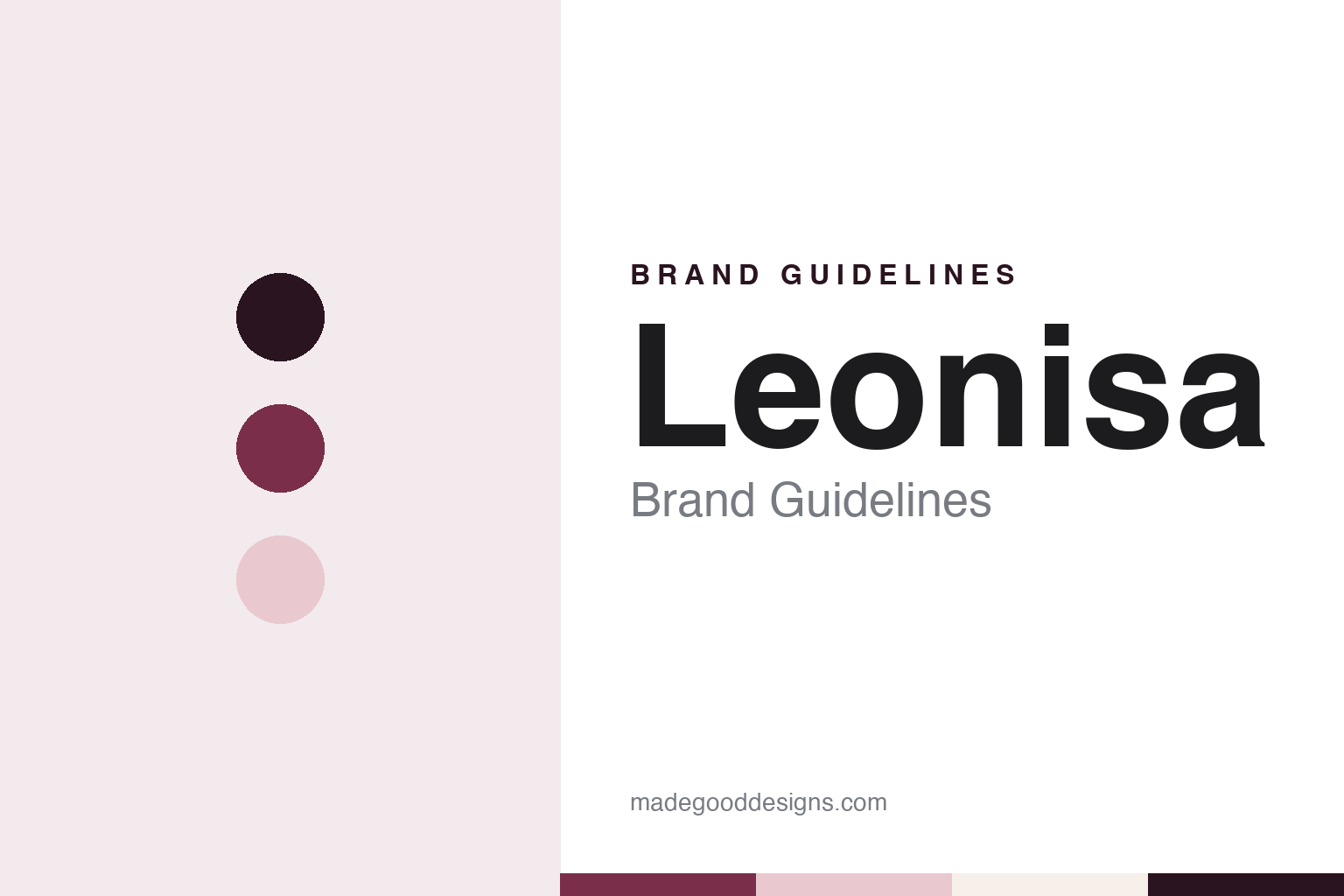
Leonisa Brand Guidelines
The Medellín lingerie maker founded by the Urrea brothers in 1956.
Aa
Two constants: a plum, blush and ivory palette and a romantic serif register. Abstract homage — not a Leonisa product or mark; no garment, logo or label is reproduced.
Four brothers
From a shop called El Volga to a Medellín workshop.
Leonisa was founded in Medellín on 20 November 1956. Portafolio, the Bogotá business paper, wrote in March 2006 that the company began as a general partnership registered as Jiménez Aristizábal & Cía. Confecciones Leonisa, set up to make women’s underwear. Its founders were four brothers from a merchant family of Guatapé, in Antioquia: Luis Enrique, Marco Aurelio, Joaquín Eduardo and Julio Ernesto Urrea, as El Tiempo listed them in July 2016 and Spanish Wikipedia lists them today.
The brothers started as traders. According to El Tiempo, they sold fabric, shirts, underwear and stockings around the towns of Antioquia, then moved in the 1950s to Armenia, in the coffee region, where they opened a shop called El Volga. El Colombiano reported in November 2022 that the satin bras made by the Medellín firm Fabritex were among the shop’s quickest sellers, which gave the family the idea of making their own. Back in Medellín they set up a workshop with one overlock machine and one flat sewing machine, making shirts, slips and petticoats, El Tiempo says.
The garment that changed the business was a pointed bra with spiral stitching in a stiff fabric, the reference 1000, also called the “punta de diamante” or Diamond Point. El Tiempo describes it as the first bra the brothers made, in the shape that Marilyn Monroe had made fashionable, and reported in 2016 that it was still being produced, now with elastic straps. Its success led the family to concentrate on underwear.
The name has more than one origin story. El Tiempo and El Colombiano both say the family first chose “Leona” and then softened it to Leonisa; El Colombiano adds that the Club de Leones objected to the first name. Spanish Wikipedia reads the name as a contraction of Lencerías Nacionales de Textiles S.A., while Portafolio wrote in 2006 that its origin was uncertain and that one theory linked it to Lyon, a French centre of corsetry and embroidery.
Colour
Reference 1000, Magic Up and the Air Bra.
Leonisa’s products have been built around bras, briefs, shapewear (known in Colombia as fajas) and swimwear. A milestone list published by Portafolio in 2006 traces the range: exclusive Swiss-type laces and a colour concept called Parisien Sexy Color in 1968; a children’s line in 1973 that later became Tiny; the Natural Collection label in 1976; a campaign titled “Sí es mujer” in 1980; Leonisa In, for younger customers, in 1988; and elastic lace in 1989.
The two products company staff singled out to El Tiempo in 2016 were the Magic Up, a padded lifting bra, and the Air Bra, which replaced conventional padding with an air capsule. Dates differ: Spanish Wikipedia gives 1993 for the Magic Up and Portafolio’s list gives 1995; Portafolio dates the Air Bra to 2000. In 2006 the company presented a thermo-bonded collection called “Viva la evolución”, with pieces joined by heat rather than seams, which Portafolio said had been shown at a lingerie fair in Paris that January before its Colombiamoda launch in July. El Tiempo also described a machine that knits a garment in one piece, replacing a bra that can otherwise have 34 parts to assemble.
Men’s underwear followed in 1975 under the name Airell, renamed Leo in the 1980s, according to Spanish Wikipedia. The same source says swimwear arrived in the 1990s and that Leonisa has sponsored the Señorita Colombia national pageant since 2007, building swimwear campaigns around it each year.
Sales have run through several channels at once. Spanish Wikipedia says a catalogue channel, with sellers taking monthly orders, began in 1993, and that the online shop opened in June 2009, first for the United States and Canada. El Tiempo listed in 2016 own stores, multi-brand shops and department stores, telephone, internet and catalogue sales, and counted 44 stores in Colombia and 33 more in 19 countries across Latin America, the United States and Spain.
Typography
Colombian fashion brands.
Colombia’s clothing, bag, leather and underwear brands are mostly home-grown companies, and several still carry the name of the person who started them. Some began as very small workshops: Vélez with belts cut by hand in Medellín in the 1980s, and Totto in a Bogotá leather factory taken over in 1987, according to Portafolio. Both grew into chains with shops across Latin America.
Much of their identity is built in the shop. Store fronts, windows and tags carry the brand as much as any advertisement does: when Totto redrew its logo in 2021, Forbes Colombia reported, the new look went to its stores, signs, shop windows and product tags. Larger-format stores and remodelled shop interiors appear in the companies’ own accounts of how they present themselves, alongside the names of their collections and of the designers, artists and athletes they work with.
Campaigns often draw on Colombian references. Totto has dressed the national Olympic delegation since 2004, Portafolio reported, and Vélez built a 2026 collection with J Balvin around the Antioquian muleteer, the arriero. Regional crafts, rural dress and the national colours recur in the way these brands show themselves at home and abroad, and the companies say so in their own campaign material.
Ownership is usually easy to trace. Several of the groups in this guide are founder-led or family-owned, and their corporate pages set out who founded them, who runs them and which export markets they serve, commonly Central and South America first, then Spain or the United States. This guide keeps to what those pages and dated press reports show, describes family-owned groups plainly, and marks the companies’ own claims as theirs.
Aa
A romantic serif for a lingerie house. (Specimen set in Playfair Display, a serif STAND-IN; NOT the Leonisa logo.)
Leonisa
A family company that went abroad early.
Exports began within a few years of the founding. El Tiempo wrote in 2016 that the first shipments went to Costa Rica seven years after operations started, through a local commercial representative, who later persuaded the family to build a plant there. Portafolio and Spanish Wikipedia date that plant to 1965; El Tiempo gives 1966 and says it was still running. By 1970 the brand was sold in 11 countries, Portafolio reported, and in 1990 it began coordinating European distribution from Spain; Spanish Wikipedia dates the entry to Spain to 1989 and names the United Kingdom, Germany, France and Italy as later markets.
Ownership has stayed inside the founding family. In 1972, El Tiempo reported, two of the brothers left over differences in how the firm was run and founded Confecciones Lumar, which Leonisa later absorbed. In March 2005 a dispute between two branches of the family over the distribution of profits was settled by an auction in which each side, holding half the company, could bid for the other’s stake; the family of co-founder Joaquín Urrea, the Urrea Arbeláez, became the sole owners, according to the same report.
On manufacturing, company staff told El Tiempo in 2016 that about 90 per cent of production was carried out in Medellín and the rest in Costa Rica, and that the Medellín output relied on hundreds of satellite workshops, many of them small family businesses that had worked for Leonisa for more than 20 years and were trained by the company.
For a design guide, Leonisa shows how a family-owned underwear maker can carry one Medellín name across catalogues, department stores and its own shops in many countries for seven decades. Compare Offcorss, a Medellín childrenswear brand, and Studio F, another Colombian fashion label. For this guide we use deep plum, blush and ivory with a serif, an unofficial interpretation; no product or logo is reproduced.
Explore & save
Keep Leonisa’s identity on hand — save it to a board in the Made Good inspiration library.
Leonisa identity set
Pin the Leonisa plum, blush and ivory palette and the romantic serif register to your own board.
Source & notes
Frequently Asked Questions
What font can I use to match the Leonisa look?
This guide describes Leonisa’s type as “A romantic serif for a lingerie house”. Its type specimen is set in Playfair Display from Google Fonts as a stand-in; Playfair Display is not Leonisa’s own lettering.
What colours are in the Leonisa palette?
This guide’s Leonisa palette is Deep plum #7A2E4A, Night aubergine #2A1420, Blush rose #E9C9CF, Warm ivory #F6EFEA and Sand #D8C3A5. The tones are the guide’s own unofficial interpretation, not official Leonisa hex codes.
When was Leonisa founded?
Leonisa was founded in 20 November 1956, in Medellín, Colombia.
Who founded Leonisa?
Leonisa was founded by Luis Enrique, Marco Aurelio, Joaquín Eduardo and Julio Ernesto Urrea in 20 November 1956.
Who owns Leonisa?
Leonisa is owned by Urrea Arbeláez family (since 2005). Leonisa is known for Reference 1000 bra, Magic Up, Air Bra.