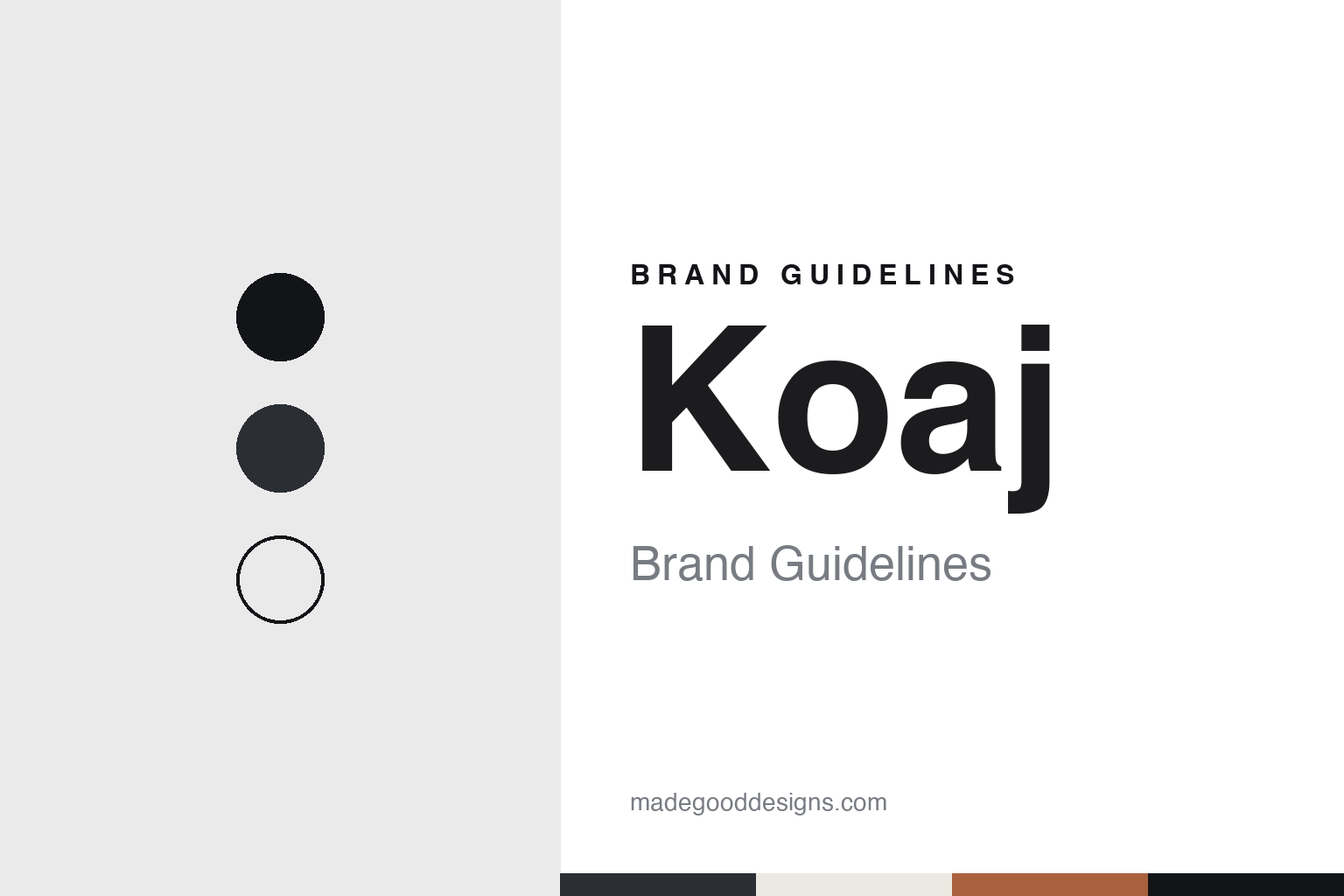
Koaj Brand Guidelines
Permoda’s 2008 youth label that became its shop name.
Aa
Two constants: a charcoal, bone and clay palette and an urban sans register. Abstract homage — not a Koaj product or mark; no garment, logo or shop sign is reproduced.
Permoda and Armi
A textile family’s son and a women’s label.
Koaj is the youngest label of Permoda, a Colombian clothing group, and the name the group now puts over its shop doors. Its story begins with an earlier label. El Cronista, in its Colombian edition in February 2025, wrote that the Cali-born businessman Hanoj Pérez Taraboulos created the trading company Permoda in 1983, dedicated to Armi, a womenswear label. Pulzo, the Colombian news site, reported in July 2020 that Pérez came from a family that traded in textiles and chose to carry on that business, and that Armi set out to dress women entering working life.
The group did not stay with one label for long. According to Pulzo, Pérez soon added collections for men and opened his own shops, taking the group into retail. A second label, Pronto, followed in 1990 for a younger customer; both Pulzo and El Cronista give that year. A third, Bkul, aimed at teenagers with what Pulzo called an “irreverent” style, arrived in 2002, the date El Cronista gives; Pulzo placed it more loosely at the start of the century.
Each label had its own age group and its own tone. That structure, one company with several named lines aimed at different stages of life, is the background to the Koaj name: it was born as the newest line in a family of labels, not as a stand-alone start-up. The founder appears in the press only in his business role, as the man who built the group from a textile trade into a set of retail labels.
Colour
Four lines under one roof.
Koaj arrived in 2008. El Cronista wrote in 2025 that in that year Pérez decided to bring his three existing labels together and give life to Koaj; Pulzo, citing the trade site FashionUnited, wrote in 2020 that Koaj completed the Permoda group in 2008, as international fast-fashion chains were arriving in Colombia.
The arrival of those chains shaped the shops. Pulzo, citing the Spanish trade site Modaes, reported that the group answered the opening of Zara in Colombia by gathering all its labels in the same premises, building multi-brand stores of up to 4,000 square metres that carried Armi, Pronto, Bkul and Koaj together. Koaj became the name over the door, and the older labels lived on as lines inside it.
A store opening in Peru shows how that format was presented abroad. Perú Retail reported in November 2013 that Koaj had opened a 450-square-metre store, in what it called the brand’s metropolitan store format, at the Real Plaza shopping centre in Trujillo. The trade site described four lines with distinct moods inside one shop: Armi drawing on New York and the dress of Wall Street, Pronto for university and city life, B.kul for fans of alternative and rock styles with a London beat, and Koaj itself, spelled there with a diaeresis, drawing on Milan. Each line had a city as its reference point, while the shop front carried one name.
The group later went back to its older names. Pulzo reported, citing Modaes, that in 2016 Permoda announced it would relaunch its earlier labels in new stores in Colombia and in the other five countries where it then traded, namely Mexico, Ecuador, Venezuela, Costa Rica and Peru, and that its international expansion had begun in 1988. In the same 2020 article, Pulzo put the group at 100 stores in Colombia and 40 elsewhere, again citing Modaes; those counts belong to that period and are not a current figure.
Typography
How Colombian fashion labels present themselves.
Colombia’s clothing, bag, leather and underwear brands are mostly home-grown companies, and several still carry the name of the person who started them. Some began as very small workshops: Vélez with belts cut by hand in Medellín in the 1980s, and Totto in a Bogotá leather factory taken over in 1987, according to Portafolio. Both grew into chains with shops across Latin America.
Much of their identity is built in the shop. Store fronts, windows and tags carry the brand as much as any advertisement does: when Totto redrew its logo in 2021, Forbes Colombia reported, the new look went to its stores, signs, shop windows and product tags. Larger-format stores and remodelled shop interiors appear in the companies’ own accounts of how they present themselves, alongside the names of their collections and of the designers, artists and athletes they work with.
Campaigns often draw on Colombian references. Totto has dressed the national Olympic delegation since 2004, Portafolio reported, and Vélez built a 2026 collection with J Balvin around the Antioquian muleteer, the arriero. Regional crafts, rural dress and the national colours recur in the way these brands show themselves at home and abroad, and the companies say so in their own campaign material.
Ownership is usually easy to trace. Several of the groups in this guide are founder-led or family-owned, and their corporate pages set out who founded them, who runs them and which export markets they serve, commonly Central and South America first, then Spain or the United States. This guide keeps to what those pages and dated press reports show, describes family-owned groups plainly, and marks the companies’ own claims as theirs.
Aa
An urban sans for a mall-floor youth label. (Specimen set in Archivo, a sans STAND-IN; NOT the Koaj logo.)
Koaj
A family of labels behind one shop name.
For identity work, Koaj is a study in how a house of labels can live behind a single name. The press record above describes a group that started with a womenswear line in 1983, added a youth line in 1990 and a teen line in 2002, and then made its newest label, Koaj, the umbrella over all of them in 2008. In the 2013 Peruvian store described by Perú Retail, the sub-lines were not hidden: each was given its own city and its own attitude, from Wall Street tailoring to London rock, inside one branded space.
That arrangement is a useful model for any retailer with several ranges. The shop name has to be short and stable enough to carry every line, while each line needs a clear, separate voice so customers can find their way through a large floor. The four-letter Koaj name suits that role on a shop front, a bag or a receipt. The sub-line names have their own spellings, such as Bkul written as B.kul and Koaj written with a diaeresis in the 2013 trade report, which shows how a name can shift slightly in print while staying recognisable.
Permoda’s own logo files, typefaces and colours are not documented in the sources for this guide, so the palette here is our own reading of a mall-floor youth label: a charcoal and an ink for signage-weight type, a warm bone white for space, and a clay accent for small highlights. The type stand-in is a compact grotesque that holds up at shop-front scale and on small swing tags alike.
For a design guide, Koaj shows how one short shop name can hold a family of labels, each with its own voice, and how that structure travelled from Bogotá to stores abroad. Compare Studio F, another Colombian fashion retailer, and Zara, whose arrival in Colombia the press links to Permoda’s multi-brand stores. For this guide we use charcoal, ink, bone white and clay with a sans, an unofficial interpretation; no product or logo is reproduced.
Explore & save
Keep Koaj’s identity on hand — save it to a board in the Made Good inspiration library.
Koaj identity set
Pin the Koaj charcoal, bone and clay palette and the urban sans register to your own board.
Source & notes
Frequently Asked Questions
What font can I use to match the Koaj look?
This guide describes Koaj’s type as “An urban sans for a mall-floor youth label”. Its type specimen is set in Archivo from Google Fonts as a stand-in; Archivo is not Koaj’s own lettering.
What colours are in the Koaj palette?
This guide’s Koaj palette is Mall charcoal #2B2E33, Ink #121417, Bone white #ECE9E2, Clay #A9603D and Paper #F7F6F2. The tones are the guide’s own unofficial interpretation, not official Koaj hex codes.
Who founded Koaj?
Koaj was founded by Hanoj Pérez Taraboulos.