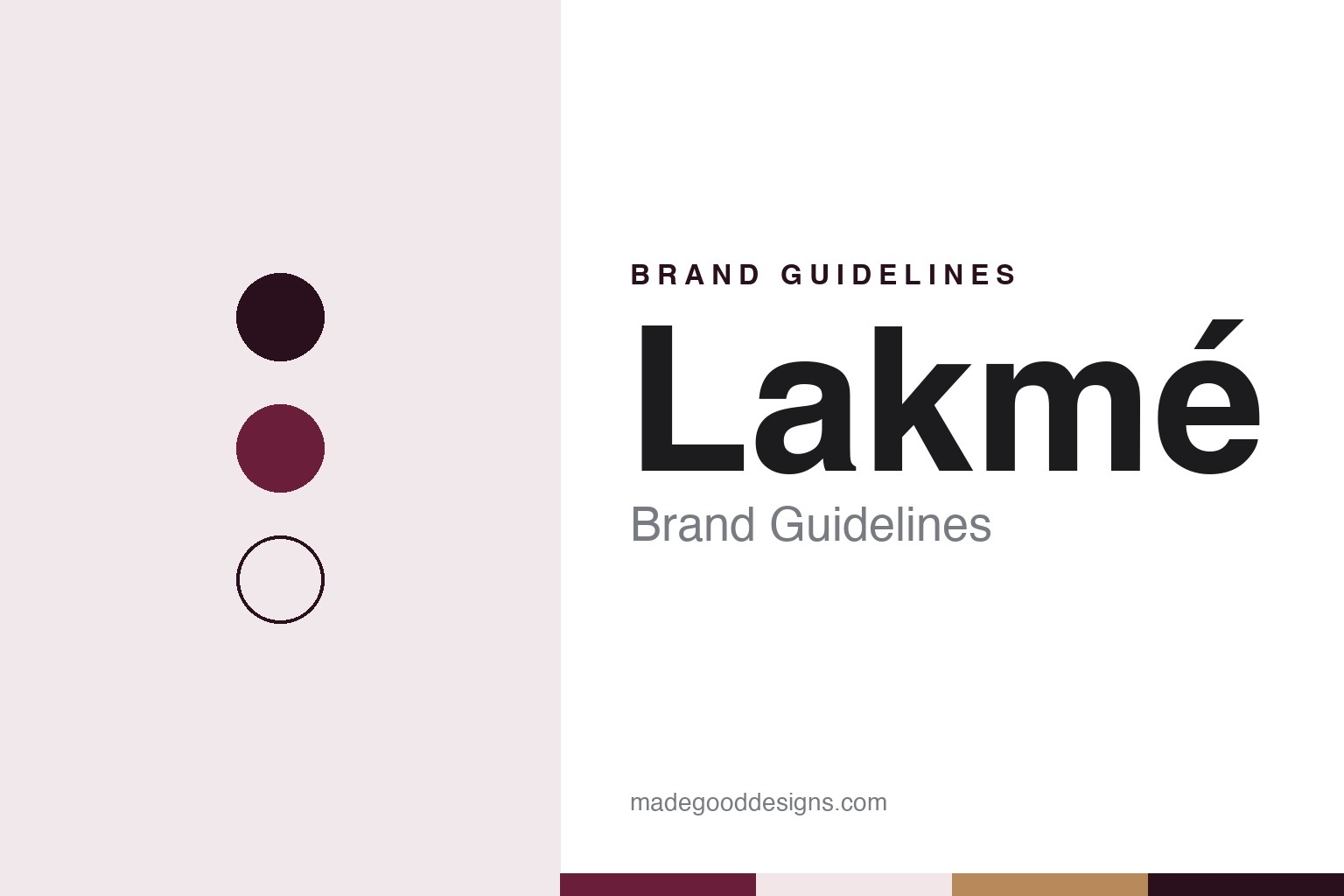
Lakmé Brand Guidelines
A 1952 Tata cosmetics company, named after an opera, and the name on India’s fashion week runway.
Aa
Two constants: a plum, rose and bronze palette and a high-contrast serif register. Abstract homage — not a Lakmé product or mark; no pack, logo or campaign image is reproduced.
Lakme Limited
A Tata company with a French name.
Lakmé began inside the Tata group. Trent Limited, the retailer that the original company later became, says on its corporate website that it was incorporated as Lakme Limited on 5 December 1952, in the business of making, selling and exporting cosmetics, toiletries and perfumery. Live History India, in a 2021 article, describes the new venture as a subsidiary of the Tata Oil Mills Company, or TOMCO, the group’s coconut-oil and soap business, and gives 1953 as the year its products were launched.
Both Live History India and Homegrown, in a 2025 feature, repeat the account that Prime Minister Jawaharlal Nehru, concerned about foreign exchange being spent on imported beauty products, asked the industrialist J.R.D. Tata to make them in India. Live History India says the company worked with the French houses Robert Piguet and Renoir and the American firm Kolmar at the start.
The name comes from an opera. Business Today, in a September 2000 article, traces it to Lakmé, the 19th-century opera by the French composer Léo Delibes, whose title character is a priestess; the French form of the name is a version of Lakshmi. Accounts differ on who chose it: Business Today credited Simone Tata, while Homegrown says the name was suggested by Robert Piguet, who acted as a consultant, and Live History India says the French partners proposed it.
Simone Tata became managing director in 1961, according to both Live History India and Homegrown. They disagree on when she became chairperson: 1982 in the first, 1989 in the second. Homegrown says that, between the 1950s and the 1990s, Lakmé ran as a division of Tata Oil Mills and became known for its kajal and its lipsticks.
Colour
A joint venture, a sale and a new name.
The route to Hindustan Lever ran through a joint venture. In 1995, Business Today reported in 2000, Lakmé Ltd and Hindustan Lever formed Lakmé Lever, a 50:50 venture to market and distribute Lakmé’s products. In 1998 Lakmé Ltd sold its brands, and its half of the venture, to Hindustan Lever, renamed itself Trent and moved into retailing. Trent’s own history says that in 1998 the company decided to leave cosmetics for apparel retailing and, in March that year, bought Littlewoods International (India), the start of the business behind its Westside stores. Some later accounts, including Live History India and Homegrown, date the sale to 1996.
Under its new owner, the brand was repositioned around fashion. Business Today described a portfolio in 2000 of three colour-cosmetics names at Lakmé Lever: Lakmé itself, set to be positioned as a fashion brand; Elle 18, aimed at college students; and Orchid, a more expensive line relaunched in 1999. It noted that Pond’s was Hindustan Lever’s main skincare brand, with Lakmé the company’s colour-cosmetics name.
The fashion link took the form of a runway. The Tribune, marking the event’s 25th year in March 2025, reported that the Fashion Design Council of India (FDCI), set up in 1998, and the sports and events company IMG, now RISE Worldwide, a subsidiary of Reliance Industries, conceived a fashion week in 2000 and approached Lakmé for the title sponsorship. The first Lakmé India Fashion Week, at the Taj in Delhi in 2000, had 32 designers presenting ready-to-wear lines over five days; the second, in Mumbai, had 44. Until 2005, The Tribune said, there was one fashion week a year, alternating between the two cities. It also credits the event’s GenNext show with giving a platform to emerging designers.
Typography
Indian beauty and personal care.
India’s beauty and personal-care brands range from names that began inside old industrial groups to labels that started on their own websites. Lakmé was incorporated in December 1952 as a Tata company, according to Trent, the retailer that the original company became, and its brands passed to Hindustan Lever, now Hindustan Unilever, in 1998, Business Today reported. Dabur says on its corporate site that it started operations in Calcutta in 1884.
Some newer brands describe themselves as digital-first. Honasa Consumer, the owner of Mamaearth, calls itself a “digital-first house of brands” on its corporate website, and says Mamaearth began in 2016. Sugar Cosmetics sold only through its own website and a marketplace partner until 2017, Inc42 reported in 2020, before moving into general trade, large-format stores in malls and its own shops.
Shops and counters remain part of the picture. Sugar’s chief executive told the trade magazine Retail4Growth in 2023 that the brand used exclusive outlets, shop-in-shop counters and multi-brand stores, and that it changes its visual merchandising every year. Lakmé has tied its name to a runway since 2000, when the Fashion Design Council of India and IMG brought it in as title sponsor of a new fashion week, The Tribune reported in 2025.
This guide sets out what can be checked about each brand: when and where it began, who founded and owns it, which named product lines and campaigns it publishes, and how it presents itself in packs, logos and stores. Where a fact rests only on a company’s own pages, the text says so, and the palettes and typefaces shown are an unofficial interpretation rather than any brand’s own.
Aa
A high-contrast serif for a name taken from the opera house. (Specimen set in Playfair Display, a serif STAND-IN; NOT the Lakmé logo.)
Lakmé
A beauty name on the runway.
The fashion week and the cosmetics brand have stayed linked. In October 2022 The Telegraph’s t2 described Lakmé Fashion Week in partnership with FDCI at the Jio World Convention Centre in Mumbai, an edition that RISE said marked a return to a physical format in Mumbai after two years; the FDCI’s Designer Stockroom sale made its Mumbai debut there. In March 2025 the Mumbai edition marked the event’s silver jubilee, The Tribune reported.
Campaigns have used the same stage. In February 2023 afaqs! reported a campaign called #UnapologeticallyMÉ, built with Ogilvy Mumbai, whose film was shot at the Falaknuma Palace in Hyderabad and which was tied to that season’s fashion week; a Hindustan Unilever vice president for skin care and colour cosmetics spoke for the brand, showing that it remained part of the company, the former Hindustan Lever. The brand’s own website today sorts its range into lips, eyes, face, nails and skincare.
The identity layers show in the name itself. The company that held the cosmetics business was registered as Lakme Limited, without the accent that the brand uses; the business that kept the original company went on as Trent, and the Lakmé name went to Hindustan Lever with the brands. In Business Today’s 2000 telling, the new owner treated Lakmé as an aspirational colour-cosmetics brand, while other Hindustan Lever names covered skincare. The same article recorded that Lakmé’s export business and most of its skincare had been taken on by Hindustan Lever itself.
For a design guide, Lakmé shows how a brand can tie its look to an event it lends its name to, from a French opera title to a runway banner. Compare Sugar Cosmetics, a Mumbai make-up label founded in 2015, and L’Oréal. For this guide we use plum, rose and bronze with a serif, an unofficial interpretation; no product or logo is reproduced.
Explore & save
Keep Lakmé’s identity on hand — save it to a board in the Made Good inspiration library.
Lakmé identity set
Pin the Lakmé plum, rose and bronze palette and the high-contrast serif register to your own board.
Source & notes
Frequently Asked Questions
What font can I use to match the Lakmé look?
This guide describes Lakmé’s type as “A high-contrast serif for a name taken from the opera house”. Its type specimen is set in Playfair Display from Google Fonts as a stand-in; Playfair Display is not Lakmé’s own lettering.
What colours are in the Lakmé palette?
This guide’s Lakmé palette is Opera plum #6B1E3A, Kohl ink #2A0F1C, Powder rose #F3E6E9, Runway bronze #B8895A and Paper #FAF7F5. The tones are the guide’s own unofficial interpretation, not official Lakmé hex codes.
When was Lakmé founded?
Lakmé was founded in December 1952 (as Lakme Limited), in India, in the Tata group.