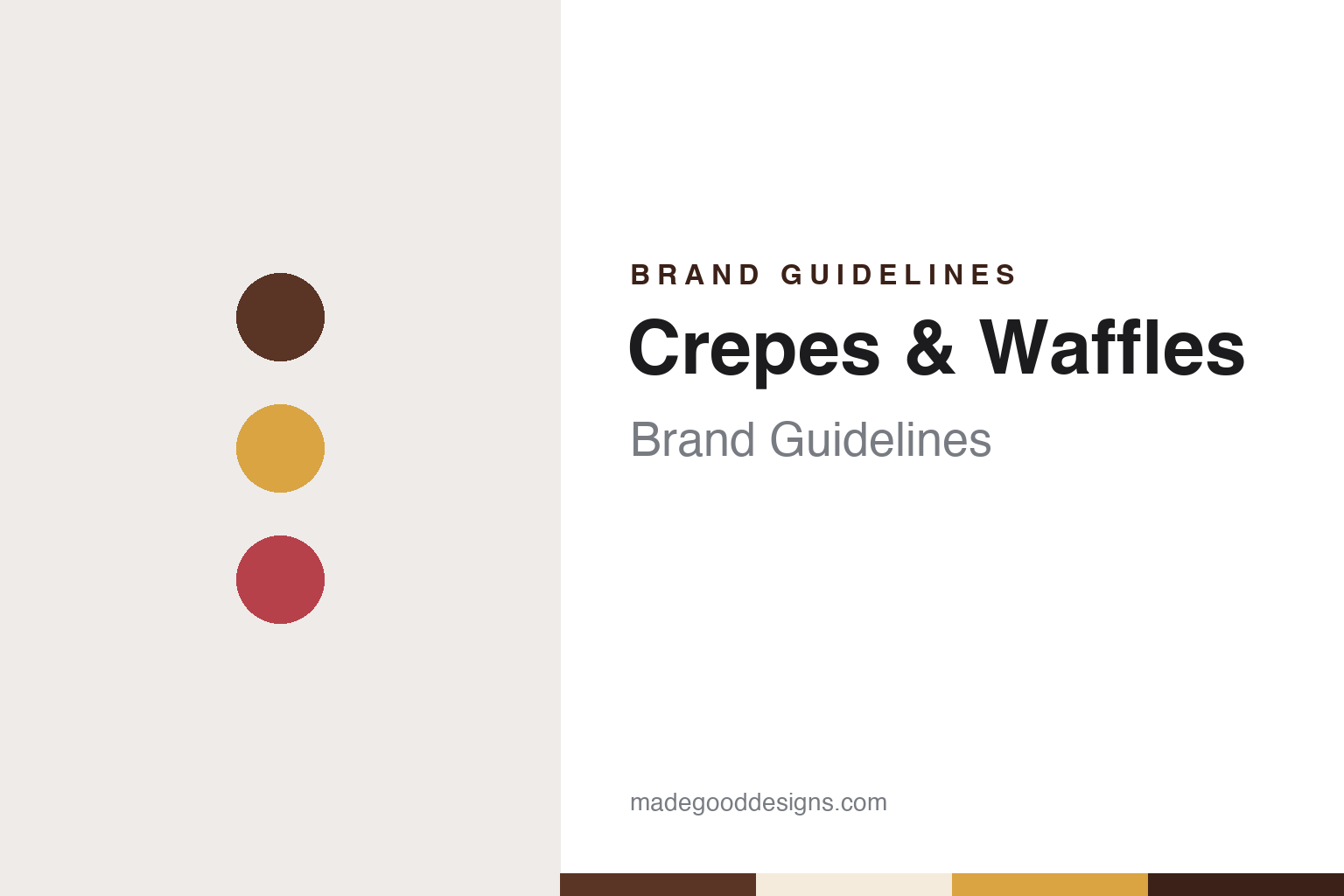
Crepes & Waffles Brand Guidelines
A Bogotá garage crêperie that grew into a national chain of restaurants and ice-cream shops.
Aa
Two constants: a cocoa, crêpe gold and berry palette and a warm bistro serif register. Abstract homage — not a Crepes & Waffles product or mark; no menu, logo or sign is reproduced.
A garage in Bogotá
Two business students and a garage in Bogotá.
Crepes & Waffles opened its first restaurant in Bogotá on 13 April 1980, El Tiempo reported in April 2023. Its founders were Beatriz Fernández and Eduardo Macía (spelled Macías in El Tiempo and Portafolio), a young couple who were then students of business administration at the Colegio de Estudios Superiores de Administración (CESA) in Bogotá. Spanish Wikipedia describes the first shop as a French-style crêperie, and English Wikipedia says the idea grew out of a student project.
The business began in the garage of a house. El Tiempo places it in the house of Fernández’s father; El País of Cali, in an August 2019 interview, added that the garage was decorated with two stuffed toy monkeys. The opening menu, El Tiempo wrote, was crêpes filled with spinach, veal, chicken, bolognese or mushrooms, flavours the chain still serves. A second shop followed in 1983 in Bogotá’s Centro Internacional business district.
The founders split the work early. In the El País interview Fernández described Macía as the co-founder who runs the business side, while she handles creative direction and what she called the company’s philosophy. She also retold the story, repeated by El País, that the waffle recipe first came from an English cookbook and that an early customer told them the waffles were poor and gave them the recipe the chain uses today. It is a founders’ anecdote rather than a documented record, and it is given here as theirs.
Growth came city by city. Fernández told El País that after Bogotá the second step was Cartagena and the third Cali, where the first restaurant opened on 11 August 1989 in the Santa Mónica district. By 2019 the chain had reached Medellín, Manizales, Pereira, Barranquilla, Santa Marta, Villavicencio and Bucaramanga, she said, and El País described the company as wholly Colombian and family-owned.
Colour
Crêpes, salads and a parallel chain of ice-cream shops.
The name describes the starting point, but the menu widened. Spanish Wikipedia lists crêpes, waffles and ice cream as the founding offer, and English Wikipedia adds salads. Alongside its restaurants the company runs a separate network of heladerías, ice-cream counters that trade under the same name, and in 2020, El Tiempo reported, it added an ice-cream truck that travels to towns where it has no restaurant.
Much of the ice-cream range is built on Colombian produce. El Tiempo describes an Arte-Sano line made with fruits and ingredients from Colombia, and El País reported in 2019 that new flavours were added roughly every two months so that local growers could sell fruits that were not yet on the menu. The same article named the suppliers behind some of them: fine cacao from the Tumaco area bought through an alliance with Cacao Hunters and from local producer organisations, blackberries grown by Nasa families of the Mosoco reserve in eastern Cauca, and organic vegetables from Bitaco, in La Cumbre. In Cali, El País added, a central kitchen makes the cones, biscuits, chocolates, ice creams and sauces for the city’s outlets.
The other constant is staffing. Spanish Wikipedia says the founders set out to hire women heads of household, and El Tiempo wrote in 2023 that such women work across the chain as servers, cooks, receptionists and waiting staff, with the stated aim of giving them stable jobs. El País gave the clearest dated figure: in August 2019 the company had 589 direct jobs in Cali across nine restaurants and three ice-cream shops, and 90.59 per cent of those staff were women heads of family. Nationally, the paper put the workforce at more than 5,600 people. In 2020, El Tiempo added, the company opened its first customer service centre, answering online and by phone and staffed by women, and set up its own team of motorbike couriers.
Typography
How the category presents itself.
Latin American restaurant, burger, chicken and café chains tend to present themselves first through the street. A shop front carries the name, a short line of colour and often a counter or an ice-cream window that can be read from the pavement, and many chains run more than one format under the same name: a quick-service counter, a table-service restaurant, a kiosk in a shopping centre or a separate ice-cream shop. Drive-through lanes, delivery apps and self-service ordering screens have since joined the shop front as places where the name has to work.
Menus do much of the brand work. Chains in the region usually give their signature dishes their own names, from a house burger to a named roast chicken or a crêpe, and repeat those names across menu boards, packaging and campaigns. Mascots and characters appear in some of these identities, and seasonal campaigns are often built around a new named dish or a limited line rather than around the company itself.
Ownership is often a group matter. Several of the larger chains belong to food or restaurant groups that run a number of brands side by side, sometimes including franchises of international names, and the parent usually describes each brand as a separate business with its own identity. Others have stayed in the hands of their founding families for decades and present that continuity as part of the story.
Corporate pages and the business press fill in the rest: who founded the chain, in which city and year, who owns it now, and where it has opened abroad, usually through franchising in neighbouring countries, Spain or the United States. For a design reader, the useful evidence is what each company itself publishes, and how consistently its name, colours and dishes carry from one format to the next.
Aa
A warm bistro serif for a crêperie that grew into a chain. (Specimen set in Fraunces, a serif STAND-IN; NOT the Crepes & Waffles logo.)
Crepes & Waffles
From Bogotá to five countries abroad.
In April 2023 El Tiempo put it at 216 restaurants and 144 ice-cream shops in countries including Colombia, Ecuador, Chile, Venezuela, Mexico and Spain. Spanish Wikipedia gives a lower breakdown of about 180 restaurants and more than 130 ice-cream shops in Colombia, plus about 30 restaurants in Ecuador, Mexico, Chile, Spain and Panama; the counts depend on the date and on how outlets are grouped.
Not every market lasted. Fernández told El País in 2019 that the company had operated in Peru and Brazil and described both as attempts that did not work out, which she put down to the difficulty of finding managers who would run the restaurants in the company’s way. Its foreign restaurants in 2019 were in Spain, Panama, Chile and Mexico, she said, and Spanish Wikipedia adds Ecuador.
The company has stayed in the founders’ hands. El País called it a family company, and Spanish Wikipedia names Rodrigo Cabrera Liévano as its president. Spanish Wikipedia gives its headquarters as Bogotá, and its founders still lead it: Portafolio interviewed Fernández about the chain’s growth in October 2019, the year before its fortieth anniversary.
For a design guide, Crepes & Waffles shows how a restaurant chain can keep one simple name across two formats, sit-down restaurants and ice-cream counters, while its menus lean on named Colombian produce. Compare Juan Valdez, another Colombian food brand with cafés at home and abroad, and Tostao, a Bogotá coffee-and-bakery chain. For this guide we use cocoa brown, crêpe gold and a berry red with a serif, an unofficial interpretation; no product or logo is reproduced.
Explore & save
Keep Crepes & Waffles’s identity on hand — save it to a board in the Made Good inspiration library.
Crepes & Waffles identity set
Pin the Crepes & Waffles cocoa, crêpe gold and berry palette and the warm bistro serif register to your own board.
Source & notes
Frequently Asked Questions
What font can I use to match the Crepes & Waffles look?
This guide describes Crepes & Waffles’ type as “A warm bistro serif for a crêperie that grew into a chain”. Its type specimen is set in Fraunces from Google Fonts as a stand-in; Fraunces is not Crepes & Waffles’ own lettering.
What colours are in the Crepes & Waffles palette?
This guide’s Crepes & Waffles palette is Cocoa brown #5A3424, Toasted crêpe #D9A441, Mora berry #B7414B, Batter cream #F4EBDD and Garden leaf #5E7F4A. The tones are the guide’s own unofficial interpretation, not official Crepes & Waffles hex codes.
When was Crepes & Waffles founded?
Crepes & Waffles was founded in April 1980, in Bogotá, Colombia.
Who founded Crepes & Waffles?
Crepes & Waffles was founded by Beatriz Fernández and Eduardo Macía in April 1980.
Who owns Crepes & Waffles?
Crepes & Waffles today: Family-owned, Bogotá. Crepes & Waffles is known for Crêpes, waffles, ice-cream shops.


