Chevignon Brand Guidelines
A 1979 French leather-jacket label with a long Colombian life.
Aa
Two constants: a saddle brown, cream and indigo denim palette and a vintage slab serif register. Abstract homage — not a Chevignon product or mark; no garment, badge or logo is reproduced.
Mazamet leather
A French label built on leather jackets.
Chevignon began as a French label. French Wikipedia says the company, Les Établissements Charles Chevignon, was founded in 1979 by Guy Azoulay, and that its early commercial success came from leather jackets made in Mazamet, in the south of France. Spanish Wikipedia adds that the name was taken from a pilot called Charles Chevignon, whom it links with an American vintage style, and it counts the classic leather jackets among the label’s most representative pieces.
The early catalogue grew quickly. French Wikipedia says an aged-leather line and a children’s line appeared a few years after the launch, and that in 1984 the label introduced the Tog’s down jacket. That jacket carried a badge Azoulay had found at a Japanese flea market, showing a bird in flight, and the image became the symbol of the label; French Wikipedia describes the logo as a mallard in flight.
The Colombian Chevignon website adds its own timeline for the following years. It says that in 1987 a licence for bags and accessories extended the collections, that in 1989 a women’s line, Chevignon Girl, was born, and that in 1990 the label opened a 600-square-metre flagship store at the Place des Victoires in Paris. The same site describes the label as casual jeanswear in which denim and leather are the main materials, mixing what it calls American practicality with European polish.
Colour
Naf Naf, Vivarte and the Royer group.
Chevignon did not stay with its founder’s company. French Wikipedia says Azoulay considered pairing with a larger fashion business from 1992, and that the label was bought in 1995 by Naf Naf, with Azoulay staying on as artistic director; Spanish Wikipedia also gives 1995 for the Naf Naf purchase.
A new artistic direction arrived in 2005, according to French Wikipedia, steering the collections back towards the vintage style of the label’s beginnings. Two years later, in 2007, the retail group Vivarte bought Naf Naf and, with it, Chevignon. French Wikipedia says a new logo followed soon after, along with a split of the collection into lines called Legend and Unlimited. For the label’s thirtieth anniversary in 2009, the Togs Unlimited down jacket was reissued, and an online store opened in 2011, when the label also returned to the United Kingdom and Germany, two of its historic markets.
Collaborations were part of that period. French Wikipedia says Jacques Shu worked with the label on five new versions of the Tog’s in 2010, sold exclusively at the Paris shop colette, and that a collection with the artistic director Milan Vukmirovic followed after the 2011 relaunch. It also lists work with the leather-goods maker Léon Flam in 2014 and with the shoemaker Pataugas in 2012, and, from late 2014, with GPA and Helstons on motorcycle helmets and jackets.
Vivarte later sold the label. French Wikipedia says Vivarte announced in October 2018 that it was negotiating a sale, and that after exclusive talks it confirmed the sale of Chevignon to Société Civile Financière Royer, the parent of the Royer group, together with the fashion and retail specialists Stéphane Collaert and Thierry Le Guénic; French Wikipedia dates the handover to March 2019.
Typography
How Colombian fashion labels present themselves.
Colombia’s clothing, bag, leather and underwear brands are mostly home-grown companies, and several still carry the name of the person who started them. Some began as very small workshops: Vélez with belts cut by hand in Medellín in the 1980s, and Totto in a Bogotá leather factory taken over in 1987, according to Portafolio. Both grew into chains with shops across Latin America.
Much of their identity is built in the shop. Store fronts, windows and tags carry the brand as much as any advertisement does: when Totto redrew its logo in 2021, Forbes Colombia reported, the new look went to its stores, signs, shop windows and product tags. Larger-format stores and remodelled shop interiors appear in the companies’ own accounts of how they present themselves, alongside the names of their collections and of the designers, artists and athletes they work with.
Campaigns often draw on Colombian references. Totto has dressed the national Olympic delegation since 2004, Portafolio reported, and Vélez built a 2026 collection with J Balvin around the Antioquian muleteer, the arriero. Regional crafts, rural dress and the national colours recur in the way these brands show themselves at home and abroad, and the companies say so in their own campaign material.
Ownership is usually easy to trace. Several of the groups in this guide are founder-led or family-owned, and their corporate pages set out who founded them, who runs them and which export markets they serve, commonly Central and South America first, then Spain or the United States. This guide keeps to what those pages and dated press reports show, describes family-owned groups plainly, and marks the companies’ own claims as theirs.
Aa
A vintage slab serif for a denim-and-leather label. (Specimen set in Bitter, a slab serif STAND-IN; NOT the Chevignon logo.)
Chevignon
A French name with a Colombian partner.
In Colombia, Chevignon has had a long second life under licence. Retail & Leisure International, the British trade publication, reported in June 2023 that the label was celebrating 30 years in Colombia under the licence format, with a local partner that designs, produces and markets the clothes in the country. As of that report, it listed 72 single-brand stores in Colombia, 38 of them run directly, and a presence in 450 multi-brand outlets. The Colombian website, chevignon.com.co, names Comodin S.A.S., based in Medellín, as the company behind it.
The name is also protected in Colombia. In a resolution dated 17 July 2025, Colombia’s Superintendence of Industry and Commerce (SIC) upheld an opposition filed by Fashion Trademarks Holding S.L., which it treated as the holder of the Chevignon mark, against an application to register the similar word “Chevigton” for clothing. The SIC declared Chevignon a well-known mark for clothing for the period from January 2018 to December 2023, refused the other registration, and noted that the Chevignon mark had been registered in Colombia since 1994. Asuntos Legales reported the decision in July 2025.
The label has also crossed into the United States. Community Impact, the Texas local news group, reported in October 2025 that a Chevignon store had opened at the Houston Premium Outlets, offering clothing for men and women with a focus on denim and leather items, according to the shopping centre’s announcement.
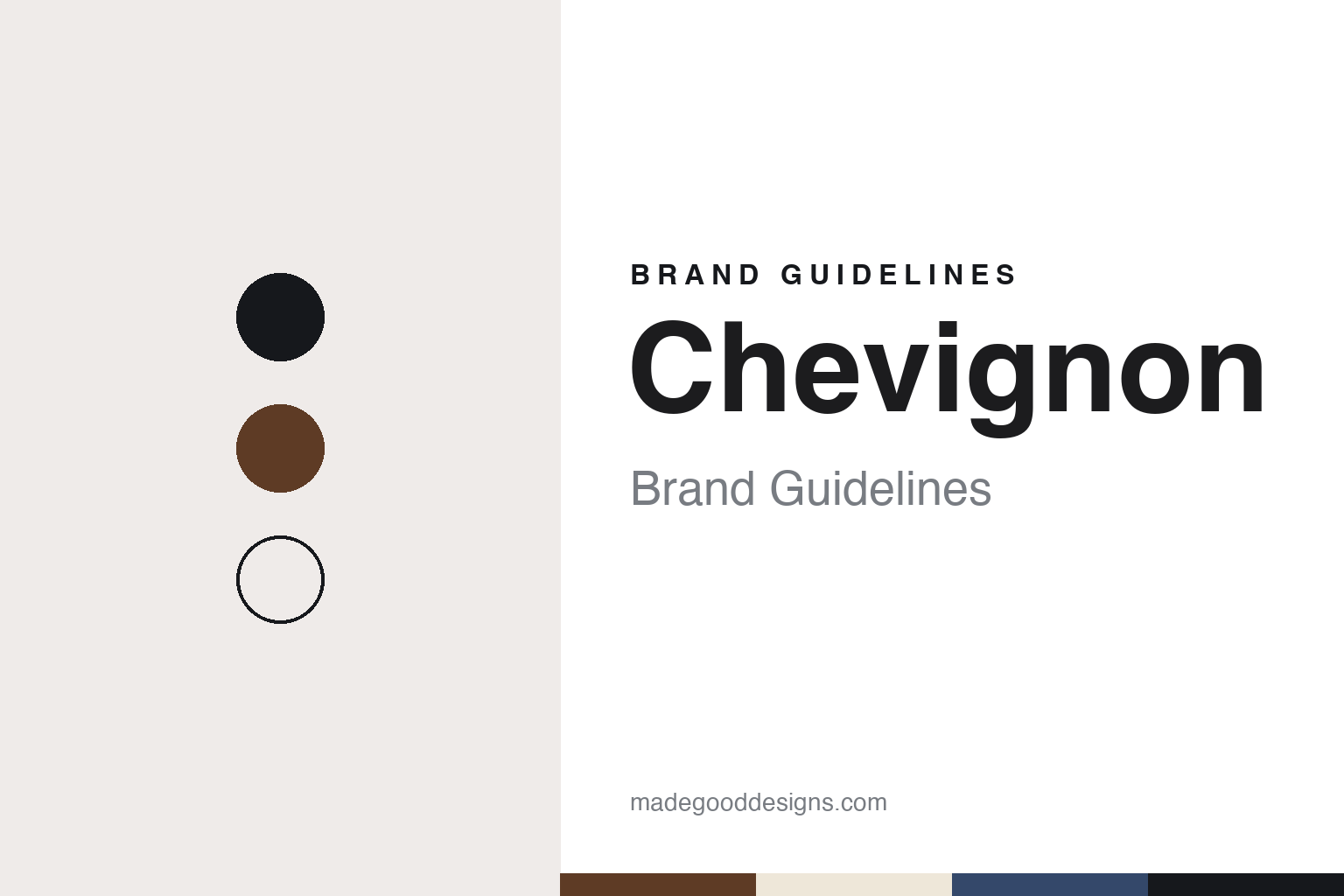
For visual identity, the bird-in-flight badge and the leather jacket are the two anchors in the label’s own story, and the Colombian site keeps denim and leather at the centre. The palette here is our own: a saddle brown for leather, an indigo denim tone, a warm cream and an ink for small text. A slab serif stands in for the label’s workwear and vintage register.
For a design guide, Chevignon shows how a French label founded in 1979 can keep its name, badge and leather-and-denim focus while a partner in another country designs and sells it for decades. Compare Americanino, another jeanswear name with a long Colombian history, and Koaj, a Colombian fashion group’s own label. For this guide we use saddle brown, cream, indigo denim and ink with a serif, an unofficial interpretation; no product or logo is reproduced.
Explore & save
Keep Chevignon’s identity on hand — save it to a board in the Made Good inspiration library.
Chevignon identity set
Pin the Chevignon saddle brown, cream and indigo denim palette and the vintage slab serif register to your own board.
Source & notes
Frequently Asked Questions
What font can I use to match the Chevignon look?
This guide describes Chevignon’s type as “A vintage slab serif for a denim-and-leather label”. Its type specimen is set in Bitter from Google Fonts as a stand-in; Bitter is not Chevignon’s own lettering.
What colours are in the Chevignon palette?
This guide’s Chevignon palette is Saddle brown #5E3B25, Ink #16181C, Cream #EEE7D9, Indigo denim #34486A and Paper #F8F6F1. The tones are the guide’s own unofficial interpretation, not official Chevignon hex codes.
When was Chevignon founded?
Chevignon was founded in 1979, in France. Chevignon is known for Leather jackets, Tog’s down jacket, denim.
Who founded Chevignon?
Chevignon was founded by Guy Azoulay in 1979. Chevignon is known for Leather jackets, Tog’s down jacket, denim.