Americanino Brand Guidelines
An Italian jeans name from 1975, run in Colombia since 1989.
Aa
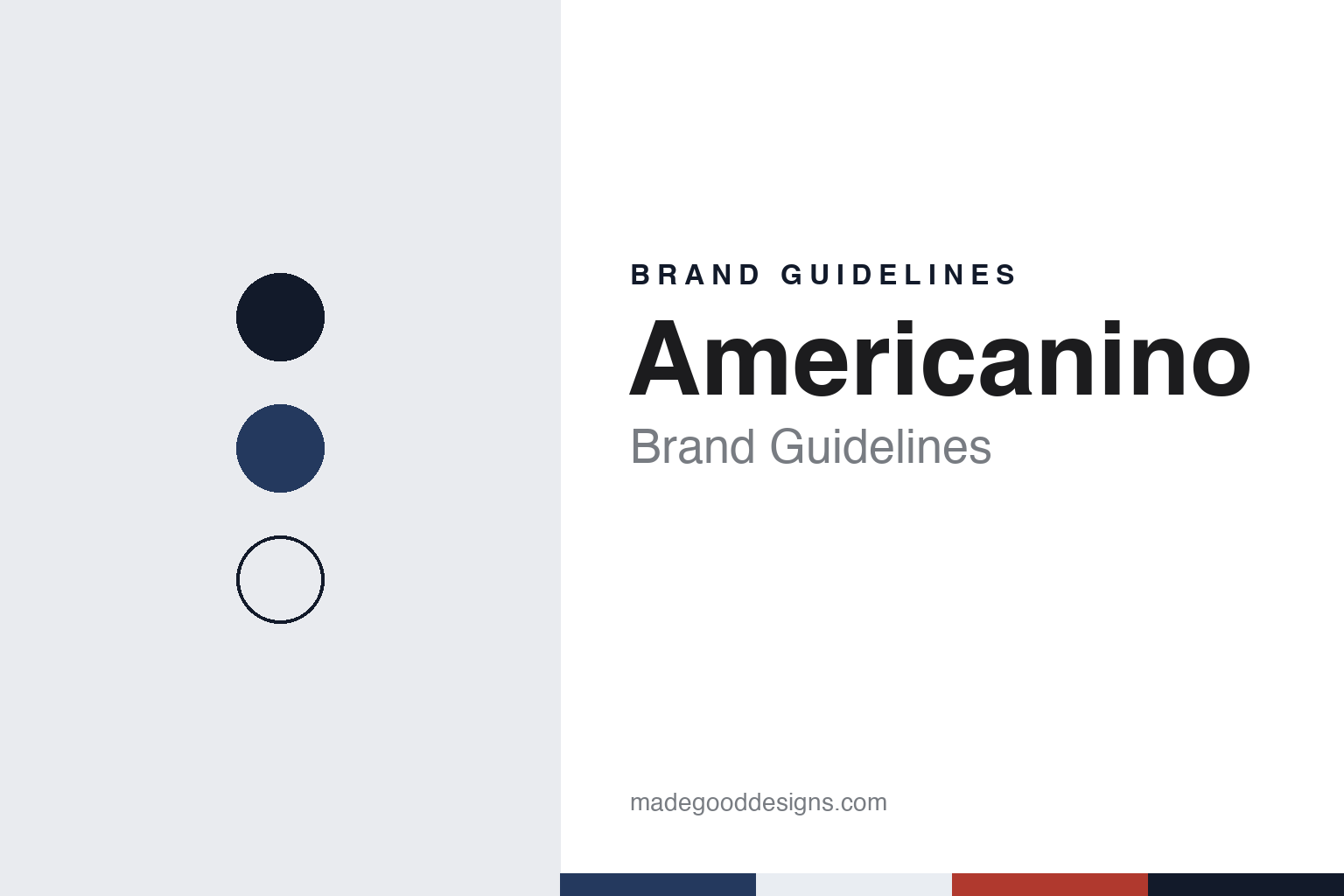
Two constants: an Americanino indigo, washed denim and brick red palette and a Denim grotesque register. Abstract homage — not an Americanino product or mark; no garment, logo or label is reproduced.
An Italian name
American comfort, Italian style.
Americanino is sold today as a Colombian high-street jeans label, but it began in Italy. In August 2025 Blu Radio reported that the brand was founded in 1975 by Gegé Schiena, with the idea of joining American comfort to Italian style. The careers site of the group that runs the brand in Colombia tells the same story in its own words: a jeanswear label created by Schiena to draw on two cultures — the ease and quality of American clothes and the style and design of Italian ones.
The brand reached Colombia in 1989. In November 2021 the business news site Halcones y Palomas reported that since 1989 Comodín S.A.S. had held a licence from the brand’s Italian parent to design and market Americanino in Colombia, the Andean region and North America. Blu Radio, writing in 2025, described the same 1989 step as an acquisition of the brand by Grupo Uribe, the Colombian group that controls Comodín. The two reports agree on the year and on who runs the brand; they describe the legal form differently, and this guide gives both.
The Italian origin is now mostly history. According to the 2021 Halcones y Palomas report, the label was at that time neither made nor sold in Italy, its country of origin. It also noted that in Chile and Argentina the name was operated by the retailer Falabella, with manufacturing and distribution separate from the Colombian business. The Colombian stores, website and collections described in this guide belong to the Comodín operation; the Falabella-run label in Chile and Argentina is a separate business under the same name.
The Colombian company’s own franchise page, read in 2026, says the brand has more than 50 years on the market and is present in Colombia and Ecuador, and invites investors to open franchised stores. A small graphic on the same page carries the founding year, 1975, next to the word denim.
Colour
A Medellín family group founded in 1907.
The owner behind the Colombian Americanino is a family business. Halcones y Palomas described Grupo Uribe in 2021 as a family-owned clothing conglomerate from Antioquia founded in 1907. In June 2024 Pulzo, citing Las2orillas, traced it to a fabric store in Medellín opened by John Uribe Escobar, and to the partnership John Uribe e Hijos formed in 1938. The group is now often called GCO. Beyond the brands it runs under licence, Halcones y Palomas noted in 2021 that the group had been the Colombian partner of the Spanish fashion chain Mango since 2004.
In August 2024 Pulzo, quoting a report by the retail consultancy Mall & Retail, set out how the group is organised: John Uribe e Hijos trades fabrics and textiles, while international clothing brands are marketed through three companies, Mercadeo y Color, Comodín and Mercadeo y Moda. Besides Americanino, the brands the group handles in Colombia include Chevignon, Naf Naf and Esprit, Pulzo reported, and the group makes clothing under its own brands and for the brands it represents, selling through its own stores and franchises in Colombia and other countries in the region.
Comodín is the company that matters for Americanino. Halcones y Palomas called it the holding company that owned 98 Americanino stores in Colombia as of 2021, with 521 employees, 62 percent of them women. The brand’s Colombian website is run in Comodín’s name today.
Inside the group, Americanino sits next to Chevignon in the list of brands Pulzo attributed to GCO in 2024. The two labels share an owner, but each has its own website, stores and campaigns.
Typography
Design and documentation.
Colombia’s clothing, bag, leather and underwear brands are mostly home-grown companies, and several still carry the name of the person who started them. Some began as very small workshops: Vélez with belts cut by hand in Medellín in the 1980s, and Totto in a Bogotá leather factory taken over in 1987, according to Portafolio. Both grew into chains with shops across Latin America.
Much of their identity is built in the shop. Store fronts, windows and tags carry the brand as much as any advertisement does: when Totto redrew its logo in 2021, Forbes Colombia reported, the new look went to its stores, signs, shop windows and product tags. Larger-format stores and remodelled shop interiors appear in the companies’ own accounts of how they present themselves, alongside the names of their collections and of the designers, artists and athletes they work with.
Campaigns often draw on Colombian references. Totto has dressed the national Olympic delegation since 2004, Portafolio reported, and Vélez built a 2026 collection with J Balvin around the Antioquian muleteer, the arriero. Regional crafts, rural dress and the national colours recur in the way these brands show themselves at home and abroad, and the companies say so in their own campaign material.
Ownership is usually easy to trace. Several of the groups in this guide are founder-led or family-owned, and their corporate pages set out who founded them, who runs them and which export markets they serve, commonly Central and South America first, then Spain or the United States. This guide keeps to what those pages and dated press reports show, describes family-owned groups plainly, and marks the companies’ own claims as theirs.
Aa
A sturdy grotesque with a wide, heavy weight. (Specimen set in Archivo, a sans STAND-IN; NOT the Americanino logo.)
Americanino
Two figures and a lot of indigo.
The brand’s mark is its clearest visual idea. Blu Radio reported in 2025 that the logo shows two Native American figures, and the company’s careers page explains the pair as two sides of one story: America and Europe, tradition and progress, past and future, masculine and feminine. The company says the tension between those opposites drives the product. That reading is the brand’s own; the company itself ties the pair to its founding idea of joining two cultures.
Denim is the centre of the range. The company describes Americanino as “jeanswear de moda urbana y espíritu joven” — urban, youthful jeanswear — and its careers page calls denim “the origin and essence of the brand,” with indigo lines that follow international fashion. The website sorts jeans by fit: for men, cuts such as slim, straight and relaxed; for women, cuts such as barrel, bootcut and flare. Shirts, polo shirts, jackets and basics fill out the stores around the jeans.
Campaigns lean on words as much as images. In March 2024 Semana reported that on 8 March the brand launched “Estamos hechas de” (“we are made of”), a campaign for International Women’s Day in which phrases written by two Colombian influencers were screen-printed onto garments and used to take over the brand’s stores across the country.
For a design guide, Americanino shows how a borrowed foreign name can become a local brand: an Italian idea from 1975, a Colombian licence from 1989, a figurative two-part logo and a range organised around indigo and fit. Compare Chevignon, the group’s other denim label, and Zara, another high-street fashion name sold in Colombia. For this guide we use indigo, washed denim and a brick red with a sans, an unofficial interpretation; no product or logo is reproduced.
Explore & save
Keep Americanino’s identity on hand — save it to a board in the Made Good inspiration library.
Americanino identity set
Save the Americanino indigo, washed denim and brick red palette and the Denim grotesque register to your own board.
Source & notes
Frequently Asked Questions
What font can I use to match the Americanino look?
This guide describes Americanino’s type as “A sturdy grotesque with a wide, heavy weight”. Its type specimen is set in Archivo from Google Fonts as a stand-in; Archivo is not Americanino’s own lettering.
What colours are in the Americanino palette?
This guide’s Americanino palette is Indigo #24395E, Ink #121A2A, Washed denim #E9EDF2, Brick red #B0392E and Paper #F7F8FA. The tones are the guide’s own unofficial interpretation, not official Americanino hex codes.
When was Americanino founded?
Americanino was founded in 1975, in Italy. Americanino is known for Jeans and denim lines.
Who founded Americanino?
Americanino was founded by Gegé Schiena in 1975. Americanino is known for Jeans and denim lines.