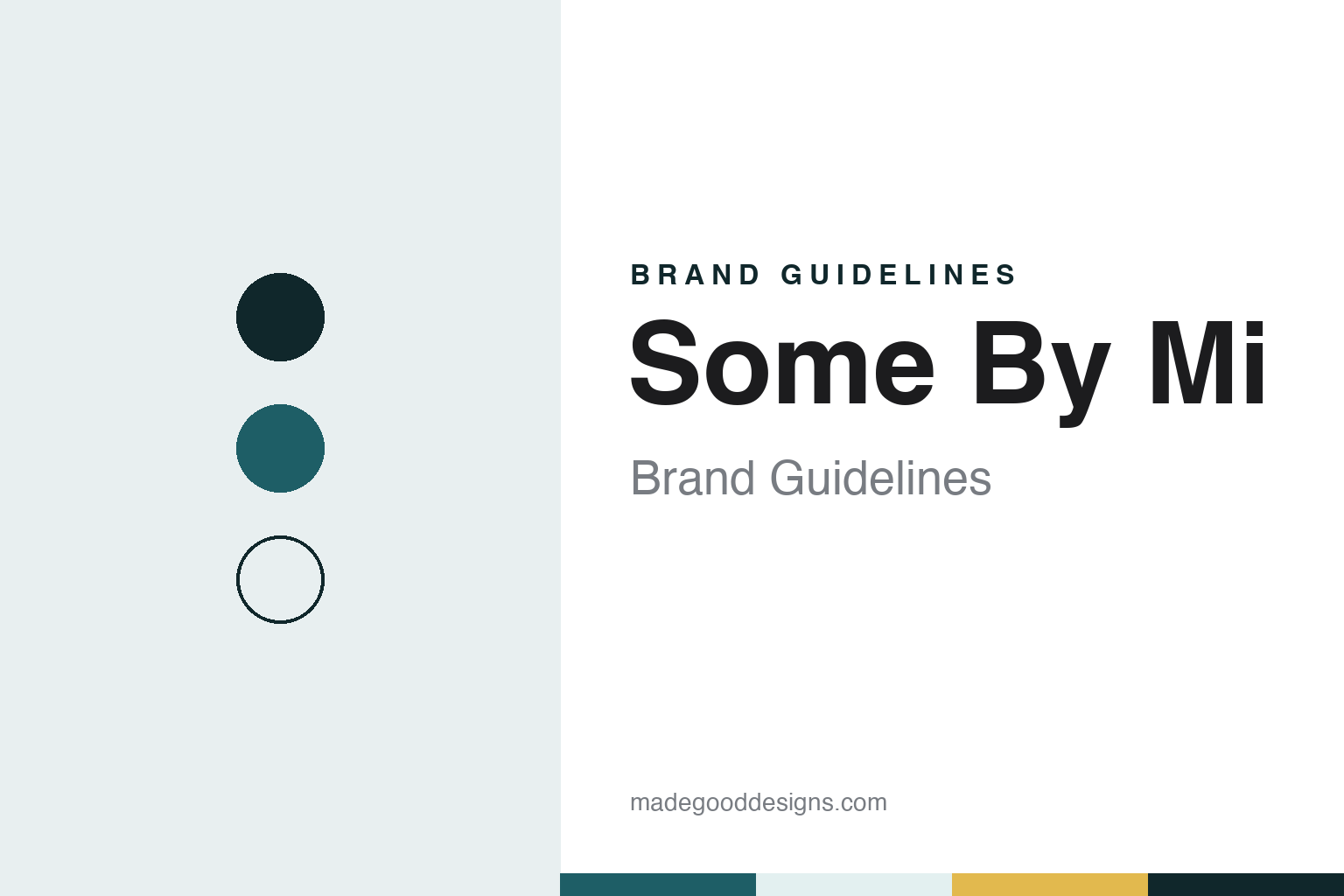
Some By Mi Brand Guidelines
Ferenbell’s Seoul Miracle line, Southeast Asia and JKL Partners.
Aa
Two constants: a Some By Mi teal, mist and yuzu palette and a Rounded modern sans register. Abstract homage — not a Some By Mi product or mark; no bottle, logo or label is reproduced.
Ferenbell
A Seoul company that looked south from the start.
Some By Mi, which the company writes in capitals as SOME BY MI, is the skincare brand of Ferenbell, a cosmetics company based in Seoul’s Gangnam district. The two Korean business sources used for this guide give slightly different starting dates. IB Tomato, the capital-markets service of News Tomato, reported in July 2026 that Ferenbell was founded in 2016 as a maker and seller of cosmetics and household goods. Maeil Business Economy, the weekly of the Maeil Business Newspaper, wrote in April 2026 that the company was set up in 2017 by its founder, Lee Ji-eun.
Both accounts agree on where the brand looked at the outset. Maeil Business Economy reported that Lee started the company after spotting demand for Korean skincare in Southeast Asia, at a time when interest in K-beauty was spreading beyond China, and that its early products were planned around the needs of shoppers in a hot, humid climate. IB Tomato wrote that the brand grew quickly once its Miracle Toner became a hit in Southeast Asian markets, naming Vietnam, Indonesia and Malaysia as the countries where it built its reputation before moving into the United States, Europe and Japan.
The name is explained on the brand’s own global shop, which glosses it as “Something by a Miracle,” and the word Miracle runs through the product names in the same way. The company also uses “Some By Us” as the title of a section on its website.
Ownership changed in 2021, when the private-equity firm JKL Partners bought Ferenbell. IB Tomato reported that JKL holds the whole company through a vehicle named Prism Two, and Maeil Business Economy described JKL as its controlling shareholder in April 2026. The day-to-day chief executive is Jin Yun-jin, who is named as CEO both on the global shop and in the Maeil Business Economy report.
Colour
The Miracle line and its relatives.
The range is organised around named lines that put an ingredient or an acid blend in the product title. The founding line is the AHA·BHA·PHA 30 Days Miracle series, whose toner Maeil Business Economy and IB Tomato both describe as the product that made the company. The same lettering, with the three acid names joined by raised dots, now appears on a body cleanser, a body toner mist and a daily mask. Alongside it, the global shop in 2026 lists a Retinol Intense line, a Retinol Bakuchiol line, a Yuja Niacin line built on the yuzu citrus, and a PDRN line.
Maeil Business Economy credited much of the company’s growth to fitting products to local habits rather than exporting what sold at home. One example it gave is packaging: for Southeast Asian shoppers, who often use sheet masks, Some By Mi sold its daily masks in multi-sheet packs from which a single sheet is pulled out, rather than in individually wrapped sachets. For shoppers in Western markets the company carried the acid blend of the Miracle line into a Miracle Body Cleanser, which the magazine named as one of its main products.
The same report described an unusual internal structure. Instead of separate planning, marketing and sales departments, Ferenbell groups e-commerce, marketing and content work into one team for each country, so that the United States team, for example, handles a product from planning through promotion to sale. The company also cut out domestic wholesalers and sells directly to shoppers, using short-form video to explain its products, according to Maeil Business Economy.
The rise of the brand abroad has brought lookalikes. Maeil Business Economy reported in April 2026 that imitation and copycat products had become a recurring problem for Ferenbell as its name grew overseas, and quoted the chief executive saying the company was answering it by keeping a clear brand identity around its named lines.
Typography
Design and documentation.
The Korean skincare brands in this group introduce themselves through a small set of fixed elements: a short coined name, a plain wordmark, and product names built from a line name and a format, so that a toner, a cream and a pad from the same family share their first words. COSRX explains its name as “Cosmetics + Rx” and writes it in capitals; Dr.Jart+ glosses its name as “Doctor Joins Art” and, in a 2018 redesign by Pentagram, turned the plus sign into a mark for its different lines.
Export shapes how these brands appear. Their online shops speak to buyers in more than one country, and the dated press tracks how two of them reached shelves abroad: Dr.Jart+ entered the American market with Sephora in 2011, according to English Wikipedia, and Chosun Biz reported in 2025 that COSRX was sold in about 150 countries. Campaigns follow the same route, from outdoor screens in Times Square to K-pop ambassadors named in a launch.
Several have been bought by larger groups, and this guide describes those deals plainly, by date and stake. Amorepacific took a 38.4% stake in COSRX in 2021 and moved to 93.2% in 2023; Estée Lauder invested in Have & Be, the company behind Dr.Jart+, in 2015 and completed its purchase in December 2019. Where a brand remains independent, the guide says so only where a dated source does.
Each entry draws on corporate pages for founders, owners and export markets, and on dated independent press for anything beyond the company’s own word. Product lines are named as the companies publish them; the guide does not describe what the products do, and the palettes and typefaces shown are an unofficial interpretation rather than any brand’s own.
Aa
A rounded modern sans for a name set in capitals. (Specimen set in Outfit, a sans STAND-IN; NOT the Some By Mi logo.)
SOME BY MI
From Southeast Asia to the Middle East and the West.
After Southeast Asia, the next region was the Middle East. Maeil Business Economy reported that the cosmetics market there is built largely around pharmacy channels, and that Ferenbell entered it through those shops with the Miracle line. The magazine said the company now sells in about 100 countries.
In North America and Europe the move has been from online to physical shops. Maeil Business Economy reported that in 2025 Some By Mi went into all of the roughly 1,450 stores of the American beauty retailer Ulta, and that in Europe it was expanding into chains including dm, Rossmann and Normal. IB Tomato wrote in July 2026 that the company’s move from online sales in Southeast Asia into offline channels in North America and Europe had brought higher marketing and channel costs. The brand’s own global shop, in 2026, offers delivery to Australia, Hong Kong, Macau, Malaysia, New Zealand, Singapore, Taiwan and the United States.
For a design guide, Some By Mi shows how a young Korean label can carry one named line, and one piece of lettering, across toners, masks and body products sold from Southeast Asian marketplaces to American and European chains. Compare it with Purito, another Korean skincare label owned by a private-equity firm and sold mostly abroad, and COSRX, another Korean skincare label that grew from Seoul into overseas markets. For this guide we use lagoon teal, mist and yuzu gold with a sans, an unofficial interpretation; no product or logo is reproduced.
Explore & save
Keep Some By Mi’s identity on hand — save it to a board in the Made Good inspiration library.
Some By Mi identity set
Pin the Some By Mi teal, mist and yuzu palette and the Rounded modern sans register to your own board.
Source & notes
Frequently Asked Questions
What font can I use to match the Some By Mi look?
This guide describes Some By Mi’s type as “A rounded modern sans for a name set in capitals”. Its type specimen is set in Outfit from Google Fonts as a stand-in; Outfit is not Some By Mi’s own lettering.
What colours are in the Some By Mi palette?
This guide’s Some By Mi palette is Lagoon teal #1E5E66, Deep teal ink #10272B, Mist #E3F0F0, Yuzu gold #E2B94E and Paper #F7FAFA. The tones are the guide’s own unofficial interpretation, not official Some By Mi hex codes.
Who founded Some By Mi?
Some By Mi was founded by Lee Ji-eun. Some By Mi is known for AHA·BHA·PHA 30 Days Miracle line.
Who owns Some By Mi?
Some By Mi is owned by JKL Partners (since 2021).