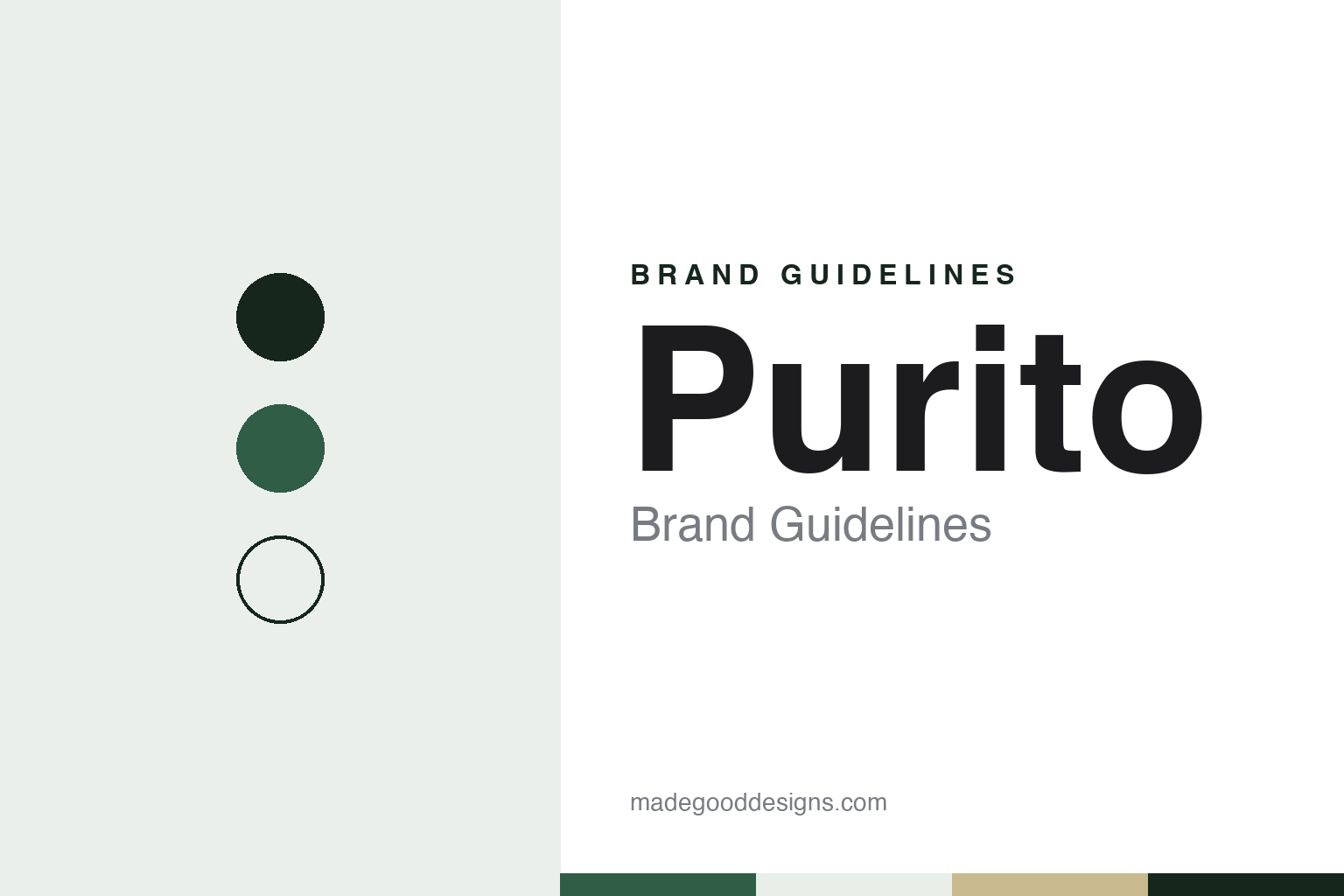
Purito Brand Guidelines
Hi Nature’s 2017 vegan label, a 2020 sunscreen pause and a Seoul rename.
Aa
Two constants: a Purito leaf green, sage and oat palette and a Quiet geometric sans register. Abstract homage — not a Purito product or mark; no bottle, logo or label is reproduced.
Hi Nature
A small Korean company with a vegan label.
Purito is the skincare brand of Hi Nature, a South Korean company that the Maeil Business Newspaper reported in August 2026 was founded in 2017 and has presented itself from the start as a maker of eco-friendly vegan cosmetics. The business and capital-markets outlet The Numbers, writing in November 2026, named Kim Kwan-hyun as its founder. The brand name, Purito, carried the company through its early years; since 2024 it has been written Purito Seoul.
The early brand was built around a short list of positions that the company published itself. Daily Vanity, the Singapore beauty site, described Purito in December 2020 as a brand that had built an international following on a “clean” K-beauty stance, saying it called itself cruelty-free and vegan-friendly, with its snail range as the exception, and listed on its website the ingredients its formulas left out. Those are the company’s own labels, and they are reported here as the company states them.
Ownership changed in November 2022. The Numbers reported that the private-equity firm Coston Asia bought the whole of Hi Nature from its founder and other shareholders through its second blind fund, holding the shares through a special-purpose company, Coston Nature Holdings. Etoday confirmed the 2022 purchase in April 2026, describing Hi Nature as the company that runs the Purito Seoul brand. The acquisition did not use acquisition finance, The Numbers added.
Hi Nature does not run its own factory. The Numbers reported in November 2026 that the company has every product made by contract manufacturers in Korea, working through OEM and ODM arrangements, which leaves it with very few fixed assets. That arrangement, in which an outside manufacturer develops a product that the brand sells under its own name, sat at the centre of the most serious episode in Purito’s history.
Colour
Named lines, a contract maker and a 2020 sunscreen pause.
On the current website, Purito Seoul organises its range by ingredient lines rather than by numbered collections. The company names Korean centella, the base of its Wonder Releaf line, along with Damyang bamboo, Gunsan oat and deep sea water drawn from Korea’s East Sea, each tied to a place on the peninsula. Aving News reported that Hi Nature showed the brand, including the Wonder Releaf Centella Toner Unscented, at the InterCHARM Korea trade fair at Coex in Seoul on 24–26 July 2024. Toners, creams, eye creams and cleansers fill out the range as the website lists it in 2026.
The episode that most people outside Korea associate with Purito came in December 2020. Cosmetics Business reported on 7 December 2020 that the ingredient website INCIDecoder had sent the brand’s Centella Green Level Unscented Sun, sold as SPF 50+ and marketed with a figure of SPF 84.5, for testing at two independent European laboratories. Beauty Independent reported on 10 December that a Polish laboratory measured an SPF of about 19 in an in-vivo test and 15.8 in an in-vitro test, and that a second in-vivo test at a German laboratory gave 19.2.
Purito answered on Instagram on 5 December 2020. According to Daily Vanity, the company explained that the sunscreen had been developed under an ODM arrangement by an outside manufacturer, that the rating had been registered with the Korean regulator before launch, and that it had now ordered its own in-vivo and in-vitro tests of all three of its sunscreens. It paused sales of the Centella Green Level Unscented Sun, the Centella Green Level Safe Sun and the Comfy Water Sun Block until those checks were done, and later offered a full refund to customers who had bought any of its sunscreens in the previous six months. Beauty Independent reported the same pause and quoted the company saying it had put its trust in the manufacturer and accepted the issue that resulted.
The pause shows on the books, too. The Numbers wrote in November 2026 that the company’s sales fell sharply in 2021 after the late-2020 dispute over the SPF of its main sunscreen, the year before Coston Asia bought it.
Typography
Design and documentation.
The Korean skincare brands in this group introduce themselves through a small set of fixed elements: a short coined name, a plain wordmark, and product names built from a line name and a format, so that a toner, a cream and a pad from the same family share their first words. COSRX explains its name as “Cosmetics + Rx” and writes it in capitals; Dr.Jart+ glosses its name as “Doctor Joins Art” and, in a 2018 redesign by Pentagram, turned the plus sign into a mark for its different lines.
Export shapes how these brands appear. Their online shops speak to buyers in more than one country, and the dated press tracks how two of them reached shelves abroad: Dr.Jart+ entered the American market with Sephora in 2011, according to English Wikipedia, and Chosun Biz reported in 2025 that COSRX was sold in about 150 countries. Campaigns follow the same route, from outdoor screens in Times Square to K-pop ambassadors named in a launch.
Several have been bought by larger groups, and this guide describes those deals plainly, by date and stake. Amorepacific took a 38.4% stake in COSRX in 2021 and moved to 93.2% in 2023; Estée Lauder invested in Have & Be, the company behind Dr.Jart+, in 2015 and completed its purchase in December 2019. Where a brand remains independent, the guide says so only where a dated source does.
Each entry draws on corporate pages for founders, owners and export markets, and on dated independent press for anything beyond the company’s own word. Product lines are named as the companies publish them; the guide does not describe what the products do, and the palettes and typefaces shown are an unofficial interpretation rather than any brand’s own.
Aa
A quiet geometric sans for a short, plain name. (Specimen set in Manrope, a sans STAND-IN; NOT the Purito logo.)
Purito Seoul
A city added to the name.
The main identity change came after the change of owner. In 2024, The Numbers and Etoday reported, the brand name went from Purito to Purito Seoul, a rename that The Numbers said was meant to stress that the products are made in Korea; the Maeil Business Newspaper dates the change to 2025, but Aving News was already using the new name at the July 2024 trade fair. Etoday wrote in April 2026 that putting the city of Seoul at the front of the brand had become the core of its global branding, and that the Seoul name carried particular weight in Europe, its main region. The website now leads with the city, using photographs of N Seoul Tower, Seoul Forest Park and Yeouido Hangang Park with their Korean names set beside the English.
The shops are mostly outside Korea. The Maeil Business Newspaper reported in August 2026 that most of Hi Nature’s sales are made abroad, through the online fashion platform Zalando in Europe and iHerb, Walmart and Amazon in the Americas, with Sephora and Boots among its retail partners in Asia, the Middle East and Latin America; The Numbers added Douglas in Europe. Etoday said the company had widened its sales base from Europe into North America and Southeast Asia. The brand’s own site links to Target in the United States.
For a design guide, Purito shows how a small Korean label can rebuild its name around a city and a set of named ingredient lines after a hard public lesson about its own product claims. Compare it with Some By Mi, another Korean skincare label owned by a private-equity firm, and Manyo, a Korean skincare label that also reworked its name. For this guide we use leaf green, pale sage and oat with a sans, an unofficial interpretation; no product or logo is reproduced.
Explore & save
Keep Purito’s identity on hand — save it to a board in the Made Good inspiration library.
Purito identity set
Pin the Purito leaf green, sage and oat palette and the Quiet geometric sans register to your own board.
Source & notes
Frequently Asked Questions
What font can I use to match the Purito look?
This guide describes Purito’s type as “A quiet geometric sans for a short, plain name”. Its type specimen is set in Manrope from Google Fonts as a stand-in; Manrope is not Purito’s own lettering.
What colours are in the Purito palette?
This guide’s Purito palette is Leaf green #2F5D46, Forest ink #16261D, Pale sage #E7EFE8, Oat husk #C9B98F and Paper #F8F9F6. The tones are the guide’s own unofficial interpretation, not official Purito hex codes.
Who founded Purito?
Purito was founded by Kim Kwan-hyun. This guide lists Coston Asia (since 2022) as its owner.
Who owns Purito?
Purito is owned by Coston Asia (since 2022).