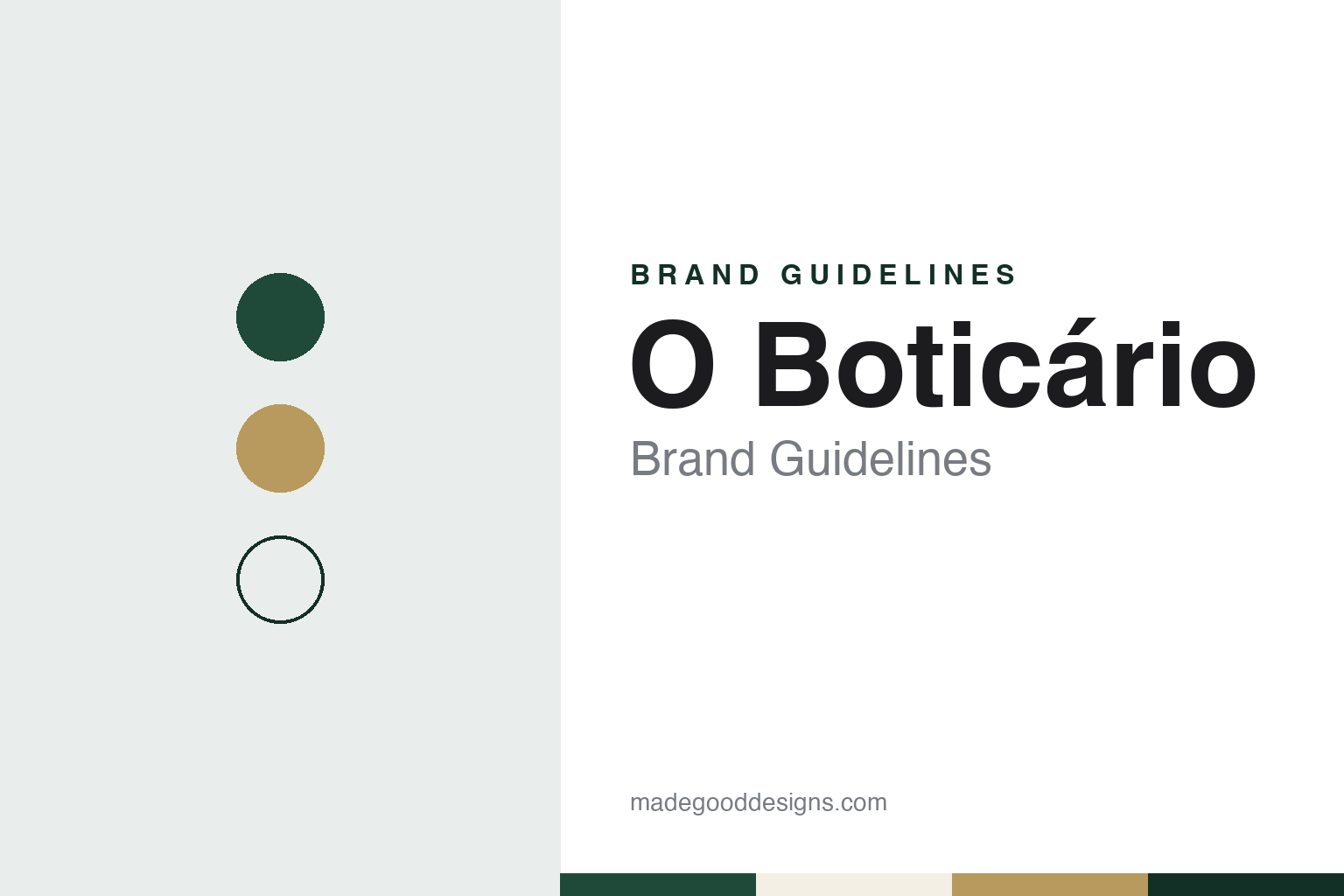
O Boticário Brand Guidelines
A Curitiba compounding pharmacy that became a franchise network.
Aa
Two constants: an apothecary green, warm cream and muted gold palette and a soft apothecary serif register. Abstract homage — not an O Boticário product or mark; no bottle, logo or label is reproduced.
The apothecary
A compounding pharmacy in Curitiba, then a shop at the airport.
O Boticário began in 1977 in Curitiba, the capital of the southern Brazilian state of Paraná. Its founder, the pharmacist Miguel Krigsner, opened a small compounding pharmacy in the city centre, a shop that mixed its own preparations to order. The founding year, the founder and the city are given alike by the trade paper Mercado&Consumo in April 2026, by Portuguese Wikipedia and by the company itself, which places the first shop on Rua Saldanha Marinho. The name is the Portuguese word for an apothecary, and the company still describes its origin as a pharmacy driven by the craft of cosmetics.
The move from one pharmacy to a national chain came through franchising. Mercado&Consumo reported in April 2026 that the first O Boticário franchise opened in 1979 in the terminal of Afonso Pena International Airport, in the Curitiba metropolitan region, and that the store has stayed in the same terminal ever since; the paper said the airport location helped carry the brand to travellers from other parts of the country. Portuguese Wikipedia dates the first franchise to 1980, so the two sources differ by a year.
Portuguese Wikipedia sets out the early steps that followed. The company opened its first factory in 1982, and a first shop in Portugal in 1985, a year the company’s own timeline gives as 1986. By 1987 it had reached its thousandth outlet. It has sold online since December 2002.
The airport shop has since become a piece of brand history in its own right. In April 2026 Mercado&Consumo reported that the franchise had reopened after a full renovation, with a new interior inspired by traditional apothecary shops, the boticas that gave the brand its name. The same report described it as a tribute to where the brand began The shop is run by a franchisee of the group.
Colour
One brand, then a holding company.
For more than three decades O Boticário was a single brand. That changed around 2010, when the business was reorganised under a holding company, Grupo Boticário, formed to diversify the portfolio and look for acquisitions, according to Portuguese Wikipedia, which cites Estadão. In the new structure O Boticário became one business unit among several, and the group, not the brand, became the owner.
New brands followed quickly. The group announced Eudora in February 2011, a direct-selling brand, G1 reported at the time, and added the make-up chain Quem Disse, Berenice? in August 2012. By February 2013 Estadão counted six business units, among them NativaSpa and The Beauty Box, and reported that the newer brands made no reference to O Boticário on their shops or packs. Portuguese Wikipedia records that the group announced its purchase of the make-up brand Vult on 9 March 2018, and the company’s timeline adds the online retailer Beleza na Web in 2019 and the hair brand Truss in 2023.
Production grew alongside the shops. G1 reported in 2011 that the group’s main factory was in São José dos Pinhais, next to Curitiba, and Portuguese Wikipedia records a second plant opened that year in Camaçari, in the north-eastern state of Bahia. In August 2024 Estadão reported that the group had announced a new factory in Pouso Alegre, Minas Gerais, together with an expansion of the São José dos Pinhais plant. In August 2026 the company said it ran three factories and eight distribution centres in five Brazilian states and in Portugal, with offices in Curitiba and São Paulo.
Leadership has passed within the founding circle. The company says Artur Grynbaum joined in 1986 and became president in 2008, succeeding Krigsner, who chairs the group’s advisory council; the chief executive is Fernando Modé, who joined the legal team in 1999, the company says. As of November 2026 the group listed more than 4,000 physical shops and a presence in more than 40 countries on its own site.
Typography
Brazilian beauty brands.
The Brazilian beauty brands in this group introduce themselves through a small set of fixed elements: a short brand name, a plain wordmark, and named lines that run across perfume, make-up and body care, so that a fragrance family or a lipstick range can carry its own name under the house name. O Boticário took its name from the Portuguese word for an apothecary and began in 1977 as a compounding pharmacy in Curitiba; in 2026 one of its franchise shops was refitted with an interior modelled on the old boticas.
The way the products are sold shapes how the brands appear. Some grew through franchise shops and kiosks in shopping centres, others through direct sales, in which representatives order from a catalogue or a service centre and sell to their own customers, and most now combine shops, sellers and online stores. Campaigns follow the same channels, from television spots for Dia dos Namorados to launches timed to a fixed date such as the lipstick day on 29 July.
Group ownership is common, and this guide describes it plainly, by date. Grupo Boticário was formed as a holding company in 2010 and has since launched or bought brands including Eudora, Quem Disse, Berenice? and Vult. Where a brand has passed to another owner, including an international cosmetics group, the entry gives the owner and the date of the deal; where a brand remains independent, the guide says so only where a dated source does.
Each entry draws on corporate pages for founders, owners and franchise networks, and on dated independent press for anything beyond the company’s own word. Product lines are named as the companies publish them; the guide does not describe what the products do, and the palettes and typefaces shown are an unofficial interpretation rather than any brand’s own.
Aa
A soft serif for an apothecary name. (Specimen set in Fraunces, a serif STAND-IN; NOT the O Boticário logo.)
O Boticário
Fragrance lines and a campaign that went to Conar.
On the shelf, O Boticário is organised by named fragrance and care lines rather than by a single house scent. The company dates its men’s line Malbec to 2004 and says it is made with an alcohol taken from fermented grapes and macerated in French oak barrels, a process the group says it has patented. In August 2026 the company named Floratta, Lily and Aura among the other lines it promotes abroad, in markets such as Portugal and Colombia. Portuguese Wikipedia lists Make B. and Intense among its make-up names and dates Nativa Spa to 2012.
Advertising has put the brand in front of the national advertising self-regulator. For Dia dos Namorados, the Brazilian Valentine’s Day, in May 2015, O Boticário ran a television campaign created by the agency AlmapBBDO in which different couples, both opposite-sex and same-sex, exchanged gifts. After consumer complaints, Conar, the advertising self-regulation council, opened a case; on 16 July 2015 it voted unanimously to archive it, Extra reported that day. The rapporteur wrote that advertising should not be counted on to leave out reality, the paper said.
The pattern across the dated sources is steady: a pharmacy name kept since 1977, growth through franchise shops, fragrance families with their own names under the house name, and, from 2010, a holding company that launched or bought other brands but kept them visually separate from O Boticário.
For a design guide, O Boticário shows how an apothecary name and a franchise shop format can carry one brand from a single pharmacy in Curitiba to thousands of outlets, while newer sister brands are given looks of their own. Compare Eudora, the direct-selling brand the same group launched in 2011, and Natura, another Brazilian beauty company built on its own sales network. For this guide we use apothecary green, warm cream and a muted gold with a serif, an unofficial interpretation; no product or logo is reproduced.
Explore & save
Keep O Boticário’s identity on hand — save it to a board in the Made Good inspiration library.
O Boticário identity set
Pin the O Boticário apothecary green, warm cream and muted gold palette and the soft apothecary serif register to your own board.
Source & notes
Frequently Asked Questions
What font can I use to match the O Boticário look?
This guide describes O Boticário’s type as “A soft serif for an apothecary name”. Its type specimen is set in Fraunces from Google Fonts as a stand-in; Fraunces is not O Boticário’s own lettering.
What colours are in the O Boticário palette?
This guide’s O Boticário palette is Apothecary green #1F4A3A, Deep green #133026, Warm cream #F4EFE4, Muted gold #B89A5E and Sage mist #D7DDD2. The tones are the guide’s own unofficial interpretation, not official O Boticário hex codes.
When was O Boticário founded?
O Boticário was founded in 1977, in Curitiba, Paraná, Brazil.
Who founded O Boticário?
O Boticário was founded in 1977 by Miguel Krigsner, pharmacist.
Who owns O Boticário?
O Boticário is owned by Grupo Boticário (holding formed 2010).


