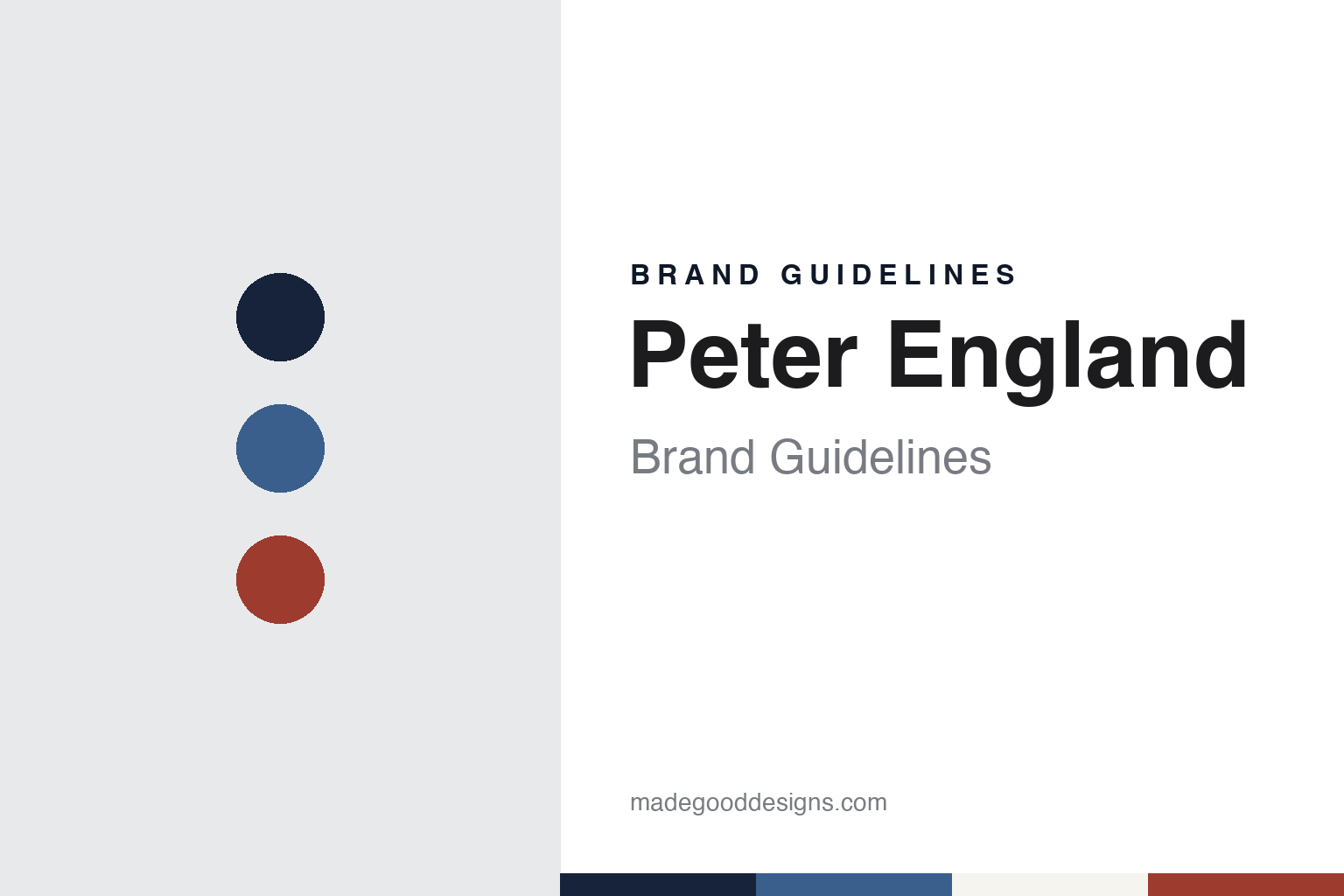
Peter England Brand Guidelines
A shirt name from Magherafelt, relaunched in India as the honest shirt.
Aa
Two constants: a deep ink, shirting blue and brick red palette and a bookish serif register. Abstract homage — not a Peter England product or mark; no garment, logo or label is reproduced.
The Magherafelt shirt
A shirt factory in County Londonderry.
Peter England started as a shirt name in the British Isles, not in India. English Wikipedia says the brand was formed in 1889 and had a shirt factory at Magherafelt, in County Londonderry; the trade title ETBrandEquity, writing in 2017, dated its antecedents to 1899 in Londonderry. The two dates differ by a decade, so both are given here.
For much of the twentieth century the name belonged to large British textile groups. English Wikipedia cites a 1975 report in the Belfast Telegraph that described the Magherafelt shirt factory of Peter England as a member of the Carrington Viyella group, at a time when the factory was adding shifts to keep up with orders. By the late twentieth century, the same article says, the business was owned by the British company Coats Viyella, the group formed through a series of mergers around William Hollins & Co, the makers of Viyella cloth.
The Magherafelt factory closed in 1992, English Wikipedia says, citing the Belfast Telegraph. In 2017 ETBrandEquity wrote that the name was still present in the United Kingdom, but that its star was already fading there by the time it was launched in India.
The link that carried the name across was Coats Viyella’s Indian business. ETBrandEquity named the Indian company that launched Peter England as Madura Coats. Allen Solly, another name with a British past, had been launched by Madura in 1993, according to FashionUnited; Peter England followed four years later.
Colour
International quality at honest prices.
Peter England was launched in India in 1997 by Madura Coats, ETBrandEquity reported in its 2017 profile, with English Wikipedia adding that the launch covered bespoke and ready-made shirts. At the time, the trade title wrote, most Indian men either wore tailored shirts, with tailored outnumbering ready-made by about four to one, or bought Indian brands with international-sounding names. Peter England was one of the few that did not have to invent a foreign history.
The positioning was simple. Vishak Kumar, then chief executive of Madura Fashion & Lifestyle and a member of the original launch team, told ETBrandEquity that the brand was presented as “international quality at honest to goodness prices: The honest shirt.” The name itself, the article said, was chosen as one that was easy to pronounce and to recognise, and the brand aimed at the value segment, which Kumar said had been largely ignored between the cheap and premium ends of the shirt market.
Distribution was the other half of the plan. A former chief operating officer of the brand told ETBrandEquity that while most brands talked to fifty to a hundred towns, Peter England talked to 500 towns, going to market through distributors rather than straight to retailers. The same article described festive lines made for different parts of India, such as Onam ranges for Kerala and Pujo ranges for West Bengal, and shirts inspired by Madhubani painting.
The range grew beyond the shirt. ETBrandEquity listed office wear, smart casuals, wedding suits, denim and a more premium line called Peter England Elite, and noted a luggage range that did not catch on and that the brand went back to rework. Its advertising moved too, from “the honest shirt” to “The Mark of Honesty” and then to “Be Everything You Love,” the trade title wrote, as shoppers came to expect honesty from a brand and the message needed to change. The brand also moved from small neighbourhood shops into malls to reach younger buyers. Today the company describes a range of shirts, trousers, denim, suits and blazers, t-shirts and activewear for young Indian men.
Typography
Indian fashion and lifestyle brands.
Indian fashion and lifestyle brands tend to present themselves through what they make for particular moments. Ethnic-wear labels sort their ranges by garment, from kurtas, suit sets and sarees to sherwanis and lehengas, and by occasion, from festivals and office days to the separate ceremonies of a wedding. Western-wear and suiting labels lean instead on fabric, fit and the working week, and many companies now sell both kinds of clothing side by side.
Ownership is part of the story. Several names sit inside larger listed or private groups, such as Aditya Birla Fashion and Retail, Vedant Fashions, TCNS Clothing and Raymond, while others remain founder-run or family-run companies that have taken outside investors. Corporate and investor pages are usually the plainest record of this: they set out founders, subsidiaries, stock-exchange listings and the dates on which a label was launched, bought or merged, and those pages are a sensible place to start when tracing who owns a brand today.
Visual identity is mostly carried by the stores and the campaigns rather than by published brand manuals. Exclusive brand outlets in malls and high streets, shop-in-shops in department stores, cricket sponsorships, cinema spots and celebrity ambassadors do much of the work, and a company’s logo is often seen first on a shopping bag, a jersey or a billboard. Colour palettes and typefaces are seldom documented in public.
This guide follows that record. It sets out founding dates, owners and listings as the companies and dated press reports give them, names collections and campaigns only where a source names them, and treats the colours and type shown here as an unofficial interpretation rather than a brand standard.
Aa
A bookish serif for a shirt with a long past. (Specimen set in Libre Baskerville, a serif STAND-IN; NOT the Peter England logo.)
Peter England
Madura, Aditya Birla and a 2025 listing.
The Indian business behind Peter England changed hands soon after the launch. English Wikipedia’s article on Aditya Birla Fashion and Retail says Madura Garments was acquired by the Aditya Birla Group in 1999; its article on Peter England gives 2000 as the year the brand was acquired. Madura was renamed Madura Fashion & Lifestyle in 2010, and in May 2015 the group’s branded clothing businesses were consolidated into the company renamed Aditya Birla Fashion and Retail, English Wikipedia says.
The group then split that company in two. English Wikipedia says the former Madura business was demerged into Aditya Birla Lifestyle Brands Limited, with effect from 1 May 2025. FashionUnited reported that the new company listed on the Bombay Stock Exchange and the National Stock Exchange on 23 June 2025, ending a year-long demerger, and that its portfolio includes Louis Philippe, Van Heusen, Allen Solly and Peter England, alongside Simon Carter, American Eagle, Reebok and Van Heusen Innerwear. The company’s own website lists Peter England among its four main brands and describes each of them as more than 25 years old in India.
The brand’s design story is therefore one of transfer. A shirt name that had a factory in Magherafelt was given a second life in India, kept its English name, and was built around a plain promise of fair value rather than luxury. Its ETBrandEquity profile in 2017 also quoted the founder of an advertising agency who had worked on the brand in the mid-2000s, who said there had been a debate about whether that plain message still worked once online shops offered permanent discounts, and whether the brand needed to become more contemporary.
For a design guide, Peter England shows how a borrowed heritage name can be repositioned around one honest, everyday idea and carried by wide distribution. Compare Allen Solly, its stablemate with an English past, and Raymond, an Indian suiting house. For this guide we use deep ink, shirting blue, poplin white and a brick red with a serif, an unofficial interpretation; no product or logo is reproduced.
Explore & save
Keep Peter England’s identity on hand — save it to a board in the Made Good inspiration library.
Peter England identity set
Pin the Peter England deep ink, shirting blue and brick red palette and the bookish serif register to your own board.
Source & notes
Frequently Asked Questions
What font can I use to match the Peter England look?
This guide describes Peter England’s type as “A bookish serif for a shirt with a long past”. Its type specimen is set in Libre Baskerville from Google Fonts as a stand-in; Libre Baskerville is not Peter England’s own lettering.
What colours are in the Peter England palette?
This guide’s Peter England palette is Deep ink #16233A, Shirting blue #3A5F8C, Poplin white #F6F4EF, Brick red #9E3B2F and Linen grey #CFCBC2. The tones are the guide’s own unofficial interpretation, not official Peter England hex codes.
When was Peter England founded?
Peter England was founded in 1889 or 1899 (sources differ), in Shirt maker, Magherafelt factory.


