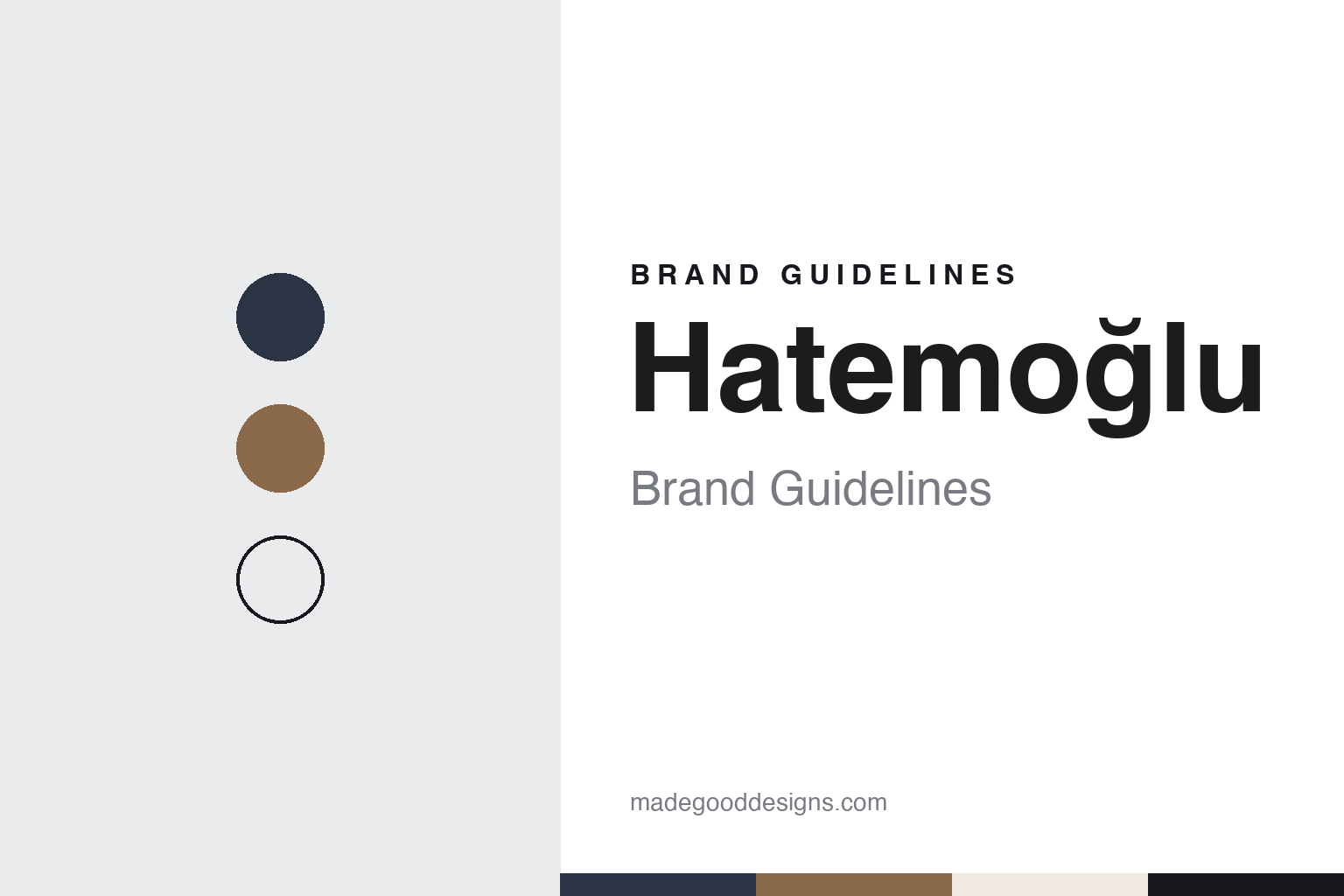
Hatemoğlu Brand Guidelines
A 1924 Kayseri coat shop turned Turkish menswear brand.
Aa
Two constants: an ink blue, tobacco and ivory palette and a tailoring serif register. Abstract homage — not a Hatemoğlu product or mark; no garment, logo or label is reproduced.
Kayseri, 1924
A coat shop in central Anatolia.
Hatemoğlu is a Turkish menswear brand that traces its start to a single shop in Kayseri, in central Anatolia, in 1924. The company says the shop was opened by Mustafa Bey, “the son of Hatem Bey,” which is what the name Hatemoğlu means, and that its early stock included men’s overcoats and women’s coats.
The 1924 date also appears in press coverage. A November 2003 report on Bigpara, the financial news site of the Hürriyet group, described the firm as a name in Turkish ready-to-wear since 1924. In August 2011 the newspaper Akşam called Hatemoğlu an 87-year-old brand. In October 2023 Bloomberg HT reported that the brand was entering its hundredth year with the autumn–winter 2023–24 season, and said it had been founded in 1924 to make women’s and men’s coats.
The company’s own history moves in steps from there. It says Hatemoğlu widened its ready-to-wear range in the 1950s in response to customer demand, opened its first Istanbul store in 1962, made its first export shipment, to Switzerland, in 1979, and staged a fashion show at Uludağ, the mountain resort above Bursa, in 1987. It says the business is now run by the third generation of the family.
Press reports from the 2000s give names to that generation. In 2003 Bigpara named the trading company as Hatemoğlu MİB Mağazacılık Ticaret and quoted a board member, Hatem Saykı, who said the firm then had four stores of its own in Türkiye alongside a growing franchise network. By 2011 Akşam described Hatem Saykı as chairman of the board.
Colour
Four labels around one tailoring house.
Hatemoğlu has grown by adding younger labels around the main brand, which the company calls “Hatemoğlu 1924.” It dates html, also written @html, a casual line for young men, to 2003; Hatem Saykı, a more fashion-led label covering suits, coats and wedding wear, to 2005; and hteen, also written H-teen, aimed at teenagers, to 2010.
Akşam’s 2011 interview explained the turn. It reported that in 2003 the firm had closed its women’s collection and stopped contract manufacturing for other companies, and had then added the Hatem Saykı and html labels. Through hteen, the paper said, the company was making suits and dinner suits in sizes for boys as young as 13. For the autumn–winter 2011 campaign Hatemoğlu chose the Brazilian model Mihaly Martins, photographed by Tamer Yılmaz, and Saykı told the paper that television series, which the company dressed, served as a shop window for its suits. The paper added that the company had in recent years put more weight on its online store, which Saykı said had quickly become one of its stronger sales channels.
Suits and dinner suits sit at the centre of the range. Bloomberg HT’s 2023 report on the centenary campaign described dinner suits and suits as constants of the collections, with dinner jackets in coloured velvet that winter and an outerwear range of coats and jackets in earth tones and wool-rich cloth. In April 2024 the shopping-centre trade magazine AVM Dergi, reporting a new Hatemoğlu store of about 160 square metres at VANMall in Van, in eastern Türkiye, listed its product groups as suits, shirts, ties and overcoats, alongside accessories and casual lines.
Summer collections follow the same tailoring base in lighter cloth. In March 2025 the business magazine Para described the spring–summer 2025 collection as drawn from the islands of the Aegean and the Mediterranean and from the Sahara, with an indigo, light blue and white palette on one side and coffee, sand and beige on the other, built around linen pieces, safari jackets and blazers worn with shorts.
Typography
Design and documentation.
Turkish fashion and menswear brands tend to present themselves through the things they make and the places they sell them. Tailored suits, shirts, knitwear, leather goods and womenswear lead the product pages, and many labels describe made-to-measure or ceremonial ranges, such as tuxedos for weddings, alongside everyday clothes. Product names and fabrics are usually given plainly, with the collection season as the main organising idea.
Retail format carries much of the identity. Some names began as department stores and now run several store formats under one roof, from full-line stores and single-brand boutiques to outlets and online shops. Others began as menswear makers and grew into chains of their own stores in shopping malls and on high streets. Flagship stores in Istanbul districts such as Nişantaşı and along the Bosphorus are often named in company histories, and the international shops, franchise partners and showrooms that companies publish give a sense of how far a label has travelled.
Group ownership is part of the picture and needs dated sources. Several labels sit inside holding companies: Boyner Group, built on the Altınyıldız textile business, runs department stores and menswear labels, while Orka Holding owns a family of menswear names. Ownership has changed over time through partnerships with foreign investors and later splits or buybacks, so the date of any ownership statement matters as much as the statement itself.
Corporate pages are the usual starting point for founders, owners and store counts. Company “about” and history pages give founding years, founders’ names and milestones in the company’s own words; national newspapers, news agencies and business press add dated reports on openings, partnerships and changes of control. For a designer, that mix explains why these identities often rest on a group name, a flagship address and a type of garment rather than on a single logo.
Aa
A bookish serif for a brand built on suits and coats. (Specimen set in Libre Baskerville, a serif STAND-IN; NOT the Hatemoğlu logo.)
Hatemoğlu
From Kayseri to Madison Avenue.
Hatemoğlu also trades abroad under a different name. The company says its SAYKI label opened its first US store on Madison Avenue in New York City in 2016, and that SAYKI now operates in New York, New Jersey, Illinois, Pennsylvania, Maryland, Massachusetts and Virginia. It also says its clothes reach customers in countries ranging from Congo and Azerbaijan to Turkmenistan and China. Exports are not new for the firm: in the 2003 Bigpara report, an export manager recalled large shipments of coats abroad in the 1980s.
The brand’s advertising has settled on one idea: the gentleman. Bloomberg HT reported in October 2023 that the centenary autumn–winter campaign was built around the Turkish word centilmenlik, “gentlemanliness,” presented as the quality that had suited the brand for a hundred years, in a film fronted by the brand face it calls Emre Bey. In March 2025 Para reported that the spring–summer 2025 film brought Emre Bey back, set to “Dalgalı,” a song by the band Adamlar, and directed by Deniz Özgün, and that the brand had used the gentlemanliness theme for the previous four seasons.
Inside Türkiye, the brand sells through its own stores and shopping-centre units such as the one AVM Dergi reported at VANMall in 2024, as well as online. The company remains in family hands, according to its own account, with the third generation in charge.
For a design guide, Hatemoğlu shows how a century-old tailoring name can stay current by adding sub-labels and a recurring campaign character rather than changing its core. Compare Kiğılı, another long-running Turkish menswear chain, and Altınyıldız Classics. For this guide we use ink blue, tobacco and ivory with a serif, an unofficial interpretation; no product or logo is reproduced.
Explore & save
Keep Hatemoğlu’s identity on hand — save it to a board in the Made Good inspiration library.
Hatemoğlu identity set
Pin the Hatemoğlu ink blue, tobacco and ivory palette and the tailoring serif register to your own board.
Source & notes
Frequently Asked Questions
What font can I use to match the Hatemoğlu look?
This guide describes Hatemoğlu’s type as “A bookish serif for a brand built on suits and coats”. Its type specimen is set in Libre Baskerville from Google Fonts as a stand-in; Libre Baskerville is not Hatemoğlu’s own lettering.
What colours are in the Hatemoğlu palette?
This guide’s Hatemoğlu palette is Ink blue #2B3445, Tobacco #8A6A4A, Camel #C2A27C, Shirting ivory #EFE9DF and Charcoal #16181D. The tones are the guide’s own unofficial interpretation, not official Hatemoğlu hex codes.
When was Hatemoğlu founded?
Hatemoğlu was founded in 1924, in Kayseri, Türkiye.
Who founded Hatemoğlu?
Hatemoğlu was founded by Mustafa Bey (company account) in 1924.