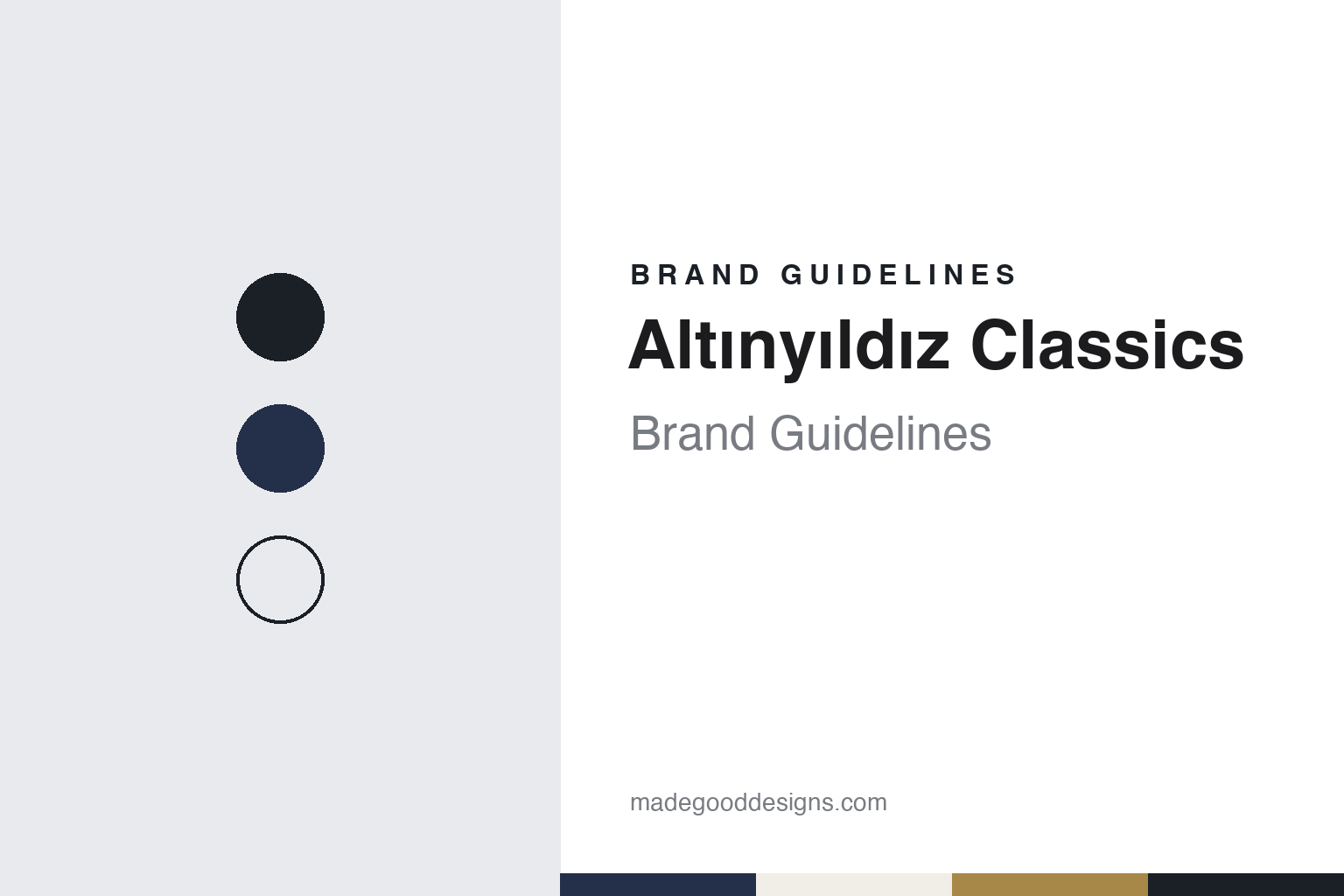
Altınyıldız Classics Brand Guidelines
A 1952 mill name worn by a Turkish menswear chain.
Aa
Two constants: an ink blue, charcoal and gold palette and a tailored serif register. Abstract homage — not an Altınyıldız Classics product or mark; no garment, logo or label is reproduced.
Altınyıldız
A textile name from 1952.
The name Altınyıldız, Turkish for “golden star,” belongs first to a textile business. English Wikipedia says Ali Osman Boyner co-founded Altınyıldız in 1952 with the idea of taking Turkish fabric to the world, began exporting in 1956, and at the end of the 1960s moved into ready-to-wear clothing; the company that held Altınyıldız is today’s Boyner Holding. Boyner Group’s own history gives the founding company’s full name as Altınyıldız Mensucat ve Konfeksiyon Fabrikaları, a wool and wool-blend cloth maker, and says the company, then still called Altınyıldız Mensucat, went public in 1991.
The same group history traces several of Turkey’s fashion retail names back to that mill. It says the upscale store Beymen opened its first shop in Şişli in 1971, and that in 1997 Altınyıldız began the retail operation that later took the name Network. The menswear chain that carries the mill’s name today, Altınyıldız Classics, is a separate retail brand built on that heritage, sold through its own shops rather than as cloth.
Ownership moved within the family group over the following decades. Boyner Group says that in 2015 the Qatar-based Mayhoola for Investments became a 50–50 partner in Boyner Perakende, the company that then held Boyner, Beymen, AY Marka and Altınyıldız, and that in 2019 the partners ended the arrangement by dividing the portfolio: Beymen and AY Marka passed to Mayhoola, while the Boyner department stores and the whole of Altınyıldız went to Boyner Holding. English Wikipedia describes the same 2019 split.
Colour
BR Mağazacılık and the menswear chain.
The chain is run by BR Mağazacılık. English Wikipedia says Boyner Group set up BR Mağazacılık in 2011 as a joint venture with Ran Konfeksiyon, a clothing maker, with its headquarters in Torbalı, İzmir, and that the company both manufactures and retails Altınyıldız Classics and Beymen Business, a menswear line that, despite its name, is not part of the Beymen Group. Boyner Group’s history dates the start of BR Mağazacılık’s operations, with Altınyıldız Classics and Beymen Business, to 2011, and its brand pages now place Altınyıldız Classics alongside Brooks Brothers, the American menswear name that the group brought to Turkey in 2023.
The shops are built around tailoring. In a 2015 project published by Architect magazine, the Istanbul practice CBTE Architecture, led by Çağdaş Belen and Tanem Eren Belen, described a 1,800-square-metre Altınyıldız Classics flagship in Istanbul for the client BR Stores, larger than the brand’s usual shops and laid out like a small department store with a shop-in-shop plan. Wall panels presented classic collections the architects named Business, Ceremony and Private Sewing, the made-to-measure service, under light-coloured ceilings, while a central zone for younger, more casual lines used open ceilings, rough metal fittings, brick paving and dark textured floors. The architects said the aim was to carry the brand’s corporate identity into the space, and they added seating units in the central area, planned around the way men shop for clothes, and display surfaces for collection details and style suggestions.
The range spans formal and casual menswear. In a lead interview with the trade magazine Retail & Leisure International in August 2019, the chief executive, Enis Habif, described collections running from suits to casual wear and said the brand also sold through concessions in the Boyner and YKM department stores and through its own online shop. The magazine reported that the Turkish actor Burak Özçivit represented the brand in several countries at the time.
Typography
Design and documentation.
Turkish fashion and menswear brands tend to present themselves through the things they make and the places they sell them. Tailored suits, shirts, knitwear, leather goods and womenswear lead the product pages, and many labels describe made-to-measure or ceremonial ranges, such as tuxedos for weddings, alongside everyday clothes. Product names and fabrics are usually given plainly, with the collection season as the main organising idea.
Retail format carries much of the identity. Some names began as department stores and now run several store formats under one roof, from full-line stores and single-brand boutiques to outlets and online shops. Others began as menswear makers and grew into chains of their own stores in shopping malls and on high streets. Flagship stores in Istanbul districts such as Nişantaşı and along the Bosphorus are often named in company histories, and the international shops, franchise partners and showrooms that companies publish give a sense of how far a label has travelled.
Group ownership is part of the picture and needs dated sources. Several labels sit inside holding companies: Boyner Group, built on the Altınyıldız textile business, runs department stores and menswear labels, while Orka Holding owns a family of menswear names. Ownership has changed over time through partnerships with foreign investors and later splits or buybacks, so the date of any ownership statement matters as much as the statement itself.
Corporate pages are the usual starting point for founders, owners and store counts. Company “about” and history pages give founding years, founders’ names and milestones in the company’s own words; national newspapers, news agencies and business press add dated reports on openings, partnerships and changes of control. For a designer, that mix explains why these identities often rest on a group name, a flagship address and a type of garment rather than on a single logo.
Aa
A tailored serif for a mill-born menswear name. (Specimen set in Cormorant Garamond, a serif STAND-IN; NOT the Altınyıldız Classics logo.)
Altınyıldız Classics
A chain at home and abroad.
In August 2019 the chief executive told Retail & Leisure International that the brand had 185 stores in Turkey and 12 abroad, in Romania, Azerbaijan, Kazakhstan, Kyrgyzstan, Uzbekistan, Iraq and Cyprus, naming a 315-square-metre store in the Afi Cotroceni mall in Bucharest and a store in the Skyline Plaza mall in Frankfurt among its key shops. English Wikipedia, citing BR Mağazacılık’s own site as of May 2024, gives the operating company around 2,000 staff, about 200 stores and more than 400 sales points in 60 of Turkey’s 81 provinces, and 60 stores in 18 other countries; those figures cover both of its brands.
Its relation to the cloth business remains one of name and group. Altınyıldız the textile company sits in Boyner Group alongside BR Mağazacılık rather than inside it, and the group says that in 2024 Altınyıldız joined forces with Bahariye Mensucat, another long-established Turkish cloth maker. The group’s structure since the 2019 split keeps the textile mill, the Boyner department stores, BR Mağazacılık and the Brooks Brothers licence under Boyner Holding, while Beymen and AY Marka, the company behind Network, passed to Mayhoola in 2019, the group says.
That shared history explains why the Altınyıldız name appears on more than one live guide. The Boyner department-store chain grew out of the same textile root, and Network began as an Altınyıldız retail venture in 1997, according to Boyner Group. Altınyıldız Classics is the branch that kept the mill’s name in front of shoppers, on suits, shirts and ceremony wear sold through its own stores and department-store concessions.
For a design guide, Altınyıldız Classics shows how a textile mill’s name can be carried onto a menswear chain and its tailoring-led stores. Compare Boyner, the department-store chain that grew from the same Altınyıldız root, and Kiğılı, another Istanbul menswear chain. For this guide we use ink blue, worsted charcoal and a gold with a serif, an unofficial interpretation; no product or logo is reproduced.
Explore & save
Keep Altınyıldız Classics’s identity on hand — save it to a board in the Made Good inspiration library.
Altınyıldız Classics identity set
Pin the Altınyıldız Classics ink blue, charcoal and gold palette and the tailored serif register to your own board.
Source & notes
Frequently Asked Questions
What font can I use to match the Altınyıldız Classics look?
This guide describes Altınyıldız Classics’ type as “A tailored serif for a mill-born menswear name”. Its type specimen is set in Cormorant Garamond from Google Fonts as a stand-in; Cormorant Garamond is not Altınyıldız Classics’ own lettering.
What colours are in the Altınyıldız Classics palette?
This guide’s Altınyıldız Classics palette is Ink blue #24304A, Worsted charcoal #1B1F26, Gold thread #A88849, Shirting white #F1EEE7 and Paper #F8F7F3. The tones are the guide’s own unofficial interpretation, not official Altınyıldız Classics hex codes.


