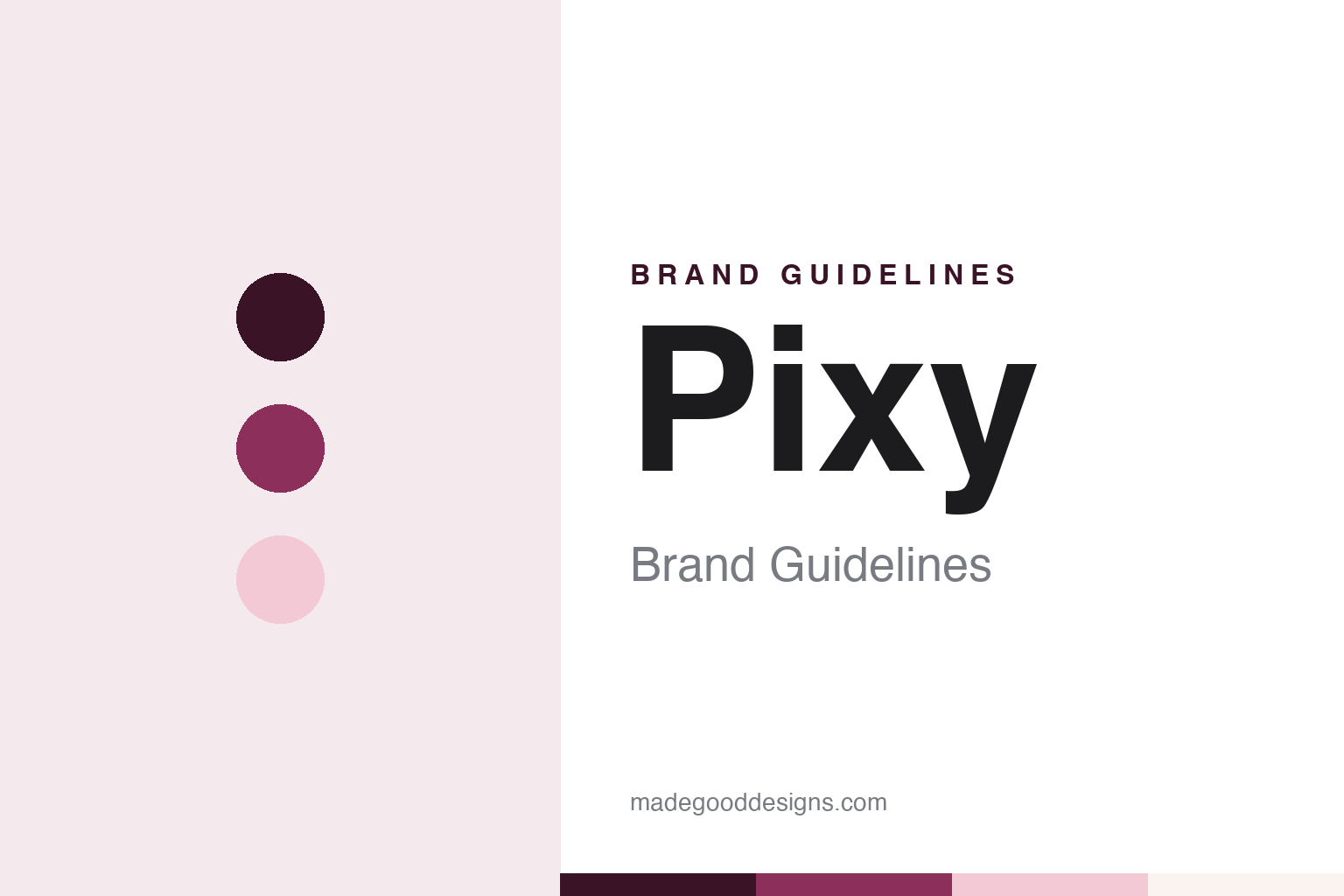
Pixy Brand Guidelines
Mandom Indonesia’s make-up brand, from a 1987 lipstick to a Gen Z relaunch.
Aa
Two constants: a berry, raspberry and petal-pink palette and a rounded sans register. Abstract homage — not a Pixy product or mark; no pack, logo or wordmark is reproduced.
Tancho Indonesia
A 1969 joint venture in Jakarta.
Pixy is the make-up brand of PT Mandom Indonesia Tbk, the Indonesian arm of the Japanese cosmetics group Mandom Corporation. The Indonesian company is the older of the two names in this story: Mandom Corporation’s own published history says it started a joint venture called P.T. Tancho Indonesia in Jakarta in November 1969, and that this company is now its consolidated subsidiary PT Mandom Indonesia Tbk. The Japanese parent took the Mandom name in 1971, according to the same history.
The Indonesian business grew into a manufacturer as well as a seller. Mandom’s history records a plastic-moulding department at the Indonesia factory in 1972, and the start of operations at PT Mandom Indonesia’s Cibitung factory in March 2001. In September 1993, the history says, P.T. Tancho Indonesia Tbk was listed on the Jakarta Stock Exchange, now the Indonesia Stock Exchange; Fortune Indonesia reports the company today under the ticker TCID.
The head office has moved more than once. Mandom’s history says the head office and factory of PT Mandom Indonesia moved from Jakarta to Bekasi in June 2015, and that the head office moved back from Bekasi to Jakarta in August 2018. In July 2025 Fortune Indonesia, reporting the company’s half-year disclosure, named Koichi Watanabe as its president director and chief executive.
Mandom Indonesia is a multi-brand company. The same Fortune Indonesia report describes it as a producer of cosmetics and body-care products and names its men’s hair-styling brand Gatsby alongside Pixy, which places the make-up brand inside a business whose other well-known name is aimed at men. Pixy is the label through which the company addresses women’s make-up.
Colour
From a 1982 launch to a lipstick in 1987.
Sources give two starting dates for Pixy, and both are worth stating. Mandom Corporation’s history lists “Launched Pixy in Indonesia” under October 1982, and then records the launch of a women’s cosmetic item, Pixy Moisture Lipstick, in Indonesia in November 1987. IDN Times, in a March 2025 report on the brand, dates Pixy from 1987 and says its story began with the launch of the Pixy Moisturizing Lipstick; the 1982 date in Mandom’s history and the 1987 lipstick in both sources can be read together as an earlier brand launch followed by the move into women’s make-up.
IDN Times adds that eye make-up followed three years after the lipstick and that a two-way cake powder was introduced in 1995. By 2025, according to the same report, the brand covered skincare, base make-up and decorative make-up.
The brand’s own website organises that range into named series and categories. In November 2026 it listed series including Make It Glow, 4 Beauty Benefits, Glowssentials and Fixed Matte, and categories for base make-up (primer, foundation, powder, contouring and cushion), decorative make-up for eyes, lips and cheeks, skincare and a wellness section. The company says Pixy products are developed for the needs of Asian women, including Indonesian women, and that the make-up style and product design are inspired by current Tokyo make-up and fashion. The site also offers a virtual make-up tool and video tutorials.
The Japanese link is visible in the brand’s management too. At the brand’s March 2025 launch, IDN Times reported, Mandom Indonesia’s senior executive officer for marketing appeared alongside the executive officer responsible for Pixy’s women’s cosmetics business.
Typography
Design and documentation.
Indonesian beauty and modest-fashion brands tend to present themselves through people, packaging and the places they sell, and only occasionally through a published identity manual. Logos and colour codes are rarely documented in the press, so a design reading has to rest on what companies show in public: the pack, the campaign, the ambassador and the corporate page that names founders and owners.
Halal statements are part of that picture, but companies publish them in different ways. Liputan6 reported in 2022 that Wardah received a halal certificate from the Majelis Ulama Indonesia in 1999, while Wardah’s founder told The Jakarta Post in 2019 that the brand did not put its certificates at the centre of its advertising. A marketing analyst quoted by the same paper linked the growth of halal cosmetics to the spread of the hijab as everyday fashion from around 2009, saying that fashion and cosmetics moved together.
Campaigns lean on familiar faces. Singers, racing drivers and other public figures appear as named ambassadors in dated launches, from a 2014 Wardah event in Jakarta reported by Fimela to a 2026 lip campaign shot in Dubai and Abu Dhabi, covered by Marketing-Interactive. Marketplace launches matter as much as shops: Monocle reported in 2025 that Paragon Corp sells through livestreams on TikTok, Shopee, Lazada and Tokopedia, and Sinar Harian reported that Emina’s 2022 Malaysian launch named Shopee, TikTok Shop and Watsons as its outlets.
Group ownership shapes the field. Paragon Corp, founded in 1985 and renamed in 2011, runs a family of brands for different ages and budgets, and older houses with roots in the jamu tradition sit alongside it with their own founders and corporate histories. Each guide in this series describes those owners plainly, dates every ambassador and launch, and treats colour and type as our own unofficial interpretation.
Aa
A rounded sans — for a brand pitched at a young audience. (Specimen set in Quicksand, a sans STAND-IN; NOT the Pixy logo.)
Pixy
A 2024 rebrand and a Gen Z relaunch.
Pixy’s current look dates from a recent reset. Fortune Indonesia reported in July 2025 that Mandom Indonesia was concentrating its marketing on Pixy, which had carried out a rebranding in 2024. The public face of that change came at an event called PIXY Bites & Beauty Soiree on 15 March 2025 at Ganara Art Space in Plaza Indonesia, central Jakarta, which IDN Times described as the brand presenting a “new face” aimed at Generation Z.
The product chosen to carry that new face was a lip tint. IDN Times reported that Hydra Glass Lip Tint was presented as the symbol of the relaunch, in eleven shades, three of them new. The shade names read like a dessert menu — Toffee Caramel, Strawberry Crepe and Cherry Pie among them, with the three new shades named Cocopandan, Berry Tea and Mocha Milky, so the whole range follows a single food-led naming system. The event itself combined a Ramadan fast-breaking with pouch painting, a photo booth and a set by the musician Adikara, according to the report.
The relaunch did not discard the brand’s history. IDN Times framed the new face as a continuation of a brand it dated to 1987, and the brand’s website still carries the familiar series names alongside newer products. According to the report, the lip tint was sold through online marketplaces and beauty stores. On the brand’s own website, older lines such as the Perfect Fit Two Way Cake, a pressed-powder compact, are shown with updated packaging in a video titled as a “new look,” next to newer formats such as the Mousse Moment and the Make It Glow Dewy Cushion. The website’s pages carry the company line “My Beauty, My Energy” in English, and its navigation mixes English category names with Indonesian text.
For a design guide, Pixy shows how a decades-old make-up brand inside a manufacturing group can be pitched again at a younger audience through playful naming and event formats. Compare Make Over, another Indonesian make-up label inside a larger group, and Wardah. For this guide we use a berry ink, a raspberry and a petal pink with a rounded sans, an unofficial interpretation; no product or logo is reproduced.
Explore & save
Keep Pixy’s identity on hand — save it to a board in the Made Good inspiration library.
Pixy identity set
Pin the Pixy berry, raspberry and petal-pink palette and the rounded sans register to your own board.
Source & notes
Frequently Asked Questions
What font can I use to match the Pixy look?
This guide describes Pixy’s type as “A rounded sans — for a brand pitched at a young audience”. Its type specimen is set in Quicksand from Google Fonts as a stand-in; Quicksand is not Pixy’s own lettering.
What colours are in the Pixy palette?
This guide’s Pixy palette is Berry ink #3A1426, Raspberry #8C2F5A, Petal pink #F4C9D6, Toffee #C08A62 and Milk #FBF3F0. The tones are the guide’s own unofficial interpretation, not official Pixy hex codes.
When was Pixy launched?
Pixy was launched in October 1982 (Mandom); 1987 (IDN Times), in Indonesia.
Who owns Pixy?
Pixy is owned by PT Mandom Indonesia Tbk. This guide dates Pixy to October 1982 (Mandom); 1987 (IDN Times), in Indonesia.


