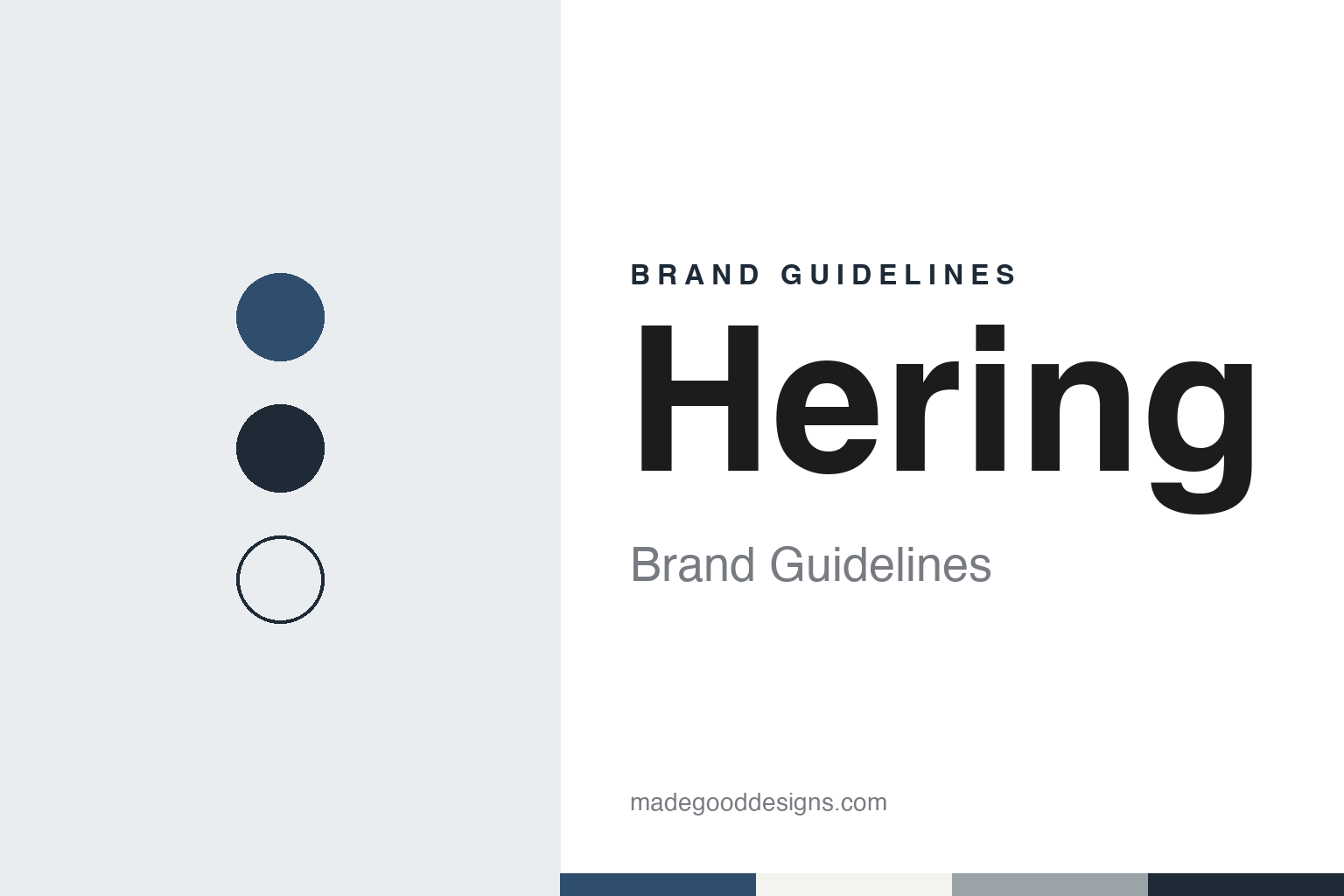
Hering Brand Guidelines
A Blumenau knitting mill whose plain T-shirt became the brand.
Aa
Two constants: a knit blue, heather grey and undyed cotton palette and a plain humanist sans register. Abstract homage — not a Hering product or mark; no fish logo or garment is reproduced.
A circular loom
Two brothers and a cotton mill in Blumenau.
Hering is one of Brazil’s oldest clothing companies still trading, according to English and Portuguese Wikipedia. Its story begins with Hermann Hering, a German immigrant who settled in Santa Catarina, in southern Brazil, a state with many German settlers. The International Directory of Company Histories, published on Encyclopedia.com, says he acquired a circular loom in 1879 and that in 1880 he and his brother Bruno opened a cotton-textile plant in Blumenau. The looms were driven first by steam, then by water and later by electricity, the same history says.
The business spread outward from Santa Catarina. According to the International Directory of Company Histories, Hering sent its first agent to Porto Alegre in 1900, began selling systematically in São Paulo between 1908 and 1910 and later reached Rio de Janeiro. By 1914 the firm, then called Hering & Cia., had imported its first spinning mill so that it could make its own cotton yarn, and by 1929 it had taken the name Companhia Hering. English Wikipedia says the headquarters and main factories are still in Blumenau.
The name gives the logo its subject. Hering is the German word for herring, and Portuguese Wikipedia, citing a January 2009 issue of the magazine Superinteressante, says the company’s logo shows two small fish, one for each brother. The family stayed in charge for well over a century: the same encyclopedia entry names Ivo Hering, a great-grandson of one of the founders, as head of the group in the 1970s, and in July 2024 Exame described the family’s sixth generation working in the business.
Colour
The basic T-shirt as a brand.
Hering’s reputation rests on plain clothes. The International Directory of Company Histories describes simple, unadorned T-shirts “worn by generations of Brazilians,” and records later ranges including pyjamas, underwear and sports shirts, a Mickey Mouse T-shirt made under licence from 1960, and Wrangler jeans made under licence from 1983 until the licence lapsed in 1998. The company also had a long detour outside clothing: it set up the soybean processor Ceval in 1972 and sold its last stake in it to Bunge in 1997.
By the late 1990s Hering was turning from a manufacturer into a retailer. The same history says the company founded two franchise chains in 1992, Wrangler and Family Store; Family Store became Hering Store, and a children’s chain grew around the PUC label. By early 1999, the same entry says, Hering had also sold its plants near Recife and its spinning mill in Blumenau, and was trying to redefine itself as a retailer built on its brand name rather than on cheap clothing. By 2020, Portuguese Wikipedia says, citing the company’s annual report, Cia. Hering had 794 stores, 701 of them under the Hering name in Brazil, Paraguay, Uruguay and Bolivia, and most of them franchised.
Manufacturing still matters. In July 2024 Exame reported that Hering made about 70 percent of what it sold and bought in the rest, with knitting in Blumenau and factories in Goiás and Rio Grande do Norte, and that it was already making some items for Farm and Foxton. The same report described collaborations with Farm, Nati Vozza and Cris Barros, a footwear line developed with Arezzo, and 42 larger stores of about 400 square metres. In September 2026 Exame reported the launch of the Camiseta Brasil, a 100 percent cotton T-shirt made with a yarn the company says it developed, after tests of more than 40 knit lots and 22 collar options.
Typography
Brazilian fashion and footwear.
Brazil’s fashion and footwear brands cover a wide range: rubber flip-flops and plastic jelly shoes, women’s shoes and handbags, beachwear and printed dresses, and men’s basics and denim. Many of them sit inside a small number of listed groups, and their corporate pages set out founders, owners and stock-market listings alongside the product ranges.
Footwear is led by large manufacturers. Alpargatas, founded in São Paulo in 1907, has made Havaianas since 1962, and Portuguese Wikipedia describes it as an Itaúsa company since its 2017 change of ownership. Grendene, founded in Farroupilha in 1971 and listed on the São Paulo stock exchange since 2004, makes Melissa, Ipanema and Rider, with plants in the north-eastern states of Ceará and Bahia, according to Portuguese Wikipedia.
Clothing and women’s shoes have consolidated too. Portuguese Wikipedia says Azzas 2154 was formed in 2024 from the merger of Arezzo&Co, the Belo Horizonte shoe group behind Arezzo and Schutz, and Grupo Soma, the Rio de Janeiro group built on Animale and Farm, which had bought Cia. Hering in 2021. Ownership in the sector changes often, so each guide in this series states its brand’s owner as a dated fact.
These brands present themselves through campaigns with well-known faces, collaborations with foreign labels and their own stores and brand spaces, from Galeria Melissa in São Paulo to Casa Ipanema in Rio de Janeiro. This guide sets out what can be checked about each brand — who founded it, who owns it and where it says its products are made — and marks clearly what rests only on the company’s own word.
Aa
A plain humanist sans for a brand built on basics. (Specimen set in Work Sans, a sans STAND-IN; NOT the Hering logo or fish mark.)
Soma, Azzas, Arezzo&Co
From family control to a fashion group, and a split.
Family control ended in 2021. On 26 April 2021 Grupo Soma, the Rio group behind Farm and Animale, announced an agreement to take over Cia. Hering, Folha de S.Paulo reported; it came about two weeks after Hering’s board had rejected an unsolicited merger proposal from Arezzo. Folha wrote that Soma saw value in Hering’s knitwear production and its experience in franchising. Exame later confirmed that Soma bought Hering in 2021.
Three years later the rival came back as a partner. Arezzo&Co and Grupo Soma agreed in February 2024 to combine, InfoMoney reported, and the merged company, renamed Azzas 2154, took effect on 31 July 2024, according to Diário do Comércio. In July 2024 the group’s leaders met at Hering’s Blumenau headquarters to present the brand’s plans inside Azzas 2154, Exame reported. In February 2026, Exame reported, Azzas joined Hering’s basics unit with its shoes-and-bags unit, keeping Blumenau as Hering’s command centre.
That structure is now being undone. On 2 September 2026 the two controlling blocs signed a binding agreement to split Azzas 2154 into two listed companies, Mercado & Consumo reported: Arezzo&Co, which would hold Arezzo, Schutz, Vans in Brazil and Hering with its extensions, and Soma, with Animale, Reserva and other clothing labels, while Farm Rio moves into a jointly owned company. Cade, Brazil’s competition authority, cleared the reorganisation without restrictions in October 2026, Diário do Comércio reported; board and shareholder approvals were still outstanding. The split was agreed in September 2026; not completed at the time of writing.
For a design guide, Hering shows how a plain product, made in large numbers for well over a century, can carry a brand without much decoration. Compare Farm Rio, its collaborator and stablemate, and Arezzo, the company Hering is set to join. For this guide we use knit blue, heather grey and undyed cotton with a sans, an unofficial interpretation; no product or logo is reproduced.
Explore & save
Keep Hering’s identity on hand — save it to a board in the Made Good inspiration library.
Hering identity set
Pin the Hering knit blue, heather grey and undyed cotton palette and the plain humanist sans register to your own board.
Source & notes
Frequently Asked Questions
What font can I use to match the Hering look?
This guide describes Hering’s type as “A plain humanist sans for a brand built on basics”. Its type specimen is set in Work Sans from Google Fonts as a stand-in; Work Sans is not Hering’s own lettering.
What colours are in the Hering palette?
This guide’s Hering palette is Knit blue #2F4E6E, Heather grey #9AA3A8, Loom ink #1E2A36, Undyed cotton #F4F3EF and River green #56786A. The tones are the guide’s own unofficial interpretation, not official Hering hex codes.
When was Hering founded?
Hering was founded in 1880, in Blumenau, Santa Catarina, Brazil.
Who founded Hering?
Hering was founded by Hermann and Bruno Hering in 1880.
Who owns Hering?
Hering is owned by Azzas 2154 (Grupo Soma from 2021) (Move to Arezzo&Co agreed September 2026; not completed).