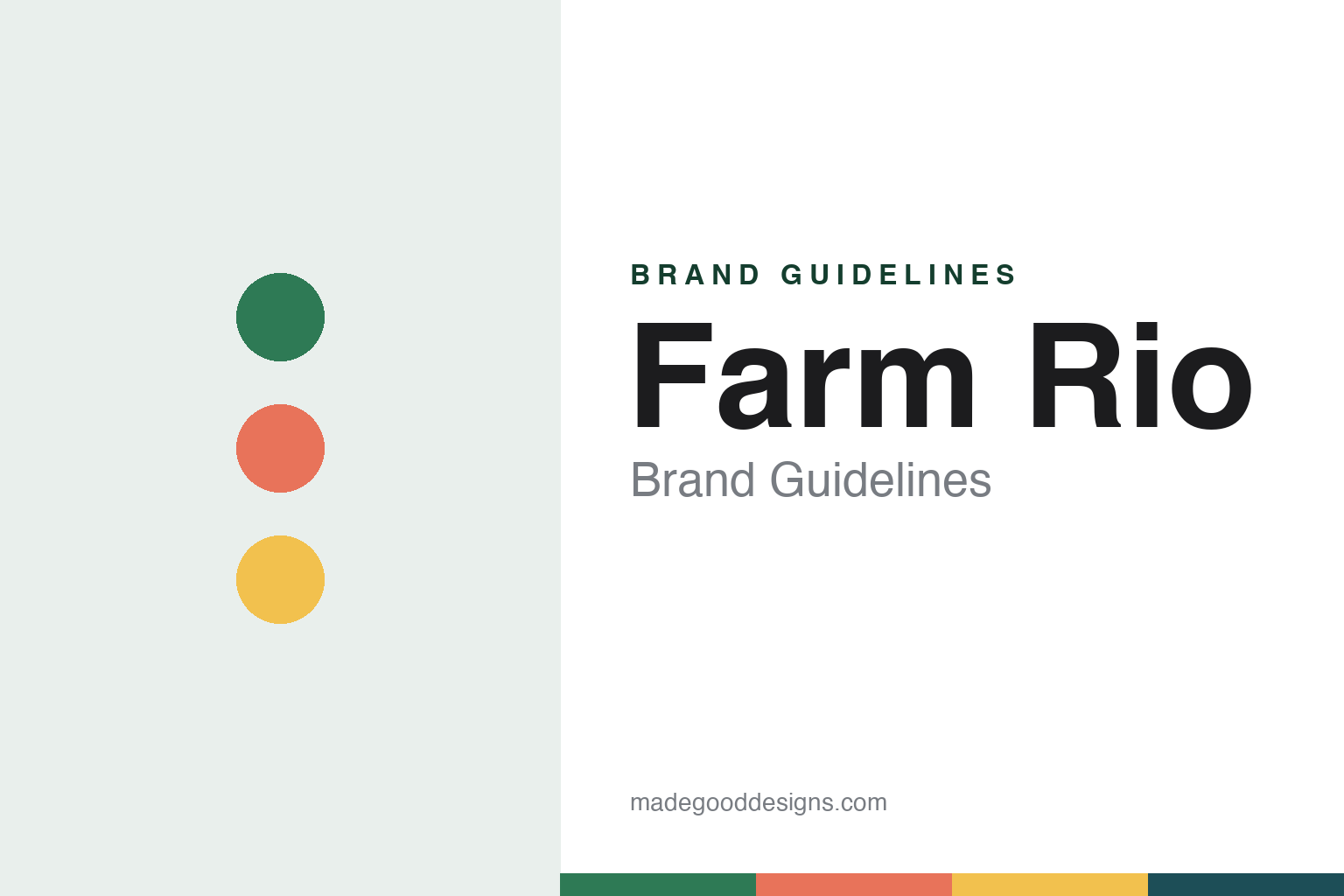
Farm Rio Brand Guidelines
The Rio print label that began at a fair in 1997.
Aa
Two constants: a leaf green, coral and banana yellow palette and a soft display serif register. Abstract homage — not a Farm Rio product or mark; no print, logo or garment is reproduced.
Babilônia Hype
A booth at an independent fair in Rio.
Farm began in Rio de Janeiro in 1997. Its co-founders, Kátia Barros and Marcello Bastos, started it in a booth at the Babilônia Hype fair, Bloomberg Línea reported in September 2022. Barros, the brand’s creative director, studied accounting at the Federal University of Rio de Janeiro and styling at Cândido Mendes University, according to the same profile. The company’s own site describes Bastos as a business administrator and says the pair began by selling colourful printed styles “inspired by the carioca spirit” at a local independent fashion market.
The two founders have kept their roles. NeoFeed described Bastos in February 2022 as Farm’s founding partner, and Brazil Journal in June 2025 as its co-founder and general director; the brand’s English-language site calls him the head of its Brazilian operations. Barros is named as creative director in all of these sources.
Abroad the label trades as FARM Rio, the form the company uses on its international website; in Brazil the shops carry the name Farm. Print is at the centre of the offer. Bastos told NeoFeed that printmaking had been one of the brand’s creative pillars since its founding, and the company says its team of Brazilian designers draws more than 700 prints a year, taking motifs from the country’s flowers and leaves and from birds such as macaws and toucans.
Colour
Grupo Soma, then Azzas 2154.
In 2010 Farm merged with the women’s label Animale to form Grupo Soma, a fashion group that went on to add other brands, NeoFeed reported in 2022; the same article noted that Soma had bought Hering in 2021. On 31 July 2024 Arezzo&Co completed its incorporation of Grupo Soma, EuQueroInvestir reported that day. Soma ceased to exist as a separate company, and from 1 August 2024 the combined group was named Azzas 2154 and traded on B3 under that name. Brazil Journal described Azzas 2154 in June 2025 as controlled by the executive Alexandre Birman, with Farm among its brands.
The group has since moved to divide itself again. On 4 November 2026, the company said, the unrestricted clearance by Brazil’s competition authority, CADE, of a reorganisation that would split Azzas 2154’s businesses into two independent listed companies became final, InfoMoney reported the next day. The split, agreed between the group’s two shareholder blocs, was not completed at the time of writing.
Farm’s sales abroad began in 2016, in the United States, Bastos told NeoFeed. He recalled that the brand took almost no orders at its debut US trade fair, but the retailer Anthropologie picked up one of its printed dresses, and that relationship grew into an American office and a business the company calls Farm Global. On the advice of consultants the brand presented itself in the US as a “contemporary” label, and its collections for that business are made in Turkey, Morocco and India, in what Bastos described as certified factories.
In 2019 Farm opened stores in New York and Miami designed by the architect Marcelo Rosenbaum, and launched online sales in the US. In 2020, with stores closed, it cut back its American structure and turned to dressing celebrities and to wholesale; Bastos named Saks, Neiman Marcus and Nordstrom among the department stores that took the brand. In Paris, NeoFeed reported, Farm started out in a 40-square-metre test space at the department store Le Bon Marché. Bastos also said the brand had built a winter business, carrying its prints onto coats.
Typography
Brazilian fashion and footwear.
Brazil’s fashion and footwear brands cover a wide range: rubber flip-flops and plastic jelly shoes, women’s shoes and handbags, beachwear and printed dresses, and men’s basics and denim. Many of them sit inside a small number of listed groups, and their corporate pages set out founders, owners and stock-market listings alongside the product ranges.
Footwear is led by large manufacturers. Alpargatas, founded in São Paulo in 1907, has made Havaianas since 1962, and Portuguese Wikipedia describes it as an Itaúsa company since its 2017 change of ownership. Grendene, founded in Farroupilha in 1971 and listed on the São Paulo stock exchange since 2004, makes Melissa, Ipanema and Rider, with plants in the north-eastern states of Ceará and Bahia, according to Portuguese Wikipedia.
Clothing and women’s shoes have consolidated too. Portuguese Wikipedia says Azzas 2154 was formed in 2024 from the merger of Arezzo&Co, the Belo Horizonte shoe group behind Arezzo and Schutz, and Grupo Soma, the Rio de Janeiro group built on Animale and Farm, which had bought Cia. Hering in 2021. Ownership in the sector changes often, so each guide in this series states its brand’s owner as a dated fact.
These brands present themselves through campaigns with well-known faces, collaborations with foreign labels and their own stores and brand spaces, from Galeria Melissa in São Paulo to Casa Ipanema in Rio de Janeiro. This guide sets out what can be checked about each brand — who founded it, who owns it and where it says its products are made — and marks clearly what rests only on the company’s own word.
Aa
A soft display serif for a print-led label. (Specimen set in Fraunces, a serif STAND-IN; NOT the Farm Rio logo.)
Farm Rio
Stores, stockists and Farm Etc.
At home the chain has grown store by store. NeoFeed counted 85 Farm stores in Brazil and two in the United States in February 2022; Bloomberg Línea, in September 2022, gave more than 80 in Brazil, two in the US and two pop-ups in European galleries. By June 2025, Brazil Journal reported, Farm had 180 stores of its own and also sold through about 1,800 multibrand clothing shops and about 1,500 shops that stock its accessories.
Those accessories have become a line of their own. Bags, water bottles, headphones and homeware sold under the Farm name had grown through collaborations with brands including Havaianas and the electric-bike maker Lev, Brazil Journal reported in June 2025, and the division had earlier been sold to wholesale accounts as “Me Leva.” Before committing, the company tested pop-up shops of accessories alone in shopping centres in Campinas and Belo Horizonte, and Bastos said many of their customers were teenagers. In June 2025 it announced a separate brand, Farm Etc, for these products, with the same Brazilian look as the clothing. Brazil Journal wrote that executives had discussed giving the accessories a life of their own since 2021, and that Barros had initially been unenthusiastic about creating a new brand. The same report said that the 36 Farm stores opened most recently had been fitted out under allowance contracts, in which the shopping centre pays for the works.
For a design guide, Farm Rio shows how a print studio can carry one visual language across markets and product types, from summer dresses to winter coats and accessories, with shops abroad designed to keep what NeoFeed called a handmade, chic atmosphere. Compare Animale, its former Grupo Soma partner, and Osklen, another Rio label with a different, material-led look. For this guide we use a leaf green, a coral, a banana yellow and a deep teal with a soft display serif, an unofficial interpretation; no product or logo is reproduced.
Explore & save
Keep Farm Rio’s identity on hand — save it to a board in the Made Good inspiration library.
Farm Rio identity set
Pin the Farm Rio leaf green, coral and banana yellow palette and the soft display serif register to your own board.
Source & notes
Frequently Asked Questions
What font can I use to match the Farm Rio look?
This guide describes Farm Rio’s type as “A soft display serif for a print-led label”. Its type specimen is set in Fraunces from Google Fonts as a stand-in; Fraunces is not Farm Rio’s own lettering.
What colours are in the Farm Rio palette?
This guide’s Farm Rio palette is Leaf green #2E7A55, Coral #E8735A, Banana yellow #F2C14E, Deep teal #1D4E57 and Sand white #FAF4EA. The tones are the guide’s own unofficial interpretation, not official Farm Rio hex codes.
When was Farm Rio founded?
Farm Rio was founded in 1997, in Rio de Janeiro, Brazil.
Who founded Farm Rio?
Farm Rio was founded by Kátia Barros and Marcello Bastos in 1997.