Assaí Brand Guidelines
A 1974 São Paulo atacarejo, the GPA years and a redrawn sun.
Aa
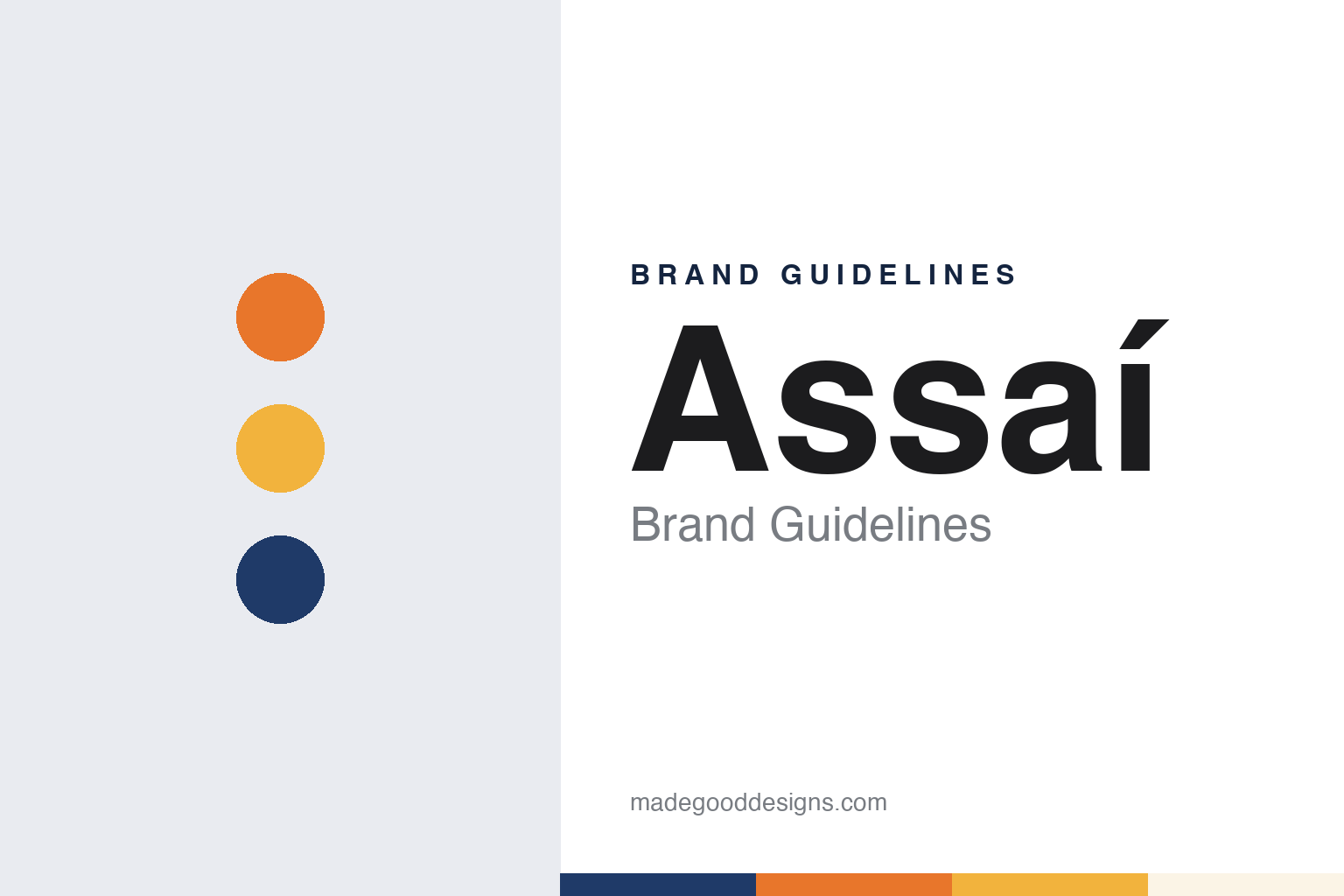
Two constants: a deep blue, sun orange and morning yellow palette and a warm slab serif register. Abstract homage — not an Assaí product or mark; no logo, sign or store fascia is reproduced.
Atacarejo since 1974
A morning sun over a São Paulo warehouse.
Assaí Atacadista is a São Paulo chain of atacarejo stores, the Brazilian word for cash-and-carry warehouses that sell in bulk to small traders and to households alike. Portuguese Wikipedia says the company was founded in October 1974 in São Paulo by Rodolfo Jungi Nagai; English Wikipedia gives the same founder and year. The marketing title Nosso Meio reported in February 2024 that the name comes from the Japanese word asahi, the morning sun, and that the chain’s original store stood in Vila Carrão, on the east side of the city.
The format has deep roots in the city. In April 2024 Mercado & Consumo reported that Assaí had opened a branch on Avenida Morvan Dias de Figueiredo, beside the Marginal Tietê in the north of São Paulo, in a building that the wholesaler Makro had occupied from 1972. The converted building, it said, has about 7,100 square metres of shop floor, 42 checkouts and parking for 500 cars and motorcycles, with a butcher, a bakery, a café and a wine cellar inside.
A consultant quoted by Estadão in July 2009, Alberto Serrentino of the retail consultancy GS&MD, described atacarejo as a Brazilian hybrid: about half the customers are small food businesses such as bakeries and snack bars, and the other half are households; entry is free and no membership card is needed.
From 2007 Assaí belonged to GPA, the group behind the Pão de Açúcar supermarkets. Portuguese Wikipedia says GPA bought 60% of the shares in 2007 and the rest in 2009. From 2011 the business was run by Belmiro Gomes, and it began a programme of expansion and store redesign, with larger sales floors, parking, air conditioning, better lighting and a wider product and service range; 27 new stores opened between 2013 and 2015, Portuguese Wikipedia says.
Colour
A spin-off, a share sale and a wave of conversions.
In March 2021 Assaí was split off from GPA and its shares were listed on B3, the São Paulo stock exchange, Portuguese Wikipedia says; a 75-year history of GPA published by the trade title SuperVarejo also dates the split to 2021. The listed company is formally Sendas Distribuidora S.A., as Bloomberg Línea noted in 2023, while the stores carry the Assaí Atacadista name.
After the split, the French retailer Casino still controlled Assaí. On 17 March 2023 Bloomberg Línea reported that Casino had sold a further block of shares, giving up control and cutting its holding to 11.7%, after an earlier sale in November 2022. Portuguese Wikipedia says Assaí became a corporation in 2023, a company with no single controlling shareholder and all shares traded freely. In June 2026 Brazil Journal listed its main holders as funds managed by Ruane Cunniff, with about 17% combined, the South African investor Orbis with about 11.6%, and the investment vehicle of the Muffato family, which runs a supermarket group from Paraná, with about 11%.
A large change to the store estate came from GPA’s hypermarkets. Portuguese Wikipedia says that in October 2021 Assaí bought 66 Extra Hiper sites, which took it into more central districts of state capitals and large cities, and that it opened 60 stores in 2022. Estadão visited the first converted stores in August 2022, two in São Paulo and one in Palmas, in Tocantins, and reported that the Extra Hiper banner had ceased to exist.
The paper described what the conversions looked like. Where atacarejo stores once stacked goods in their own shipping boxes, the new ones had a cleaner look, with a butcher, a deli counter, a barbecue corner, a bakery and a full wine section. The Anhanguera store in Vila Leopoldina, in the west of São Paulo, covered more than 30,000 square metres of built area, with parking for more than 1,200 vehicles and electric-car chargers installed with GreenYellow, Estadão reported.
Portuguese Wikipedia, revised in August 2026, puts the chain at more than 300 stores in 24 states and the Federal District. Since 2018 the company has sponsored the Campeonato Brasileiro football league, it adds, and in 2024 it marked its fiftieth year with a series of street races.
Typography
Bulk, banners and group ownership.
Brazilian retail brands are read most easily through their store formats. The food format at the centre of this group is the atacarejo, a word that joins atacado, wholesale, and varejo, retail. In 2009 the consultant Alberto Serrentino told Estadão that it is a Brazilian hybrid: about half the shoppers are small food businesses and half are households, entry is open without a membership card, and the range is built on basic branded goods sold in bulk. Chains such as Assaí and Atacadão present themselves through big warehouse stores, large signs and services added inside them, such as butchers, bakeries and wine sections.
Group ownership shapes these brands as much as design does. Banners are bought, converted and spun off: Assaí left GPA in 2021, Carrefour bought Atacadão in 2007, and stores from Extra, Makro and Grupo BIG have been converted to other banners. For the pharmacy, home, stationery and book chains in this set, each guide names the owner, any merger and the dates as published sources give them.
Logos and campaigns are documented unevenly. Some changes are reported in detail by marketing titles, as with Assaí’s redrawn sun of 2024, made with Troiano Branding; for many banners the official colours and typefaces are not published at all, so the palettes in these guides are our own interpretations. Own-label ranges, loyalty programmes and apps appear here only as the companies or the press describe them.
Corporate pages fill in the rest: founders, owners, stock-market listings and delistings, and, for at least one bookseller in this set, judicial recovery, the Brazilian court-supervised restructuring process. These guides state such events plainly, with their dates, and say when a chain closed or changed hands rather than implying that it still trades as before.
Aa
A warm slab serif, after a wordmark whose serifs now carry the name. (Specimen set in Zilla Slab, a serif STAND-IN; NOT the Assaí logo.)
Sol do Amanhã
A sun redrawn for fifty years.
Assaí’s mark is built around a sun. On 19 February 2024 the company presented a redrawn logo it calls the “Sol do Amanhã”, tomorrow’s sun, to mark fifty years since its founding, Nosso Meio reported. The work was done with the brand consultancy Troiano Branding and the agency StarMKT. The sun honours the origin of the name in the Japanese asahi, the magazine said, and the company also cited Harper Lee’s novel To Kill a Mockingbird, published in Brazil as O Sol é para Todos, “the sun is for everyone”.
The changes are specific. The glow that had been drawn as waves became simpler straight bands of warm colour in a gradient, set at the same height as the old waves and recalling the semicircle of the brand’s earliest version. The letters of the name and the alignment of their serifs replaced the rectangular module that had framed the wordmark, Nosso Meio said, so the name could be set larger, softer and with more space between the letters. The new mark appeared on the website, app and social channels from 19 February 2024, after trials at three stores, in São Luís, in Bauru and at the original branch in Vila Carrão.
For a design guide, Assaí shows how one warm, simple symbol can carry a bulk-buying format across hundreds of large stores and a phone screen. Compare Pão de Açúcar, its former sister banner in GPA, and Atacadão, the cash-and-carry chain of Carrefour Brasil. For this guide we use a deep blue, a sun orange and a morning yellow with a slab serif, an unofficial interpretation; no product or logo is reproduced.
Explore & save
Keep Assaí’s identity on hand — save it to a board in the Made Good inspiration library.
Assaí identity set
Pin the Assaí deep blue, sun orange and morning yellow palette and the warm slab serif register to your own board.
Source & notes
Frequently Asked Questions
What font can I use to match the Assaí look?
This guide describes Assaí’s type as “A warm slab serif, after a wordmark whose serifs now carry the name”. Its type specimen is set in Zilla Slab from Google Fonts as a stand-in; Zilla Slab is not Assaí’s own lettering.
What colours are in the Assaí palette?
This guide’s Assaí palette is Deep blue #1F3A68, Ink blue #14243F, Sun orange #E8762B, Morning yellow #F2B33D and Warm paper #FBF4E6. The tones are the guide’s own unofficial interpretation, not official Assaí hex codes.
When was Assaí founded?
Assaí was founded in October 1974, in São Paulo, Brazil.
Who founded Assaí?
Assaí was founded by Rodolfo Jungi Nagai in October 1974.