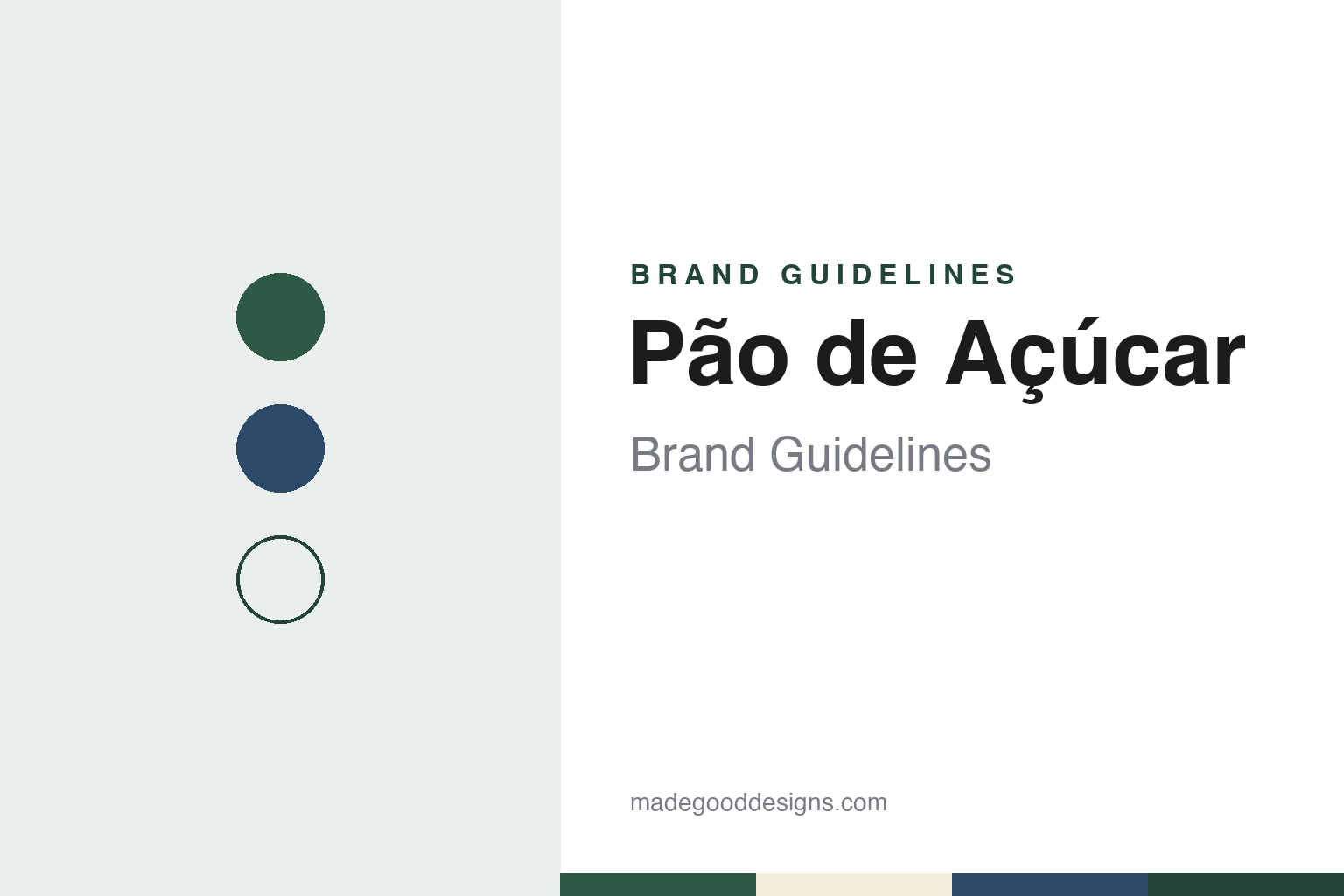
Pão de Açúcar Brand Guidelines
A 1948 pastry shop whose name became a supermarket banner.
Aa
Two constants: a green, bay blue and cream palette and a warm serif register. Abstract homage — not a Pão de Açúcar or GPA asset; no logo, store sign or own-label pack is reproduced.
The Doceira
A pastry shop named for a Rio landmark.
Pão de Açúcar began as a pastry shop. The International Directory of Company Histories, in its entry on the group published on Encyclopedia.com with figures to 2005, says Valentim dos Santos Diniz, a Portuguese immigrant who arrived in Brazil in 1929, opened a pastry shop named Pão de Açúcar in São Paulo in 1948. English Wikipedia says he named it after Rio de Janeiro’s Sugarloaf Mountain, the first view of Brazil he had on arriving by boat. The trade magazine SuperVarejo, in a 2023 history marking the group’s 75 years, calls the business the Doceira Pão de Açúcar and says it supplied sweets and savouries in distinctive packaging for social and corporate events.
The move into groceries came in 1959. The Directory says the shop had added two branches by the end of 1952 and in 1959 acquired another chain and, with it, its first supermarket; SuperVarejo says Valentim opened the first Pão de Açúcar supermarket that year in the Jardim Paulista district, with the help of his son Abilio Diniz, and that the store still trades at the same address. There were 11 stores in 1965, the Directory says, and in 1966 the chain opened its first store outside the city, in Santos. By 1969 it had 55 stores and had opened a São Paulo supermarket that traded around the clock.
The 1970s widened the business. The Directory says a store opened in Lisbon in 1970, and that in 1971 the group launched Jumbo, a hypermarket selling general goods as well as food, and introduced its own private-label products, beginning with a detergent. The Diário do Grande ABC, in a December 2009 history, adds stores in Portugal, Angola and Spain in the early 1970s, the opening of the Jumbo in Santo André in 1971 and the 1976 purchase of the appliance chain Eletroradiobraz. In 1981 the group’s retail chains were merged into Companhia Brasileira de Distribuição, or CBD, which remains the legal name of the company now known as GPA.
Colour
One name across many formats.
Over the following decades the Pão de Açúcar name came to sit on one banner among many. The Diário do Grande ABC lists 1980s formats including the Sandiz department stores, Minibox discount grocers, Superbox warehouse stores and Peg & Faça DIY shops, and says the Extra hypermarkets opened at the end of that decade. After a restructuring in the 1990s the group ran four formats — Pão de Açúcar, Extra, Superbox and Eletro — and in 1997 it listed its shares on the New York Stock Exchange, the paper says. SuperVarejo dates the opening of the first Extra to 1989.
The supermarket banner settled into a clear position. In 2005, according to the Directory, Pão de Açúcar had 185 stores in a neighbourhood-supermarket format aimed at higher-income shoppers with a cosmopolitan lifestyle, while the group as a whole ran five chains and 553 stores in 13 states. The Directory also records that stores in São Paulo’s more prosperous districts carried gourmet lines in their bakery sections, that the group launched Pão de Açúcar Delivery, an online grocery service, in 1995, and that in 1998 it opened Pão de Açúcar Kid’s, an educational supermarket for children, in São Paulo.
Today the name spans several formats. In June 2026 InfoMoney listed the group’s banners as Pão de Açúcar, Minuto Pão de Açúcar and Pão de Açúcar Fresh, alongside Extra and Mini Extra, and named own-label brands sold in its stores including Qualitá, Taeq, Pra Valer and Club des Sommeliers. Portuguese Wikipedia adds the Pão de Açúcar Adega format, branded fuel stations and the delivery service to the family of sub-brands. In October 2026 the trade site Mercado & Consumo reported that 20 stores across four banners — Pão de Açúcar, Extra Mercado, Minuto Pão de Açúcar and Mini Extra — had moved to 24-hour trading, in cities including São Paulo, Campinas, Fortaleza, Recife, Rio de Janeiro and Brasília, with click-and-collect orders available overnight.
That structure is what a designer meets: one name, taken from a Rio landmark, carried by a full-size neighbourhood supermarket, a small convenience format and a range of own-label products, while the parent’s initials, GPA, carry the corporate role.
Typography
Category context.
Brazilian retail brands are read most easily through their store formats. The food format at the centre of this group is the atacarejo, a word that joins atacado, wholesale, and varejo, retail. In 2009 the consultant Alberto Serrentino told Estadão that it is a Brazilian hybrid: about half the shoppers are small food businesses and half are households, entry is open without a membership card, and the range is built on basic branded goods sold in bulk. Chains such as Assaí and Atacadão present themselves through big warehouse stores, large signs and services added inside them, such as butchers, bakeries and wine sections.
Group ownership shapes these brands as much as design does. Banners are bought, converted and spun off: Assaí left GPA in 2021, Carrefour bought Atacadão in 2007, and stores from Extra, Makro and Grupo BIG have been converted to other banners. For the pharmacy, home, stationery and book chains in this set, each guide names the owner, any merger and the dates as published sources give them.
Logos and campaigns are documented unevenly. Some changes are reported in detail by marketing titles, as with Assaí’s redrawn sun of 2024, made with Troiano Branding; for many banners the official colours and typefaces are not published at all, so the palettes in these guides are our own interpretations. Own-label ranges, loyalty programmes and apps appear here only as the companies or the press describe them.
Corporate pages fill in the rest: founders, owners, stock-market listings and delistings, and, for at least one bookseller in this set, judicial recovery, the Brazilian court-supervised restructuring process. These guides state such events plainly, with their dates, and say when a chain closed or changed hands rather than implying that it still trades as before.
Aa
A warm serif for a name that began on a pastry-shop sign. (Specimen set in Fraunces, a serif STAND-IN; NOT the Pão de Açúcar logo.)
Pão de Açúcar
Partners, shareholders and a debt plan.
Ownership changed several times. In 1999 the French retailer Casino bought about 21.3 percent of CBD’s voting capital, the Directory says, while SuperVarejo gives a quarter; in May 2005 Casino raised its stake and took half the common shares of a holding company that partly owned the group, with Casino and Abilio Diniz given equal seats on its boards. In late 2003 the group formed a joint venture with Grupo Sendas in Rio de Janeiro. In 2009 it bought Globex, owner of the Ponto Frio chain, and in December that year announced a merger agreement with Casas Bahia, the Diário do Grande ABC reported. In September 2013 Abilio Diniz stepped down as chairman, English Wikipedia says, citing The Wall Street Journal. In 2021 the group announced the spin-off of its cash-and-carry chain Assaí, SuperVarejo says.
The shareholder base has since spread out. English Wikipedia says Casino cut its stake to 22.5 percent in 2024. In 2025 Brazil’s competition authority, Cade, cleared without restrictions the purchase of a stake in CBD by the Coelho Diniz family, owners of a 22-store supermarket chain in eastern Minas Gerais and not related to the founding family, SuperVarejo reported; the family then held 24.5 percent. By June 2026, InfoMoney reported, the family held 25.1 percent of the ordinary shares, the investment company Bonsucex Holding about 25.8 percent and Casino 20.3 percent, after shareholders removed a clause in the company’s articles that had required a takeover offer above a set holding.
The group has also been through a debt restructuring. On 10 March 2026 GPA filed for recuperação extrajudicial, an out-of-court restructuring agreed with creditors and ratified by a court, Estadão’s E-Investidor reported, adding that the company said the filing covered only non-operating debts and kept wages, supplier contracts and store running costs outside it. The plan was updated on 5 May, ratified by a São Paulo bankruptcy court on 7 October and took effect when the ruling was published on 20 October 2026, g1 reported.
For a design guide, Pão de Açúcar shows how a 1948 pastry shop’s name became a supermarket banner, a convenience format and an own-label family under one parent group. Compare Assaí, the cash-and-carry chain the group spun off, and Carrefour, whose Brazilian business the Directory names as its main rival in the mid-2000s. For this guide we use a deep green, a bay blue and a cane cream with a serif, an unofficial interpretation; no product or logo is reproduced.
Explore & save
Keep Pão de Açúcar’s identity on hand — save it to a board in the Made Good inspiration library.
Pão de Açúcar identity set
Pin the Pão de Açúcar green, bay blue and cream palette and the warm serif register to your own board.
Source & notes
Frequently Asked Questions
What font can I use to match the Pão de Açúcar look?
This guide describes Pão de Açúcar’s type as “A warm serif for a name that began on a pastry-shop sign”. Its type specimen is set in Fraunces from Google Fonts as a stand-in; Fraunces is not Pão de Açúcar’s own lettering.
What colours are in the Pão de Açúcar palette?
This guide’s Pão de Açúcar palette is Sugarloaf green #2E5A45, Bay blue #2D4A68, Cane cream #F3ECDC, Granite grey #6B675F and Paper #FAF8F3. The tones are the guide’s own unofficial interpretation, not official Pão de Açúcar hex codes.
When was Pão de Açúcar founded?
Pão de Açúcar was founded in 1948 (pastry shop); 1959 (supermarket), in São Paulo, Brazil.
Who founded Pão de Açúcar?
Pão de Açúcar was founded by Valentim dos Santos Diniz in 1948 (pastry shop); 1959 (supermarket).