Pague Menos Brand Guidelines
A Fortaleza pharmacy named for paying less.
Aa
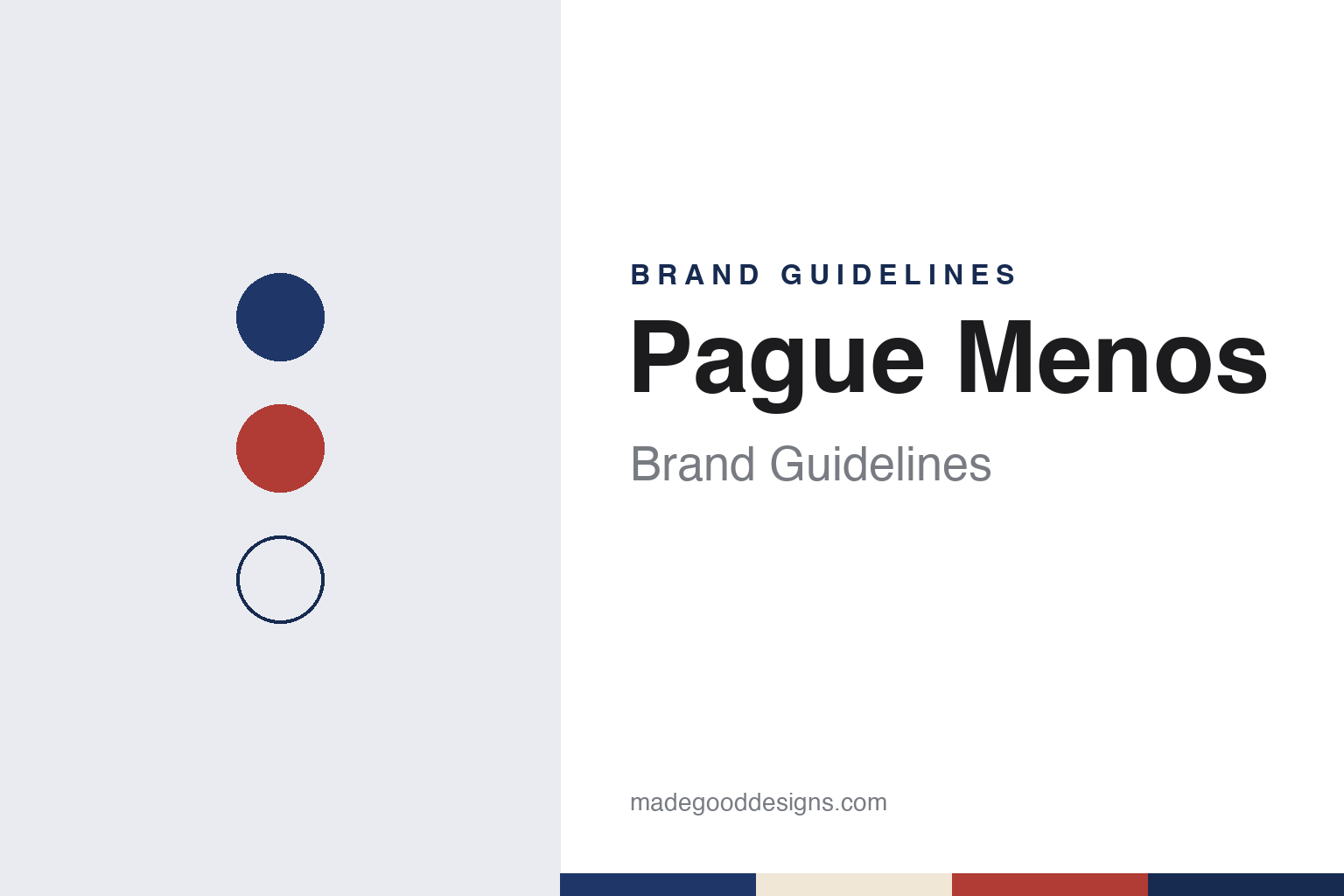
Two constants: an ink blue, brick red and sand palette and a plain grotesque register. Abstract homage — not a Pague Menos asset; no logo, store sign or pack is reproduced.
Pay Less
A Fortaleza pharmacy with a borrowed idea for a name.
Pague Menos — Portuguese for “pay less” — is a pharmacy chain from Fortaleza, the capital of Ceará in north-east Brazil. Its founder, the economist Francisco Deusmar de Queirós, opened the first store in 1981: Portuguese Wikipedia dates the opening to 19 May 1981, and the company’s investor-relations timeline places that store in the Ellery district of Fortaleza. Before going into retail Queirós worked in finance. In a May 2026 interview with the Fortaleza newspaper O Povo he said he had studied economics at the Federal University of Ceará, taught at university, helped set up the Ceará stock exchange in 1976 and then a brokerage, PAX, whose earnings paid for the pharmacy.
The name has a story of its own. Queirós told O Povo that he had seen the Payless ShoeSource shoe chain in the United States and liked its name, and that it paired well with Bom Preço, “good price,” a name already in use in Brazil. He also told the paper that he had not wanted a shop with just a counter, a pharmacist and identical shelves of medicines: from early on the chain let customers pay electricity and telephone bills at its tills and buy convenience goods such as ice cream and chocolate.
The company’s own timeline sets out the next steps. It says it introduced self-service in its stores in 1988, began taking bill payments in 1989, and in 1993 opened a compounding pharmacy and its first store outside Ceará, in Natal, Rio Grande do Norte. Portuguese Wikipedia dates the adoption of a US-style drugstore model, selling hygiene, beauty and convenience goods alongside medicines, to 1985. Queirós told O Povo that the chain opened a store on Alameda Itu in São Paulo on 7 June 2002, the chain’s first step from the north-east into São Paulo.
Colour
Stores, services and a renewed mark.
Pague Menos presents itself less through a single product than through the store format and the services around it. The company says it created its Sempre loyalty card in 2005, put a “Sempre Bem” health-and-beauty programme on Brazilian broadcast television in 2008, and in 2015 introduced Clinic Farma, consulting rooms inside its pharmacies. Queirós told O Povo in 2026 that Clinic Farma gives the pharmacist a separate room in which to see each customer individually. The company also says that in 2006 it launched an online store and AME, a business line for specialist medicines.
The identity was renewed in 2016. The company’s timeline says a new Pague Menos brand was launched that year, the same year the US private-equity firm General Atlantic took a 17 percent stake; Portuguese Wikipedia dates the General Atlantic investment to December 2015. The timeline says the chain passed 1,000 stores in more than 350 municipalities in 2017, and in 2018 opened store number 1,000 in Fortaleza as its flagship, a three-storey building of more than a thousand square metres. Portuguese Wikipedia adds a concept store at Praia de Iracema, on the Fortaleza seafront, opened in 2019; O Povo notes that the site previously housed a restaurant.
Events carry the name beyond the shop. The company runs the Encontro de Mulheres Pague Menos, a women’s gathering that Portuguese Wikipedia dates to 1997, and a circuit of street races begun in 2010 and held in several cities. He also pointed to a technology arm, PmenosLab, which the paper describes as linking architecture, data engineering and artificial intelligence.
For a designer, the name works by being literal: two plain Portuguese words that say what the shop promises, carried on store fronts from Ceará to São Paulo.
Typography
Category context.
Brazilian retail brands are read most easily through their store formats. The food format at the centre of this group is the atacarejo, a word that joins atacado, wholesale, and varejo, retail. In 2009 the consultant Alberto Serrentino told Estadão that it is a Brazilian hybrid: about half the shoppers are small food businesses and half are households, entry is open without a membership card, and the range is built on basic branded goods sold in bulk. Chains such as Assaí and Atacadão present themselves through big warehouse stores, large signs and services added inside them, such as butchers, bakeries and wine sections.
Group ownership shapes these brands as much as design does. Banners are bought, converted and spun off: Assaí left GPA in 2021, Carrefour bought Atacadão in 2007, and stores from Extra, Makro and Grupo BIG have been converted to other banners. For the pharmacy, home, stationery and book chains in this set, each guide names the owner, any merger and the dates as published sources give them.
Logos and campaigns are documented unevenly. Some changes are reported in detail by marketing titles, as with Assaí’s redrawn sun of 2024, made with Troiano Branding; for many banners the official colours and typefaces are not published at all, so the palettes in these guides are our own interpretations. Own-label ranges, loyalty programmes and apps appear here only as the companies or the press describe them.
Corporate pages fill in the rest: founders, owners, stock-market listings and delistings, and, for at least one bookseller in this set, judicial recovery, the Brazilian court-supervised restructuring process. These guides state such events plainly, with their dates, and say when a chain closed or changed hands rather than implying that it still trades as before.
Aa
A plain grotesque for a name made of two everyday words. (Specimen set in Archivo, a sans STAND-IN; NOT the Pague Menos logo.)
Pague Menos
A listing, an acquisition and new management.
The company opened to outside capital in stages. Portuguese Wikipedia says it registered as a public company with Brazil’s securities regulator, the CVM, in 2011, and that merger talks with Ultrafarma in 2011 and 2012 did not go ahead. The company’s timeline says it listed its shares on the B3 exchange in São Paulo in September 2020, in the Novo Mercado segment. Pague Menos then bought Extrafarma, a pharmacy chain of more than 400 stores in ten states, which Portuguese Wikipedia says had belonged to the Ultrapar group; InfoMoney reported on 10 August 2022 that the purchase had been completed a little over a week earlier, and that the company was focusing on the North and North-east of Brazil.
Management has since passed from the founding family to an outside executive. InfoMoney reported in December 2023 that the board had chosen Jonas Marques, an executive from the pharmaceutical industry, to succeed the founder’s son Mário Queirós as chief executive after eight years in the post, with a transition beginning on 4 January 2024 and Mário Queirós moving to the board. The founder’s daughter Patriciana Rodrigues chairs the board, according to O Povo. In that May 2026 interview, the founder said the chain had about 1,700 stores, a presence in all 26 states and the Federal District, and 27,000 employees; those are his figures.
For a design guide, Pague Menos shows how a regional pharmacy can build a national brand on a literal name, a service-led store and a loyalty scheme. Compare Droga Raia and Drogasil, two other Brazilian pharmacy banners. For this guide we use an ink blue, a brick red and a warm sand with a sans, an unofficial interpretation; no product or logo is reproduced.
Explore & save
Keep Pague Menos’s identity on hand — save it to a board in the Made Good inspiration library.
Pague Menos identity set
Pin the Pague Menos ink blue, brick red and sand palette and the plain grotesque register to your own board.
Source & notes
Frequently Asked Questions
What font can I use to match the Pague Menos look?
This guide describes Pague Menos’ type as “A plain grotesque for a name made of two everyday words”. Its type specimen is set in Archivo from Google Fonts as a stand-in; Archivo is not Pague Menos’ own lettering.
What colours are in the Pague Menos palette?
This guide’s Pague Menos palette is Ink blue #1F3768, Brick red #B03C35, Warm sand #F0E7D7, Slate #525B68 and Paper #F9F8F5. The tones are the guide’s own unofficial interpretation, not official Pague Menos hex codes.
When was Pague Menos founded?
Pague Menos was founded in 1981, in Fortaleza, Ceará, Brazil.
Who founded Pague Menos?
Pague Menos was founded by Francisco Deusmar de Queirós in 1981.