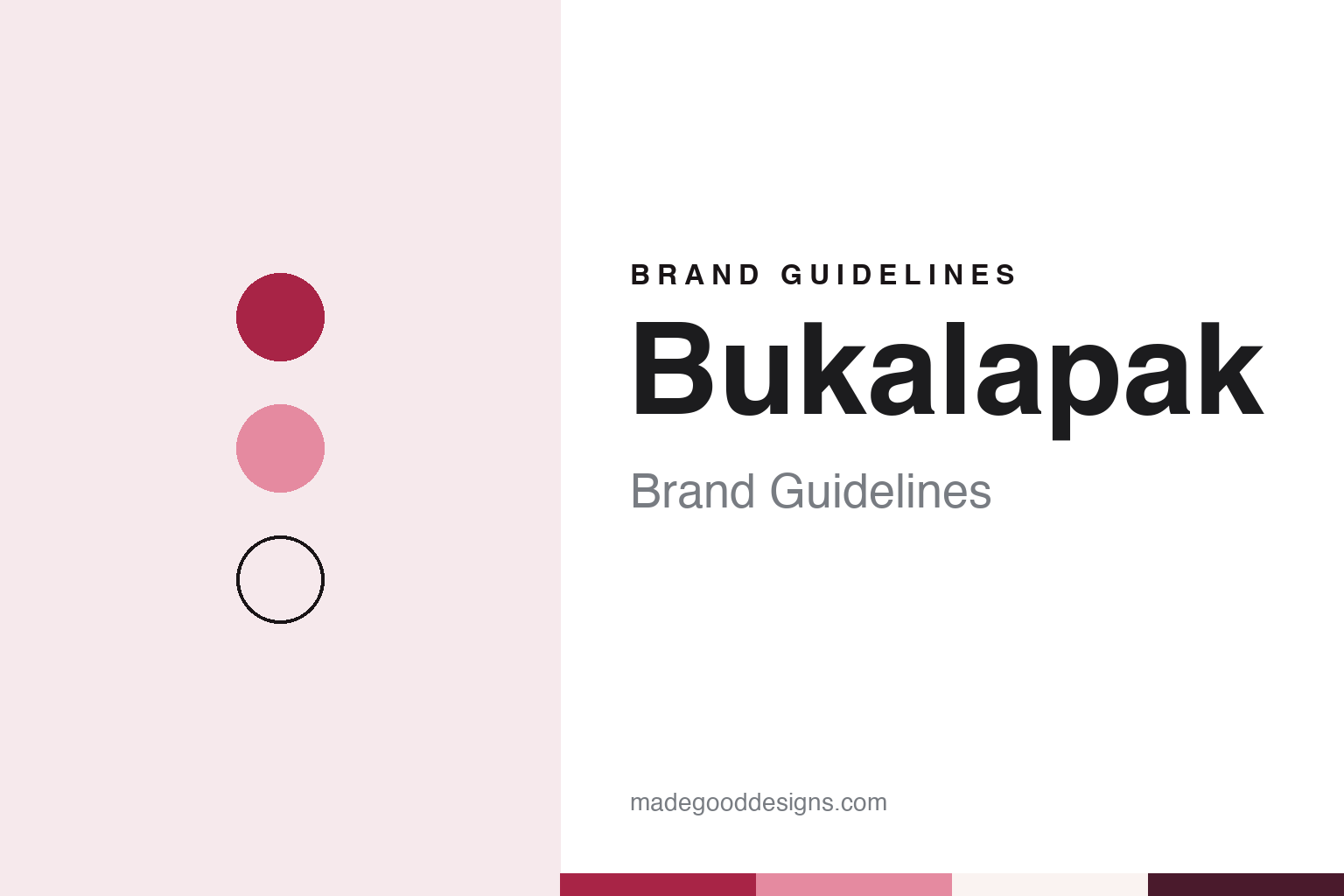
Bukalapak Brand Guidelines
A 2010 market stall that moved from physical goods to virtual products.
Aa
Two constants: a crimson, rose and warm paper palette and an open geometric sans register. Abstract homage — not a Bukalapak asset; no logo, app screen or product is reproduced.
Open a market stall
A boarding house near ITB in Bandung.
Bukalapak was founded on 10 January 2010 by Achmad Zaky, Nugroho Herucahyono and Fajrin Rasyid, in a boarding house where they lived as students of the Bandung Institute of Technology, Liputan6 reported in August 2021, citing the company’s own website. English Wikipedia tells it slightly differently: Zaky co-founded the business with his friend Herucahyono after graduating from the institute, and Rasyid joined the pair to manage its finances. The name means “open a market stall” in Indonesian, and the sellers who trade on the platform came to be called pelapak, stallholders.
In its early years, English and Indonesian Wikipedia say, the site caught on among cyclists during the craze for folding and fixed-gear bikes, and for a time it was known as a marketplace for bicycles and cycling accessories, which helped build its user base. By 2013 it worked with more than 80,000 sellers, English Wikipedia says. The Indonesian media group Emtek became a shareholder in 2014 and by July 2020 was a major shareholder, according to the same source.
The bigger turn came in 2017, when Bukalapak launched Mitra Bukalapak for warungs, the small family-run shops found across Indonesia, Liputan6 reported. Through it, a warung could offer extra online services such as bill payments and phone-credit top-ups, and order stock from distributors of everyday goods, which the paper described as a way of shortening the distribution chain for small shops. English Wikipedia describes the business that followed as “all-commerce”: the marketplace alongside online-to-offline services, business-to-business supply, financial products and logistics, including the BukaSend service from 2019, which lets partners act as shipping agents through the app, and BukaGudang fulfilment from 2020. Its financial side, the same source says, included the BMoney share-trading app and Bukatabungan, a digital banking app made with Standard Chartered.
Colour
The 2021 listing and a change of leaders.
The founders stepped back one by one. Zaky announced in December 2019 that he would leave, and in January 2020 handed the chief executive role to Rachmat Kaimuddin, English Wikipedia says; Herucahyono resigned as chief technology officer, and Rasyid departed in June 2020. English Wikipedia credits Kaimuddin with recruiting large venture investors and with taking the company to its stock-market listing. Indonesian Wikipedia links the founders’ exit to a change in the company’s strategy, and in February 2020 it records a partnership with Bank Mandiri on branchless banking and QRIS payments.
Bukalapak then went public. Its shares were offered to the public from 27 to 30 July 2021 and began trading on the Indonesia Stock Exchange on 6 August 2021 under the code BUKA, as the 28th company to list there that year, Liputan6 reported on the day. The listed company is PT Bukalapak.com Tbk. By then, Liputan6 reported, Bukalapak served more than 6.5 million pelapak, 8 million Mitra Bukalapak partners and 100 million users. At the time, the paper said, it had three subsidiaries named in its offering: Buka Mitra Indonesia, a business-to-business platform for physical, virtual, financial and logistics products; Buka Investasi Bersama, a financial-technology company set up in June 2019; and Buka Pengadaan Indonesia, a digital procurement partner for companies and small businesses.
Kaimuddin left at the end of that year. Bukalapak told the stock exchange that it had received his resignation letter on 28 December 2021 and named Willix Halim, who had joined as chief operating officer in 2016, acting president director, Katadata’s D-insights reported on 30 December 2021. Halim later took the chief executive role, English Wikipedia says.
Typography
How the region’s platforms and retailers present themselves.
Southeast Asia’s e-commerce platforms present themselves first through their apps. The home screen of a marketplace carries its name, a run of category icons, banners for the current sale and links to payments, top-ups and delivery services, and that screen does much of the work a shop front once did. Tokopedia, which English Wikipedia says took its name from the Indonesian word for “shop” and the word “encyclopedia,” and Bukalapak, whose name means “open a market stall,” both chose plain Indonesian words that describe what the service does.
Shopping-festival dates and partner programmes carry much of the identity beyond the app. Date-named sales, celebrity brand ambassadors and seasonal campaigns appear on the platforms’ own pages and in the local press; Indonesian Wikipedia records Tokopedia’s ambassadors from 2014 onwards. Programmes for small shops, such as Mitra Tokopedia and Mitra Bukalapak for family-run warungs, take the platform name off the screen and onto counters, signs and receipts.
For Vietnam’s retailers — phone and electronics chains, grocery chains and supermarket groups — the store fascia is a public face alongside the app and the website, and the companies’ corporate pages set out their store formats, sister banners and owners. Store counts and formats in this guide are given only as a dated source reports them.
Corporate pages and the press also carry the ownership story, which in this region often changes the brand itself. Tokopedia merged with Gojek into GoTo in May 2021, TechCrunch reported, and in 2024 it took in TikTok Shop’s Indonesian business, while Bukalapak listed in Jakarta in August 2021 and ended its physical-goods marketplace in early 2025. This guide sets out what can be checked about each company — founders, owners, listings and mergers — and says plainly when a fact rests only on the company’s own word.
Aa
An open geometric sans for a plain-spoken name. (Specimen set in Plus Jakarta Sans, a sans STAND-IN; NOT the Bukalapak logo.)
Bukalapak
From physical goods to virtual products.
In January 2025 Bukalapak changed what it sells. The company wrote on its official blog on 7 January that it would “transform” to focus on virtual products and stop selling physical products on the Bukalapak marketplace, The Jakarta Post reported the next day. Physical items such as home accessories, fashion and electronics stayed on sale only until 9 February 2025, while virtual products, including electricity bills, tax payments and digital gold vouchers, remained available.
Indonesian Wikipedia says the transition was completed on 7 March 2025, and lists phone credit, data packages and electricity tokens among the products Bukalapak kept; English Wikipedia adds vouchers, game credits and financial services. Indonesian Wikipedia also lists Mitra Bukalapak, the warung programme, among the divisions the company concentrated on in 2025.
The name has outlived the model it was coined for. A brand that once invited anyone to open a stall and sell bicycles now fronts a business of digital top-ups, payments and warung services, while the listed company keeps the original web address in its legal name, PT Bukalapak.com Tbk.
For a design guide, Bukalapak shows how a literal, everyday name can stay in place after the business behind it changes shape. Compare Tokopedia, the Jakarta marketplace launched a year earlier, and Shopee, another Southeast Asian marketplace. For this guide we use a stall crimson and a rose with warm paper and an open sans, an unofficial interpretation; no product or logo is reproduced.
Explore & save
Keep Bukalapak’s identity on hand — save it to a board in the Made Good inspiration library.
Bukalapak identity set
Pin the Bukalapak crimson, rose and warm paper palette and the open geometric sans register to your own board.
Source & notes
Frequently Asked Questions
What font can I use to match the Bukalapak look?
This guide describes Bukalapak’s type as “An open geometric sans for a plain-spoken name”. Its type specimen is set in Plus Jakarta Sans from Google Fonts as a stand-in; Plus Jakarta Sans is not Bukalapak’s own lettering.
What colours are in the Bukalapak palette?
This guide’s Bukalapak palette is Stall crimson #A82446, Rose #E58AA0, Plum #4A1A2C, Warm paper #FAF3F1 and Ink #191416. The tones are the guide’s own unofficial interpretation, not official Bukalapak hex codes.
When was Bukalapak founded?
Bukalapak was founded in 10 January 2010, in Bandung, Indonesia.
Who founded Bukalapak?
Bukalapak was founded by Achmad Zaky, Nugroho Herucahyono and Fajrin Rasyid on 10 January 2010.