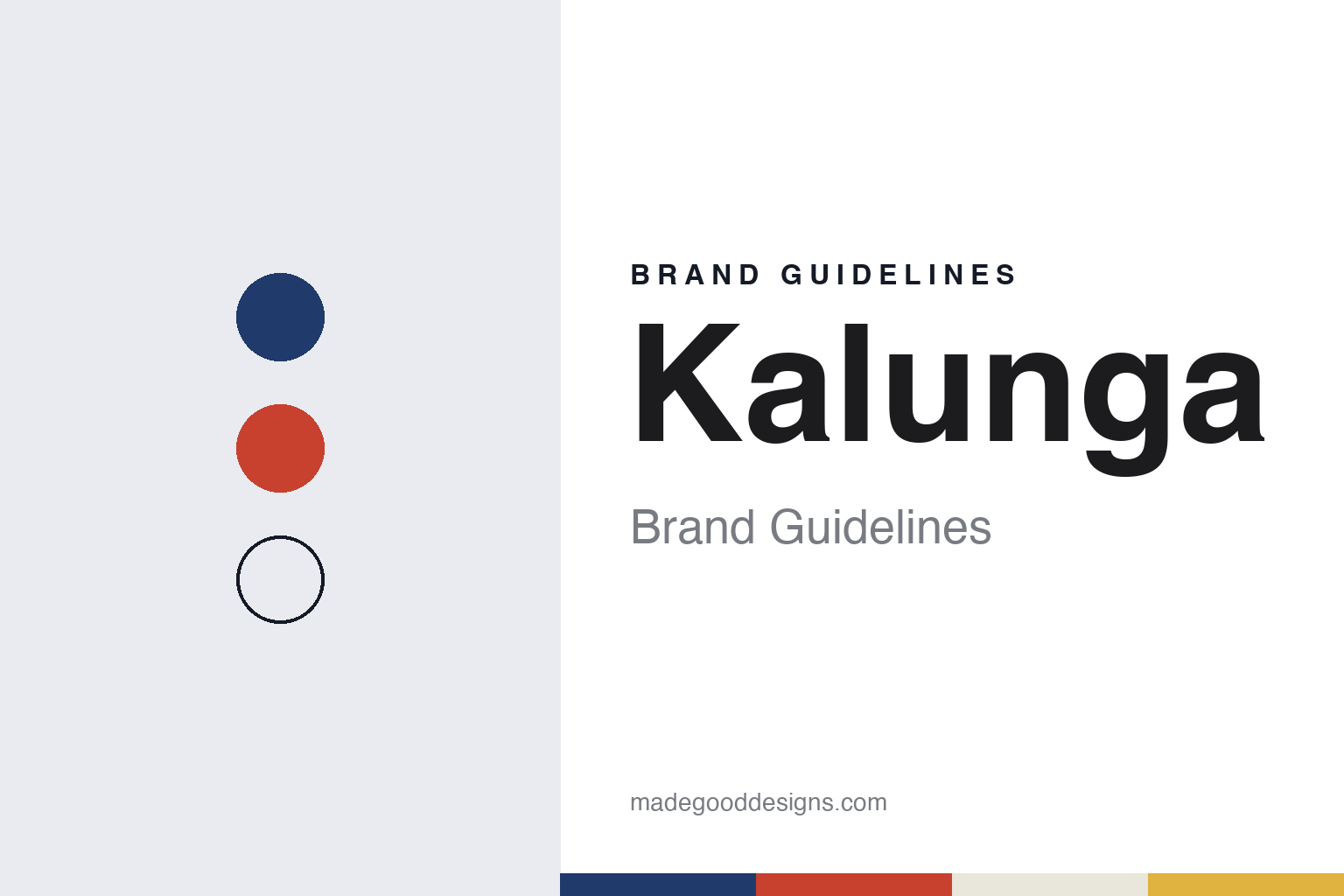
Kalunga Brand Guidelines
A 1972 Vila Mariana stationer that grew into a national chain.
Aa
Two constants: an ink blue, notebook red and ruled-paper palette and a sturdy sans register. Abstract homage — not a Kalunga product or mark; no notebook, logo or shopfront is reproduced.
A neighbourhood stationer
Vila Mariana, 1972.
Kalunga began as a small stationery shop in the Vila Mariana district of São Paulo in 1972. Portuguese Wikipedia dates the opening to May 1972 and names the founder as Damião Garcia, a former travelling salesman with a background in the printing trade who had recently moved to the city from Bauru, in the interior of São Paulo state, with his family. O Estado de S. Paulo gave the same founder and the same first shop in Vila Mariana, in the city’s south zone, in September 2022, when the company reached 50 years; it added that the business expanded strongly in later years, once it was in the hands of Garcia’s sons.
The name, according to Portuguese Wikipedia, comes from “calunga,” a word in a Bantu language that the encyclopaedia translates as “everything good.”
The business changed shape more than once. Folha de S.Paulo wrote in April 2025 that Kalunga was founded as a neighbourhood shop, became a wholesaler in the following decade, supplying small stationers and offices, and turned back to retail in the 1990s, when it began selling computer products. Gazeta do Povo had described the same origin in April 2018, as a small wholesale shop in São Paulo, and noted that for many years the chain stayed within São Paulo state and the city of Rio de Janeiro. From the 2000s, the newspaper said, it moved into cities such as Curitiba, Recife and Salvador, and into smaller cities with populations from about 200,000, often opening in shopping centres.
Colour
Paper, computers and a print counter.
Kalunga sells across three areas: stationery, office supplies and computer products. In 2018 Gazeta do Povo counted more than 11,000 items, sold both to individual shoppers buying a few things and to offices and traders buying in quantity. Portuguese Wikipedia says the online shop lists more than 12,000 items, across computing, stationery, office materials and media.
Part of the range is its own. Notebooks, diaries and ring binders under the Spiral name are made within the group, Gazeta do Povo reported; Portuguese Wikipedia names the maker as the subsidiary Spiral do Brasil. The factory had belonged to the controlling shareholders personally until they sold it to the retailer: Valor Investe reported the sale in January 2021, and in September 2022 Estadão said the deal had been concluded, after investors had raised it as a potential conflict of interest while the company prepared a share listing in 2020. Kalunga completed the regulatory steps for that listing but did not go ahead with it, the newspaper said.
The stores add services to the shelves. In 2018 Gazeta do Povo described Copy & Print, a small quick-print shop inside Kalunga stores where customers can print or order banners, cards, invitations and other printed material; at that time three stores had one, two in São Paulo and one in Rio de Janeiro. Online selling began in 2001, according to Folha, and customers can buy online and collect from a store through a service called Click e Retire. Portuguese Wikipedia also describes a monthly Revista Kalunga, a catalogue magazine that lists the products alongside editorial features on suppliers, education and culture.
Typography
Design and documentation.
Brazilian retail brands are read most easily through their store formats. The food format at the centre of this group is the atacarejo, a word that joins atacado, wholesale, and varejo, retail. In 2009 the consultant Alberto Serrentino told Estadão that it is a Brazilian hybrid: about half the shoppers are small food businesses and half are households, entry is open without a membership card, and the range is built on basic branded goods sold in bulk. Chains such as Assaí and Atacadão present themselves through big warehouse stores, large signs and services added inside them, such as butchers, bakeries and wine sections.
Group ownership shapes these brands as much as design does. Banners are bought, converted and spun off: Assaí left GPA in 2021, Carrefour bought Atacadão in 2007, and stores from Extra, Makro and Grupo BIG have been converted to other banners. For the pharmacy, home, stationery and book chains in this set, each guide names the owner, any merger and the dates as published sources give them.
Logos and campaigns are documented unevenly. Some changes are reported in detail by marketing titles, as with Assaí’s redrawn sun of 2024, made with Troiano Branding; for many banners the official colours and typefaces are not published at all, so the palettes in these guides are our own interpretations. Own-label ranges, loyalty programmes and apps appear here only as the companies or the press describe them.
Corporate pages fill in the rest: founders, owners, stock-market listings and delistings, and, for at least one bookseller in this set, judicial recovery, the Brazilian court-supervised restructuring process. These guides state such events plainly, with their dates, and say when a chain closed or changed hands rather than implying that it still trades as before.
Aa
A sturdy sans for shelf labels and store signs. (Specimen set in Barlow, a sans STAND-IN; NOT the Kalunga logo.)
Kalunga
A shirt sponsor and a national chain.
The name travelled well beyond São Paulo through football. Estadão wrote in 2022 that the brand was already known nationally, even before the chain left the state capital, because of its years as a sponsor of Corinthians. Portuguese Wikipedia dates the shirt sponsorship from January 1985 to December 1994 and calls it the longest in the club’s history. In 2018, the encyclopaedia adds, Kalunga became the main sponsor of the esports team Red Canids.
The chain grew to a national size. Estadão counted about 220 stores in September 2022; in April 2025 Folha put the figure at 223 physical stores, 50 of them in the city of São Paulo. The company is family-controlled: in September 2022 Estadão described two of the founder’s sons, the Garcia brothers, as its partners. As of that report, the share listing prepared in 2020 had not taken place, and the company had slowed its store openings: in 2020 the closure of shops, offices and schools had cut demand for stationery, and the focus had moved to the margins of existing stores, the newspaper said.
Behind the stores sits a distribution network. In 2018 Gazeta do Povo reported three rented distribution centres in Barueri, in Greater São Paulo, and a plot bought for a centre of the company’s own. Portuguese Wikipedia describes a distribution centre beside the Rodovia Castelo Branco, about 30 kilometres from central São Paulo, covering more than 30,000 square metres and serving both the stores and deliveries to customers.
For a design guide, Kalunga shows how a stationery chain can carry one name across shop counters, its own notebooks, a print service and a catalogue magazine. Compare Tok&Stok, another São Paulo retailer founded in the 1970s, and Saraiva, a São Paulo bookseller. For this guide we use an ink blue, a notebook red and a ruled-paper white with a sturdy sans, an unofficial interpretation; no product or logo is reproduced.
Explore & save
Keep Kalunga’s identity on hand — save it to a board in the Made Good inspiration library.
Kalunga identity set
Pin the Kalunga ink blue, notebook red and ruled-paper palette and the sturdy sans register to your own board.