Saraiva Brand Guidelines
The São Paulo bookseller of 1914 and its 2023 bankruptcy.
Aa
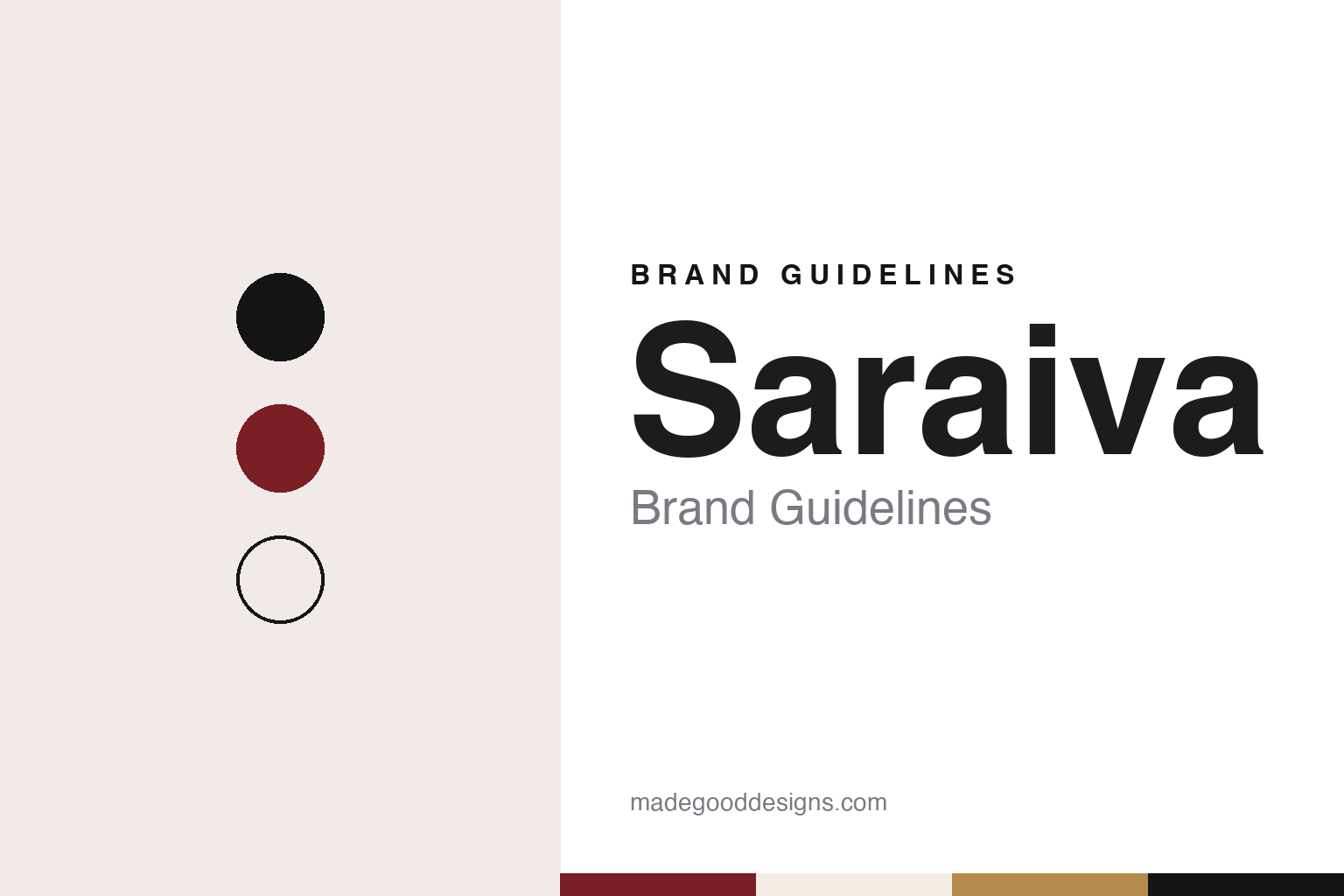
Two constants: a Saraiva bookbinding red and cream palette and a Bookish serif register. Abstract homage — not a Saraiva product or mark; no shopfront, logo or sign is reproduced.
Livraria Acadêmica
A law-book shop beside the São Paulo law school.
Saraiva began as a single bookshop in the centre of São Paulo. Portuguese Wikipedia dates its founding to 13 December 1914 and names its founder as Joaquim Inácio da Fonseca Saraiva, an immigrant from Trás-os-Montes in northern Portugal. The first shop stood on the Largo do Ouvidor, close to the São Paulo Faculty of Law, and traded as Livraria Acadêmica. Because of that neighbour, Portuguese Wikipedia says, it came to specialise in legal titles, law books for the faculty next door.
The business changed its legal form in 1947, when it became a corporation named Saraiva S.A. – Livreiros Editores, “booksellers and publishers.” In 1972 it became a publicly listed company. A second shop opened on the Praça da Sé, the city’s cathedral square, in the 1970s; Portuguese Wikipedia notes that it lasted until the very end of the chain. In the 1980s the company moved into book distribution, and from 1983 it began to open shops across the country, mostly in shopping centres.
Those mall shops grew into larger formats. The company’s Saraiva Mega Store shops, Portuguese Wikipedia says, sold Brazilian and imported books alongside music and films, electronics, games and stationery, turning the bookshop into a broad entertainment store. In 1998 Saraiva opened its own online shop, giving the old law-book seller a national reach beyond its physical branches.
Colour
Siciliano, the megastores and the sale of the publisher.
The chain grew sharply through a purchase. On 6 March 2008 Saraiva bought all the shares of the rival bookseller Livraria Siciliano, Portuguese Wikipedia says, adding 63 Siciliano shops in fourteen Brazilian states to its own 36. The two businesses later appeared together as Saraiva e Siciliano S/A in the company’s court filings.
For most of its history Saraiva was both a bookseller and a publisher, and the second half of that business went first. On 18 June 2015 Brazil Journal reported that Saraiva had sold its publishing house and its school-teaching systems to Abril Educação, an education group controlled by the investment firm Tarpon. The buyer took over the imprints Saraiva, Atual, Formato and Benvirá, among others, and the paper described what remained as a pure retailer, owner of a chain of 112 bookshops. The publishing imprints were therefore no longer part of the retail company after 2015, even though they kept the Saraiva name.
The buyer renamed itself. In February 2016 PublishNews reported that the merger of the Saraiva imprints into what was by then called Somos Educação was close to complete, with the Saraiva education teams moving into the Somos offices that month. From that point the bookshop chain and the publishing imprints were separate businesses under separate owners, and this guide concerns the bookshop chain.
Typography
Brazilian retail identity.
Brazilian retail brands are read most easily through their store formats. The food format at the centre of this group is the atacarejo, a word that joins atacado, wholesale, and varejo, retail. In 2009 the consultant Alberto Serrentino told Estadão that it is a Brazilian hybrid: about half the shoppers are small food businesses and half are households, entry is open without a membership card, and the range is built on basic branded goods sold in bulk. Chains such as Assaí and Atacadão present themselves through big warehouse stores, large signs and services added inside them, such as butchers, bakeries and wine sections.
Group ownership shapes these brands as much as design does. Banners are bought, converted and spun off: Assaí left GPA in 2021, Carrefour bought Atacadão in 2007, and stores from Extra, Makro and Grupo BIG have been converted to other banners. For the pharmacy, home, stationery and book chains in this set, each guide names the owner, any merger and the dates as published sources give them.
Logos and campaigns are documented unevenly. Some changes are reported in detail by marketing titles, as with Assaí’s redrawn sun of 2024, made with Troiano Branding; for many banners the official colours and typefaces are not published at all, so the palettes in these guides are our own interpretations. Own-label ranges, loyalty programmes and apps appear here only as the companies or the press describe them.
Corporate pages fill in the rest: founders, owners, stock-market listings and delistings, and, for at least one bookseller in this set, judicial recovery, the Brazilian court-supervised restructuring process. These guides state such events plainly, with their dates, and say when a chain closed or changed hands rather than implying that it still trades as before.
Aa
A bookish serif for a bookseller’s register. (Specimen set in Fraunces, a serif STAND-IN; NOT the Saraiva logo.)
Saraiva
Judicial recovery, closure and bankruptcy.
The retail chain did not survive. Saraiva filed for judicial recovery, Brazil’s court-supervised restructuring, on 23 November 2018, PublishNews reported, citing a weak economy and a worldwide fall in sales at physical bookshops. Portuguese Wikipedia says the request was granted on 26 November 2018, after the company had closed 19 shops that October and kept 85, and that creditors approved the recovery plan on 29 August 2019. Creditors approved an amendment to the plan in February 2021 and the court followed in March, Tecnoblog reported in August 2021, adding that three attempts that year to sell either a group of shops or the online business had drawn no bidders. The first, in April 2021, offered a block of 23 physical shops or the online operation, or both together; the second, in May, and the third, in August, repeated the offer on revised terms. In 2020, Portuguese Wikipedia says, the chain had also lost court cases brought by publishers who wanted back the books they had placed on consignment in shops that were closing, and in 2022 part of its creditors agreed to convert debt into shares.
The shop count kept falling. Portuguese Wikipedia says Saraiva closed 36 shops between March and November 2020, leaving 39, and that it had 34 in 2022, against 113 at the start of 2017. In September 2023 the company closed its last shops; on 4 October 2023 it asked the court to declare it bankrupt, and on 6 October 2023 the São Paulo bankruptcy court did so, PublishNews reported. The judge found that the company had not been meeting its recovery plan; the remaining assets were to be auctioned to pay creditors, with workers’ claims first, and the shares stopped trading. The court kept the firm RV3 Consultores as judicial administrator, with the task of valuing what was left; lawsuits and enforcement actions against the company were suspended, and it was given 30 days to present a list of its creditors. In February 2025, Portuguese Wikipedia says, the chain’s web address was put up for auction after its registration lapsed. Saraiva no longer trades as a bookshop chain.
For a design guide, Saraiva shows a hundred-year-old Brazilian bookseller whose identity outlived its shops only as a name. Compare it with Kalunga, a Brazilian stationery retailer, and with Dafiti, a São Paulo online fashion retailer. For this guide we use a bookbinding red, cream and gilt with a serif, an unofficial interpretation; no product or logo is reproduced.
Explore & save
Keep Saraiva’s identity on hand — save it to a board in the Made Good inspiration library.
Saraiva identity set
Pin the Saraiva bookbinding red and cream palette and the Bookish serif register to your own board.