Atacadão Brand Guidelines
A 1962 Maringá wholesaler, Carrefour in 2007 and Grupo BIG.
Aa
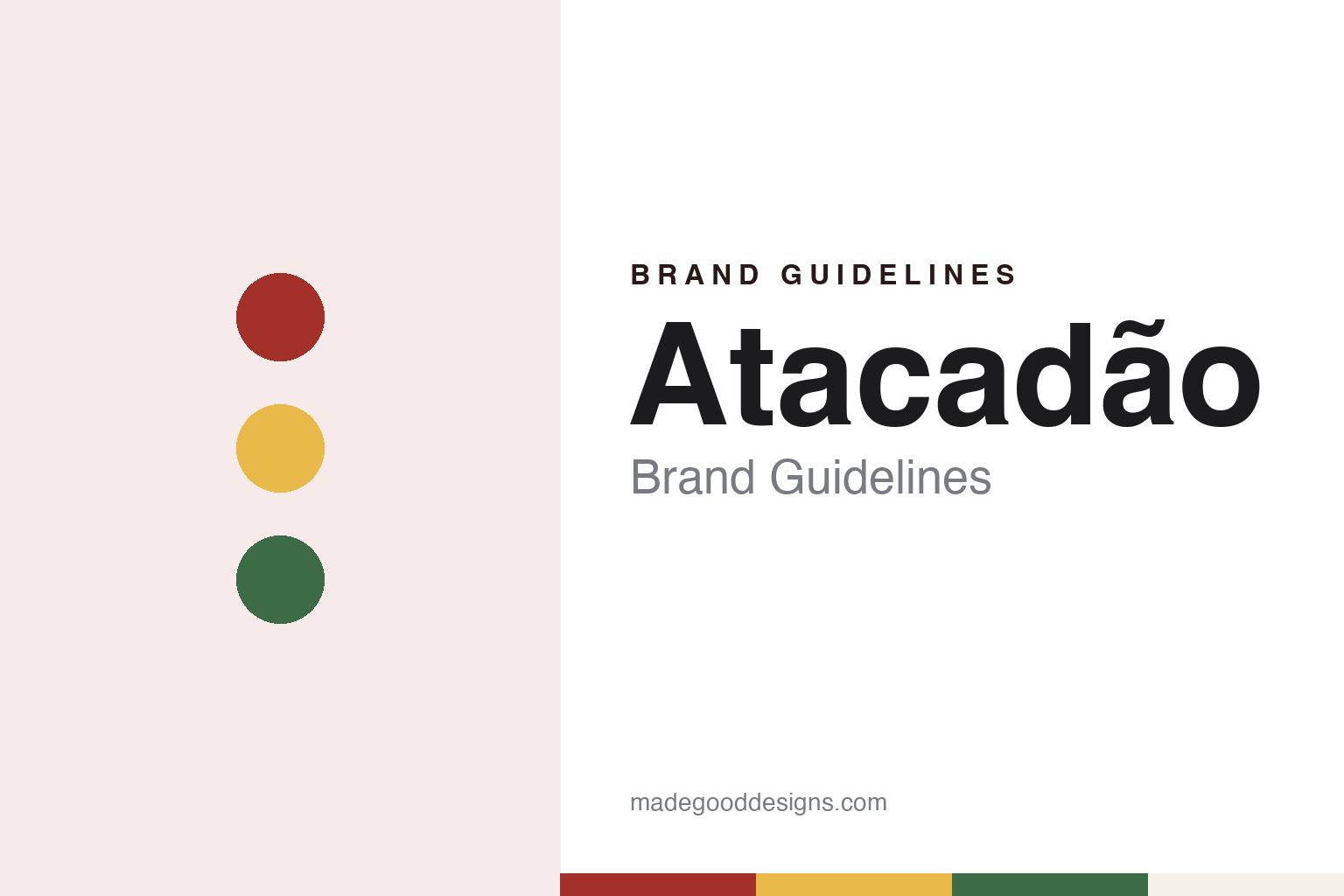
Two constants: a brick red, grain yellow and leaf green palette and a wide grotesque sans register. Abstract homage — not an Atacadão product or mark; no logo, sign or store fascia is reproduced.
Maringá, 1962
A Paraná wholesaler that went national.
Atacadão began in Maringá, a city in the southern state of Paraná. English and Portuguese Wikipedia both say it was founded in 1962 by Alcides Parizotto, who led the business until 1991; the company marks its anniversary on 12 April. After Parizotto left, the chain passed to the Lima family and two executives, Farid Curi and Herberto Uli Schmeil, Portuguese Wikipedia says. Today it is a banner of Grupo Carrefour Brasil, the Brazilian arm of the French retailer Carrefour.
The business mixes two formats, Portuguese Wikipedia says: self-service cash-and-carry stores open both to households and to small and mid-sized traders, and delivery wholesale for larger businesses and shopkeepers. Some sites add services under the names Atacadão Posto and Atacadão Drogaria. As of the end of March 2025, it counted 380 cash-and-carry stores and 34 wholesale units across every state and the Federal District, according to Portuguese Wikipedia, with bakery, butcher and sliced-goods counters in more than 170 stores.
In July 2009 Estadão quoted the retail consultant Alberto Serrentino, who described the Brazilian atacarejo as a hybrid of wholesale and retail: about half the customers are small food businesses such as bakeries and snack bars, the other half households on modest incomes, entry is open with no membership, and each store stocks some 6,000 to 7,000 lines of basic branded goods. He credited Pão de Açúcar with coining the word atacarejo itself.
Carrefour bought Atacadão in April 2007. Estadão reported on 23 April 2007 that the French group was taking over a chain of 34 stores. The news site g1 gave the same count of 34 stores the day before. By July 2009 the chain had 59 stores in 15 states, and the team that had run it before the sale had been kept on, Estadão reported.
Colour
Makro, Grupo BIG and a delisting.
Growth since then has come from new stores and from rivals’ sites. In 2020 Carrefour bought Makro stores in Brazil, 30 according to English Wikipedia and 29 according to Portuguese Wikipedia, together with 14 fuel stations, to take Atacadão further into Rio de Janeiro and the Northeast; the stores were converted to the Atacadão format.
A larger step came with Grupo BIG, the former Walmart Brasil. On 30 June 2023 Carrefour Brasil told the CVM, Brazil’s securities regulator, that it had finished converting 129 former BIG stores, a year after the acquisition and six months ahead of its original timetable, Mercado & Consumo reported. Of those, 76 became Atacadão: 46 from the Maxxi wholesale banner, 27 BIG hypermarkets, two TodoDia stores and one Sam’s Club. The rest became Carrefour hypermarkets or Sam’s Club stores.
Ownership was simplified in 2025. Carrefour S.A., which already owned about 67% of the Brazilian company, signed an agreement on 12 February 2025 to take the remaining shares and make it a wholly owned subsidiary, Capital Aberto reported in April 2025; the vote of minority shareholders was moved from 7 April to 25 April. Banco do Brasil’s investment news site reported that shareholders approved the plan at an extraordinary meeting at the end of April, and that the shares traded on B3 for the last time on 30 May 2025. The stores kept trading under the Carrefour and Atacadão banners.
The Atacadão model has also travelled. In July 2009 Estadão reported Carrefour’s plan to take it to Colombia; English Wikipedia says the stores there were renamed Carrefour Maxi and then Maxi, and that Carrefour’s Colombian assets were sold to the Chilean group Cencosud in October 2012. Portuguese Wikipedia lists the format in Morocco, Argentina, Romania, Tunisia, Egypt and Spain, in some countries under other Carrefour banners, and English Wikipedia says Atacadão Maroc is run by the Moroccan group LabelVie.
France got its only Atacadão on 20 June 2024, at the O’Parinor shopping centre in Aulnay-sous-Bois, English Wikipedia says. On 8 October 2026 actu Paris reported that the store, where shoppers need no trade card and most discounts start at three units, had never really found its public; Carrefour told the site the store was a test.
Typography
Bulk, banners and group ownership.
Brazilian retail brands are read most easily through their store formats. The food format at the centre of this group is the atacarejo, a word that joins atacado, wholesale, and varejo, retail. In 2009 the consultant Alberto Serrentino told Estadão that it is a Brazilian hybrid: about half the shoppers are small food businesses and half are households, entry is open without a membership card, and the range is built on basic branded goods sold in bulk. Chains such as Assaí and Atacadão present themselves through big warehouse stores, large signs and services added inside them, such as butchers, bakeries and wine sections.
Group ownership shapes these brands as much as design does. Banners are bought, converted and spun off: Assaí left GPA in 2021, Carrefour bought Atacadão in 2007, and stores from Extra, Makro and Grupo BIG have been converted to other banners. For the pharmacy, home, stationery and book chains in this set, each guide names the owner, any merger and the dates as published sources give them.
Logos and campaigns are documented unevenly. Some changes are reported in detail by marketing titles, as with Assaí’s redrawn sun of 2024, made with Troiano Branding; for many banners the official colours and typefaces are not published at all, so the palettes in these guides are our own interpretations. Own-label ranges, loyalty programmes and apps appear here only as the companies or the press describe them.
Corporate pages fill in the rest: founders, owners, stock-market listings and delistings, and, for at least one bookseller in this set, judicial recovery, the Brazilian court-supervised restructuring process. These guides state such events plainly, with their dates, and say when a chain closed or changed hands rather than implying that it still trades as before.
Aa
A wide grotesque sans for bulk-store signage. (Specimen set in Archivo, a sans STAND-IN; NOT the Atacadão logo.)
Atacadão
One name for traders and households.
The name is rooted in Portuguese: atacado is the word for wholesale, which is also the root of atacarejo. When Estadão asked in 2009 what the format would be called in Colombia, the head of Carrefour Brasil said the name only carried its meaning in Brazil and that the local team was researching a new one, which in the end became Carrefour Maxi.
The 2024 French test shows the other side of a bulk format. actu Paris reported that the positioning, halfway between trade and private shoppers, had confused customers, and that the CFDT union at Carrefour called the concept too vague, with prices that were not always easy to read. Most reductions there began at three units, the site said, while many items carried no reduction at all.
At home, the scale is in the store estate: from 34 stores in 2007 to 380 cash-and-carry stores and 34 wholesale units by March 2025, by the counts of Estadão and Portuguese Wikipedia, many of them in converted Makro, Maxxi and BIG buildings.
For a design guide, Atacadão shows how a plain, descriptive name and simple bulk pricing can serve two kinds of shopper in the same aisle. Compare Carrefour, its parent group, and Assaí, the atacarejo chain spun off from GPA in 2021. For this guide we use a brick red, a grain yellow and a leaf green with a sans, an unofficial interpretation; no product or logo is reproduced.
Explore & save
Keep Atacadão’s identity on hand — save it to a board in the Made Good inspiration library.
Atacadão identity set
Pin the Atacadão brick red, grain yellow and leaf green palette and the wide grotesque sans register to your own board.
Source & notes
Frequently Asked Questions
What font can I use to match the Atacadão look?
This guide describes Atacadão’s type as “A wide grotesque sans for bulk-store signage”. Its type specimen is set in Archivo from Google Fonts as a stand-in; Archivo is not Atacadão’s own lettering.
What colours are in the Atacadão palette?
This guide’s Atacadão palette is Brick red #A3312A, Roast brown #2A1A17, Grain yellow #E9B949, Leaf green #3D6B45 and Carton paper #F6F1E7. The tones are the guide’s own unofficial interpretation, not official Atacadão hex codes.
When was Atacadão founded?
Atacadão was founded in 1962, in Maringá, Paraná, Brazil. Atacadão is known for Cash-and-carry and delivery wholesale.
Who founded Atacadão?
Atacadão was founded by Alcides Parizotto in 1962. Atacadão is known for Cash-and-carry and delivery wholesale.