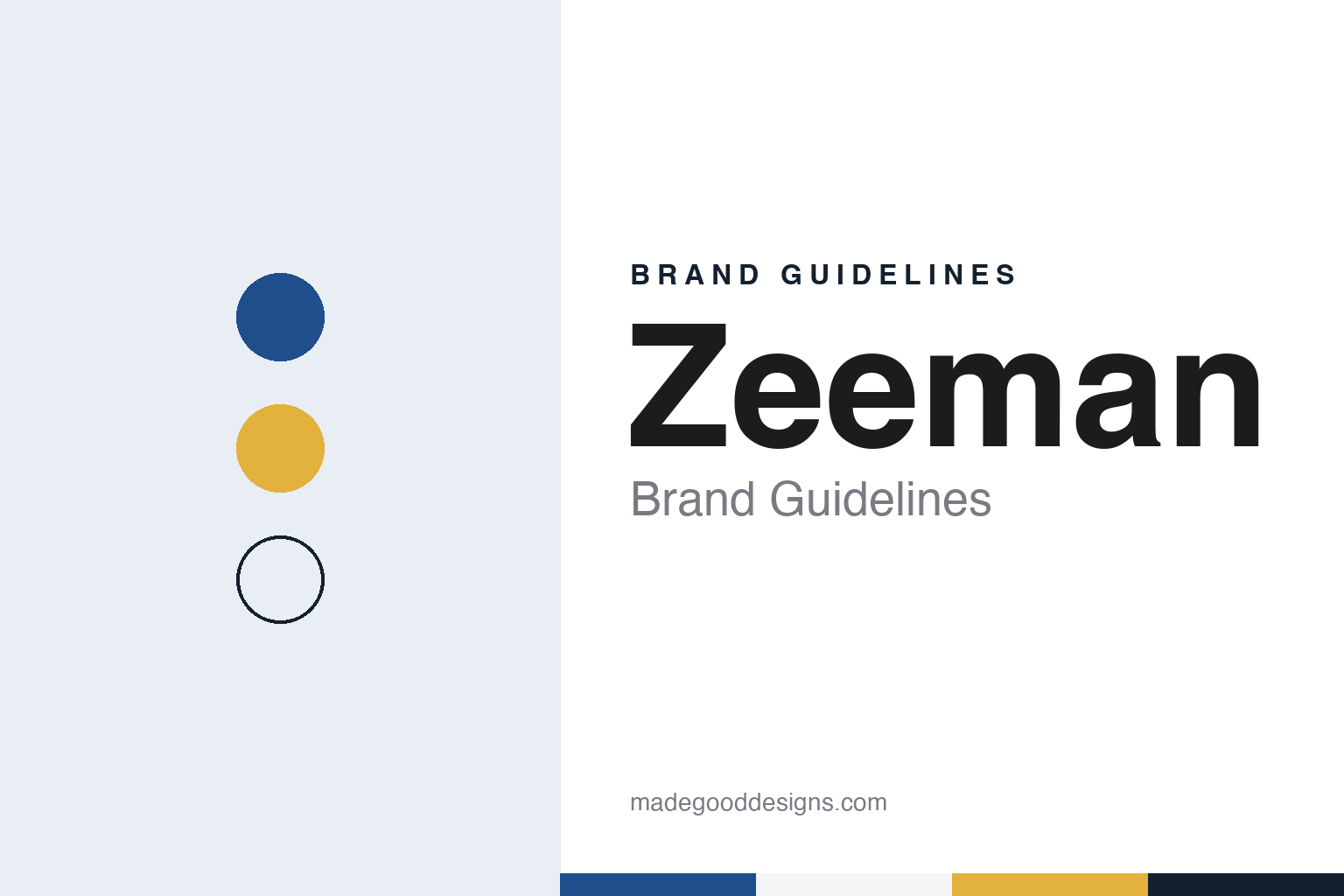
Zeeman Brand Guidelines
The 1967 Alphen textile discounter with a sailor mark.
Aa
Two constants: a blue, white and yellow palette and a plain grotesque register. Abstract homage — not a Zeeman product or mark; no logo, sailor figure or pack is reproduced.
A textile supermarket
Self-service clothes and textiles in Alphen.
Zeeman began in 1967, when Jan Zeeman opened the first shop under his name in Alphen aan den Rijn, RetailDetail reported in June 2020. The company’s own history page describes it as a supermarket for low-price clothes and textiles at a time when few Dutch stores were self-service, selling through efficient organisation and bulk buying. RetailDetail wrote that the first branch brought the big-box supermarket idea, then spreading, into the textile trade, and that the founder held to simplicity and discount throughout.
Growth came through buying. The company says it grew faster from 1974 through a number of large acquisitions, and that it bought Brons in 1980. In its early years Zeeman was also part of a loose “club of nine” discount retailers, with Wibra, Scholten and Ter Stal, whose members divided the Dutch market between them, according to Dutch Wikipedia in its article on Wibra; that arrangement ended as Zeeman and Wibra bought some of the others.
Ownership has stayed in the family. Jan Zeeman stepped down as chief executive in 1999 and left the supervisory board in 2014, RetailDetail reported in June 2020. The corporate site says all of the shares are held by the Zeeman family and that the business is led from a service office in Alphen aan den Rijn. Erik-Jan Mares led the company for nine years until 1 July 2026; in March 2026 Zeeman named Boudewijn van Nieuwenhuijzen, previously chief executive of Super Indo in Indonesia, part of Ahold Delhaize, and earlier a manager at HEMA and Unilever, to take over as chief executive on 1 August 2026, RetailDetail reported.
Colour
Basics, a sailor and a few stunts.
The format is plain. Zeeman’s corporate site groups the range into four core areas — baby and children’s clothes, legwear, household textiles, and underwear and sleepwear — with women’s and men’s fashion and some non-textile goods, such as food and cleaning products, alongside. It says its products are mainly sourced and made in Bangladesh, China, India, Pakistan and Turkey by specialised suppliers rather than in its own factories, some of them partners for 20 to 30 years, and that it has been a member of the Fair Wear Foundation since October 2019 and publishes its supplier list on Open Supply Hub.
The mark is part of the story. Jan Zeeman wanted to keep everything in his own hands, from transport to the logo with the sailor, which he reportedly drew himself, RetailDetail wrote in June 2020. The figure plays on the name: zeeman is the Dutch word for a seaman. By 2020, when the chain had grown from one Alphen shop to stores in seven countries, RetailDetail called the sailor logo “now so famous.”
Zeeman uses stunts to argue that ordinary things need not cost much. In February 2024 it put a collection of “Zeeman basics” for avatars into the game Roblox, presented by the company as a playful statement about spending on virtual fashion, RetailDetail reported. In September 2025 it sold a pendant with a laboratory-grown diamond set in sterling silver, online only from 4 September; RetailDetail said this followed earlier launches of a wedding dress and a perfume, and reported that the first stock of several thousand pieces sold out in under an hour. A jewellery company then brought summary proceedings in The Hague, arguing that the campaign’s price comparison with jewellers was misleading. At the hearing on 26 September 2025 the parties settled, and Zeeman placed a correction on its website saying the comparison was not representative, RetailDetail reported on 29 September 2025.
Typography
Design and documentation.
The Netherlands and Belgium have a dense network of discount, home, fashion and grocery chains, and many of them present themselves first through the shop front. A fascia on a shopping street is often the most visible part of the brand: when Blokker restarted in 2025, NOS reported that the old logo, in block capitals and without its full stop, went back up on the fronts of the reopened shops, and in April 2024 RetailDetail reported that Xenos would put its logo on eight former Casa shops it had taken back.
Websites carry the rest of the identity. Xenos groups its range online into departments such as furniture, garden, cooking and table, household and party goods, with trend pages and a customer club called Xtra Xenos; both Blokker and Xenos publish a folder, the retail leaflet, on their sites next to a shop finder. Xenos says it follows trends closely and buys new ranges in large volumes, so the assortment changes quickly.
Ownership is part of the story, and the companies describe it plainly. Some of these chains grew up inside family groups: Blokker Holding, built by the descendants of a couple who opened a shop in Hoorn in 1896, once owned Xenos, Leen Bakker, Bart Smit and Intertoys before selling them off between 2017 and 2019, and Xenos now describes its owner, Nieuwgeluk Group, as a Dutch family office. Restructurings, bankruptcies and restarts have reshaped several familiar names, and corporate pages and the trade press record those changes with dates.
This guide sets out what can be checked about each brand: who founded it, who owns it, how its shops, ranges and logos have changed, and what has happened to it. Company statements are marked as such, and counts of shops and countries are given with the date of the source.
Aa
A plain grotesque for basics on a shelf. (Specimen set in Archivo, a sans STAND-IN; NOT the Zeeman logo.)
Zeeman
From Alphen to a European network, then a trim.
The chain spread beyond the Netherlands over several decades. In June 2020 RetailDetail counted about 1,300 stores and 7,000 staff in the Netherlands, Belgium, Germany, France, Luxembourg, Austria and Spain. On 26 April 2023 Zeeman opened its first Portuguese store, in Matosinhos near Porto, making Portugal its eighth country, RetailDetail reported, when the chain had more than 1,320 branches.
The network has since been trimmed. In its annual report published in May 2026, Zeeman said it had closed 24 stores in 2025 and announced that it would close all thirteen stores in Portugal and Austria, which it called pilot markets with too little potential, RetailDetail reported on 26 May 2026. The same report described store closures in France and Spain and a German network focused on North Rhine-Westphalia and Berlin, alongside a mechanised distribution centre and a rebuilt online shop. The corporate site now lists stores in six countries: Belgium, Germany, France, Luxembourg, the Netherlands and Spain.
Second-hand clothing is a smaller thread. In May 2022 Zeeman began selling used baby and children’s clothes under the name Resale in two Belgian stores, Genk and Merksem, sourced through Het Goed, a Dutch social enterprise that runs second-hand shops and also placed collection boxes there, RetailDetail reported; in the Netherlands customers could already hand in clothes at every Zeeman store. In 2025, RetailDetail wrote in May 2026, the retailer expanded its second-hand range.
For a design guide, Zeeman shows how a plain format, a short range list and one simple mark can carry a family discounter across borders. Compare Wibra, its old partner in the “club of nine,” and Primark, another low-price clothing chain. For this guide we use a harbour blue, white and a buoy yellow with a sans, an unofficial interpretation; no product or logo is reproduced.
Explore & save
Keep Zeeman’s identity on hand — save it to a board in the Made Good inspiration library.
Zeeman identity set
Pin the Zeeman blue, white and yellow palette and the plain grotesque register to your own board.
Source & notes
Frequently Asked Questions
What font can I use to match the Zeeman look?
This guide describes Zeeman’s type as “A plain grotesque for basics on a shelf”. Its type specimen is set in Archivo from Google Fonts as a stand-in; Archivo is not Zeeman’s own lettering.
What colours are in the Zeeman palette?
This guide’s Zeeman palette is Harbour blue #1F4E8C, Deep ink #14202E, Sail white #F3F5F7, Buoy yellow #E3B23C and Paper #F9FAFB. The tones are the guide’s own unofficial interpretation, not official Zeeman hex codes.
When was Zeeman founded?
Zeeman was founded in 1967, in Alphen aan den Rijn, Netherlands.
Who founded Zeeman?
Zeeman was founded by Jan Zeeman in 1967. Zeeman is known for Baby and children’s clothes, legwear, household textiles.
Who owns Zeeman?
Zeeman today: Family-owned, service office in Alphen aan den Rijn.


