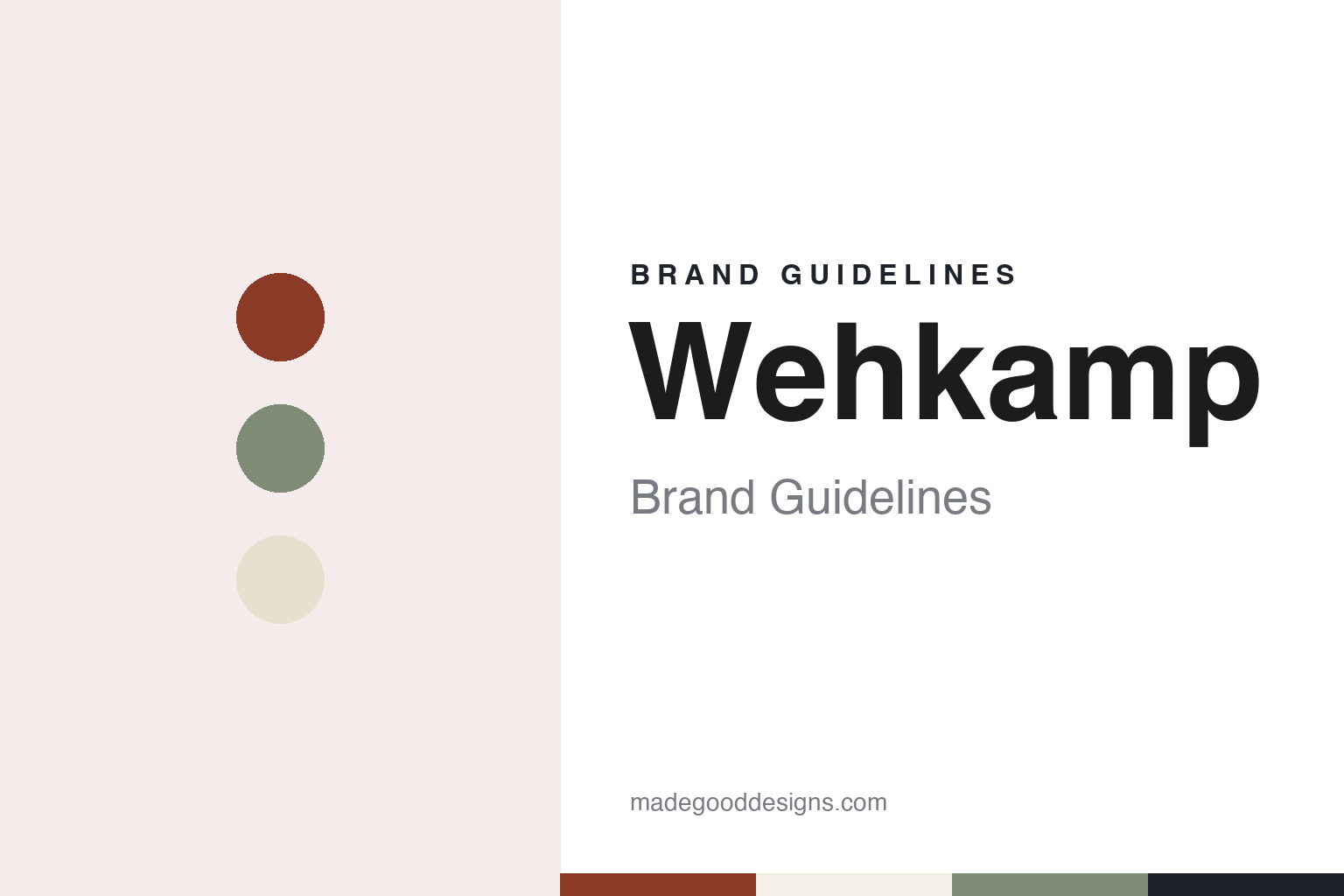
Wehkamp Brand Guidelines
A 1952 Slagharen mail-order firm, a Zwolle webshop and Omoda.
Aa
Two constants: a brick, sage and linen palette and a catalogue serif register. Abstract homage — not a Wehkamp asset; no logo, catalogue or parcel is reproduced.
Fabriekskantoor
Bedding by post from a village in Overijssel.
Wehkamp began in 1952 in Slagharen, a village in Overijssel, when Herman Wehkamp set up “Wehkamp’s Fabriekskantoor,” Dutch Wikipedia says. Its goods, initially mattresses and other bedding, were ordered by post in response to advertisements in broadcast listings magazines and women’s magazines, and they were sent out by post as well. From a warehouse in Slagharen the company later worked from Dedemsvaart, Maurik and Zwolle.
The mail-order model rested on records. Dutch Wikipedia says mechanising the administration and the address file mattered almost from the start, and that the customer database built from it proved the most important factor in the business over the years; paying in instalments arrived soon after the founding. In 1962, after ten years of growth, Herman Wehkamp sold his shares to The Great Universal Stores (GUS) of London. A site in Maurik opened in 1969, and in 1975 the head office moved to Zwolle, which Dutch Wikipedia still gives as its head office.
Under GUS the business tried new ways to take orders. In 1985 it introduced a voice-response telephone system called “Jimmy,” which let customers order around the clock, and in 1990 it moved from postal delivery to the carrier SelektVracht, Dutch Wikipedia says. Wehkamp started its own website in 1995, with auctions of a few items to draw visitors, and by mid-1999 all of its roughly ten thousand items could be bought online. Ecommerce News, writing in July 2025, also dates the opening of the webshop to 1995.
Colour
Investors, a holding company and a warehouse in Zwolle.
GUS sold the business in 2006. In January that year Industri Kapital, later IK Investment Partners, agreed to buy Wehkamp from GUS, Dutch Wikipedia says, and in the same year the company turned from a catalogue firm with a website into an online retailer led by the internet, under the name Wehkamp.nl; by 2010 all of its sales came through the internet. In December 2008 IK agreed to sell to a group of investors made up of the sitting management and a member of the supervisory board, who took over the holding company RFS Holland Holding.
One older part of the business went its own way in those years. Transfair, Wehkamp’s own collections department, dated from 1972, when it was called Transconto, and from 1977 it also worked for other companies, Dutch Wikipedia says; after passing to IK with Wehkamp, it was sold to the Scandinavian credit-management firm Lindorff in 2007.
Under RFS the site took in other retailers. Ecommerce News wrote in July 2025 that in 2007 C&A got its own corner within the Wehkamp site, followed by similar alliances with Scapino, Beter Bed, Hunkemöller and WE Fashion, and that the holding also bought the online shops Create2Fit and fonQ. In 2015 the British investment firm Apax Partners took ownership, the same report said, and in September 2015 King Willem-Alexander opened Wehkamp’s new automated distribution centre in Zwolle. Dutch Wikipedia gives that building as 53,000 square metres, joined in 2019 by a second building to form one centre of about 110,000 square metres, which has held all of Wehkamp’s logistics since 2021.
More changes followed under Apax. In 2021 Wehkamp took over kleertjes.com, an online shop for children’s clothing, and on 28 June 2021 the shop was separated from Tinka, formerly Lacent, its provider of deferred payment and credit, Dutch Wikipedia says. In April 2023 Wehkamp introduced a small symbolic charge for each returned item, and Ecommerce News notes that charges for delivery followed later. The same publication reported that the group had also bought the brand rights to the fashion label Coolcat.
Typography
How Dutch and Belgian chains present themselves.
The Netherlands and Belgium have a dense network of discount, home, fashion and grocery chains, and many of them present themselves first through the shop front. A fascia on a shopping street is often the most visible part of the brand: when Blokker restarted in 2025, NOS reported that the old logo, in block capitals and without its full stop, went back up on the fronts of the reopened shops, and in April 2024 RetailDetail reported that Xenos would put its logo on eight former Casa shops it had taken back.
Websites carry the rest of the identity. Xenos groups its range online into departments such as furniture, garden, cooking and table, household and party goods, with trend pages and a customer club called Xtra Xenos; both Blokker and Xenos publish a folder, the retail leaflet, on their sites next to a shop finder. Xenos says it follows trends closely and buys new ranges in large volumes, so the assortment changes quickly.
Ownership is part of the story, and the companies describe it plainly. Some of these chains grew up inside family groups: Blokker Holding, built by the descendants of a couple who opened a shop in Hoorn in 1896, once owned Xenos, Leen Bakker, Bart Smit and Intertoys before selling them off between 2017 and 2019, and Xenos now describes its owner, Nieuwgeluk Group, as a Dutch family office. Restructurings, bankruptcies and restarts have reshaped several familiar names, and corporate pages and the trade press record those changes with dates.
This guide sets out what can be checked about each brand: who founded it, who owns it, how its shops, ranges and logos have changed, and what has happened to it. Company statements are marked as such, and counts of shops and countries are given with the date of the source.
Aa
A catalogue serif for a family name. (Specimen set in Fraunces, a serif STAND-IN; NOT the Wehkamp logo.)
Wehkamp
Back in Dutch family hands.
In 2026 Wehkamp changed hands again. On 4 June 2026 the Zeeland family business Omoda announced that it would take over Wehkamp from Apax Partners, RetailDetail reported, bringing the online department store back into Dutch hands after eleven years; Omoda had made eleven acquisitions in the previous seven years, including Assem and Mijn Modewereld. The Netherlands Authority for Consumers and Markets (ACM) decided on 29 June 2026 that Omoda, through its subsidiary O-Group, could acquire sole control of Wehkamp Retail Group Holding, finding that enough competition would remain. On 13 July 2026 RetailDetail reported that, with that approval, the acquisition was complete, placing Omoda, Assem, Wehkamp and kleertjes.com under one roof as Omoda Brands.
The ACM decision describes what Wehkamp sells: a broad range aimed at Dutch consumers in the middle segment, from shoes, clothing, bags and accessories to beauty, home and living, kitchen, cleaning and toys. Dutch Wikipedia adds that almost all of its sales are made in the Netherlands. The way it presents itself has long leaned on that breadth; in February 2015 Twinkle wrote that Wehkamp presented itself as “the” department store on the internet. The family name has stayed on the shop through every owner since 1952, from GUS in London to Omoda in Zeeland.
For a design guide, Wehkamp shows how a name built on catalogues and order forms can carry over to a webshop and a single large warehouse. Compare bol, the Utrecht online shop that opened its marketplace in 2011, and Zeeman, another Dutch clothing retailer. For this guide we use brick, sage, linen and ink with a serif, an unofficial interpretation; no product or logo is reproduced.
Explore & save
Keep Wehkamp’s identity on hand — save it to a board in the Made Good inspiration library.
Wehkamp identity set
Pin the Wehkamp brick, sage and linen palette and the catalogue serif register to your own board.
Source & notes
Frequently Asked Questions
What font can I use to match the Wehkamp look?
This guide describes Wehkamp’s type as “A catalogue serif for a family name”. Its type specimen is set in Fraunces from Google Fonts as a stand-in; Fraunces is not Wehkamp’s own lettering.
What colours are in the Wehkamp palette?
This guide’s Wehkamp palette is Brick #8C3A28, Ink #1E222B, Sage #7F8C76, Linen #E9DFCF and Paper #F4EFE7. The tones are the guide’s own unofficial interpretation, not official Wehkamp hex codes.
When was Wehkamp founded?
Wehkamp was founded in 1952 (as Wehkamp’s Fabriekskantoor), in Slagharen, Netherlands.
Who founded Wehkamp?
Wehkamp was founded by Herman Wehkamp in 1952 (as Wehkamp’s Fabriekskantoor).
Who owns Wehkamp?
Wehkamp today: Wehkamp, Zwolle, part of Omoda Brands (2026). Wehkamp is known for Mail order, then an online department store.


