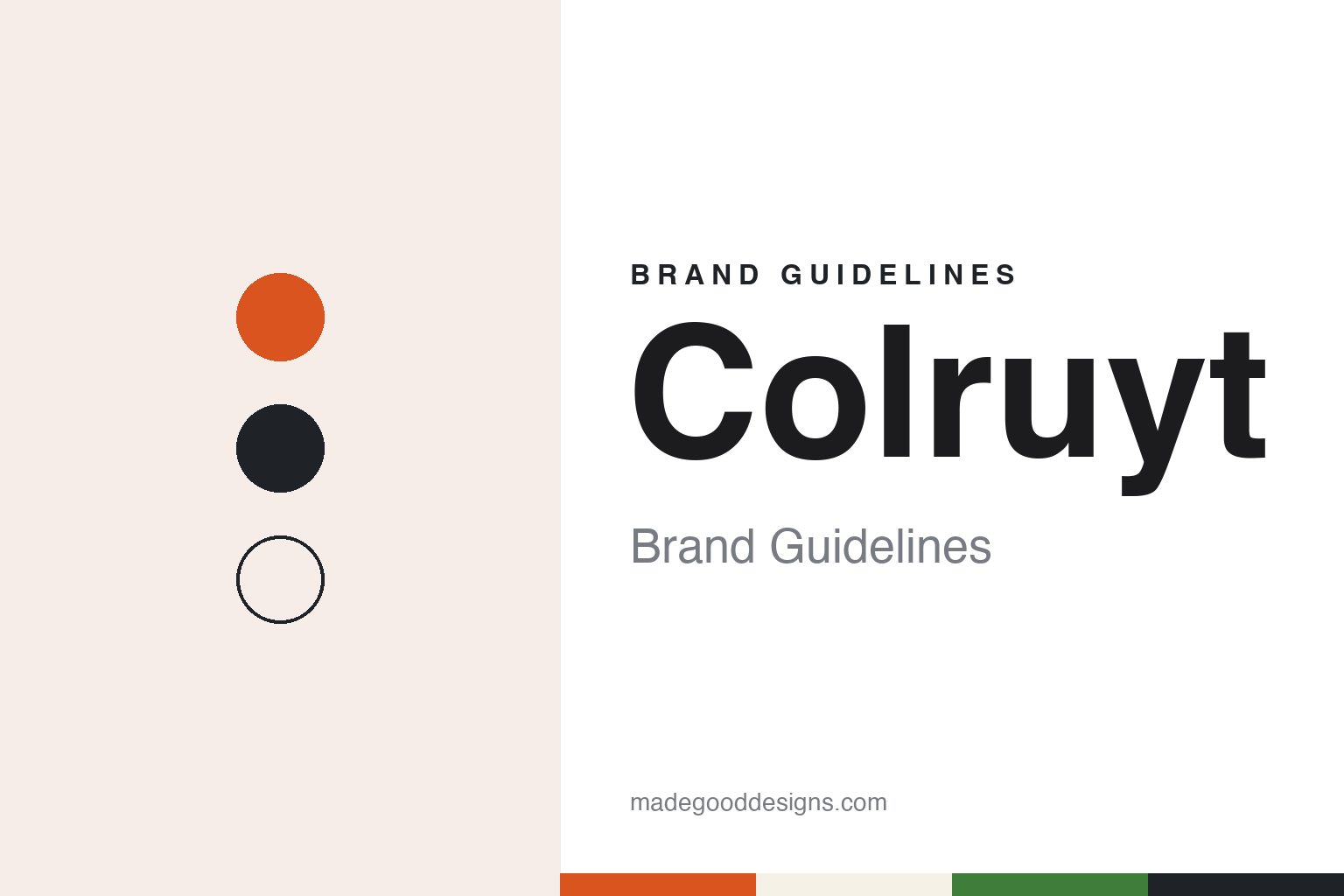
Colruyt Brand Guidelines
A 1928 Lembeek wholesaler, Boni stamps and a lowest-price name.
Aa
Two constants: a price orange, ink and cream palette and a grotesque sans register. Abstract homage — not a Colruyt product or mark; no store fascia, logo or label is reproduced.
Lembeek
A baker’s son and a wholesale trade.
Colruyt grew out of a bakery in Lembeek, now part of Halle, south-west of Brussels. Dutch Wikipedia says Franz Colruyt, born in Lembeek in 1901, was the second of eleven children of the baker Joseph Colruyt and worked in his father’s business delivering food to shops and large customers. In 1928 he gave up baking and set up a wholesale trade in “colonial goods” such as coffee and spices; French Wikipedia describes the same step. Colruyt Group’s own history page also dates its start to 1928, when, it says, Franz began delivering bread to shops and large customers in the Brussels region and soon added other groceries.
Until the war, Dutch Wikipedia says, the wholesaler mainly served shops around Halle and Tubize. The sources used for this guide do not say how the company operated during the occupation of 1940–1944. After the Second World War the business grew, built up customers in and around Brussels, and began bottling wine and roasting coffee. In 1950 Franz Colruyt incorporated it as Etablissementen Franz Colruyt NV, with his brothers Henri and Jules involved, according to Dutch Wikipedia.
The 1950s brought the Boni name. The company says Franz introduced Boni stamps in 1953, a loyalty scheme whose name referred to the voucher customers received once they had collected enough stamps; Boni shops were run by independent grocers who bought from Colruyt, Dutch Wikipedia says. In 1958 his son Jo Colruyt and Jo’s brothers took over the running of the firm, which by then supplied about 800 small independent shops and had some 150 staff.
The move into retail followed. Dutch Wikipedia says Jo Colruyt opened a self-service cash-and-carry in Halle in 1964, with bills worked out on punch cards, and in the mid-1960s took over the Verloo self-service shop in Ixelles, which became Discount Verloo. As other retailers adopted the word “discount,” a new name was needed, and in 1976 all the shops took the name Colruyt.
Colour
A price promise in the store name.
The chain’s full name carries its pitch. In Belgium and Luxembourg the stores trade as Colruyt Laagste Prijzen in Dutch and Colruyt Meilleurs Prix in French, Dutch Wikipedia says. The company dates the start of its discount model to 1964 and, from 1985, its “Red Prices,” price comparisons it published in leaflets. In 1987, Dutch Wikipedia says, punch cards gave way to price labels and full barcode scanning at the tills, which let the firm automate replenishment, stock control and ordering.
Own label sits at the centre of the shelves. Boni Selection, launched in May 2013, gathered own-brand products that had until then carried different names; Dutch Wikipedia counts more than 3,500 Boni Selection products, sold in Colruyt, Okay, Spar Colruyt Group and Bio-Planet stores, among others, with Everyday as the plain economy line and Kangourou for non-food. Coffee is sold as Graindor. Much of the own label is made in-house: Dutch Wikipedia says products come from the group’s Fine Food production units, led by meat processing, alongside spreads, a coffee roastery, wine bottling, cheese and a bakery, across nine production sites.
Around the Colruyt stores, other formats grew. Dutch Wikipedia dates the neighbourhood chain OKay to 1998, the online grocery service Collect&Go to 2000, the organic supermarkets Bio-Planet to 2001 and the fresh-food markets Cru to 2014. Colruyt Group says it became licence holder of the Spar retail format in Belgium in 2003, working with independent retailers. In 2007, the company says, the growth of these businesses led to a group level, Colruyt Group, and in 2017 the Xtra card and app brought the stores and webshops onto one customer platform. Fashion came in through The Fashion Society, which groups ZEB, PointCarré and The Fashion Store and has been wholly owned since 2020, Dutch Wikipedia says.
Typography
Fascias, folders and own label.
The Netherlands and Belgium have a dense network of discount, home, fashion and grocery chains, and many of them present themselves first through the shop front. A fascia on a shopping street is often the most visible part of the brand: when Blokker restarted in 2025, NOS reported that the old logo, in block capitals and without its full stop, went back up on the fronts of the reopened shops, and in April 2024 RetailDetail reported that Xenos would put its logo on eight former Casa shops it had taken back.
Websites carry the rest of the identity. Xenos groups its range online into departments such as furniture, garden, cooking and table, household and party goods, with trend pages and a customer club called Xtra Xenos; both Blokker and Xenos publish a folder, the retail leaflet, on their sites next to a shop finder. Xenos says it follows trends closely and buys new ranges in large volumes, so the assortment changes quickly.
Ownership is part of the story, and the companies describe it plainly. Some of these chains grew up inside family groups: Blokker Holding, built by the descendants of a couple who opened a shop in Hoorn in 1896, once owned Xenos, Leen Bakker, Bart Smit and Intertoys before selling them off between 2017 and 2019, and Xenos now describes its owner, Nieuwgeluk Group, as a Dutch family office. Restructurings, bankruptcies and restarts have reshaped several familiar names, and corporate pages and the trade press record those changes with dates.
This guide sets out what can be checked about each brand: who founded it, who owns it, how its shops, ranges and logos have changed, and what has happened to it. Company statements are marked as such, and counts of shops and countries are given with the date of the source.
Aa
A sturdy grotesque sans for a price-led grocer. (Specimen set in Archivo, a sans STAND-IN; NOT the Colruyt logo.)
Colruyt Group
A listed family business in Halle.
Colruyt is a listed family business. Dutch Wikipedia says NV Colruyt has been listed on Euronext Brussels since 1977 and was part of the Bel20 index until 2023, and that the Colruyt family and its investment company Korys hold more than 70% of the shares. In 2023 the company name changed from Etablissementen Franz Colruyt NV to Colruyt Group NV, and Stefan Goethaert, formerly chief operating officer, succeeded Jef Colruyt as chief executive; the company says Jef Colruyt had led it for more than 28 years. English Wikipedia gives the head office as Halle.
The store map has shifted in both directions. On 2 February 2024 Colruyt Group notified the Belgian Competition Authority of its purchase of 57 Smatch, Match and Louis Delhaize supermarkets from the Louis Delhaize Group, a company separate from the Delhaize chain. In a press release of 17 April 2024 the authority said three shops had been removed from the deal after its review of local catchment areas, and approved the acquisition of the remaining 54. Dutch Wikipedia says the group runs takeovers under the temporary name Comarkt while it decides which format each store becomes.
France went the other way. Colruyt had run its own supermarkets there since 1996, after buying the French distributor Ripotot, French Wikipedia says. RetailDetail reported on 2 March 2026 that, after a review by the French competition authorities, Colruyt Group had completed the sale of 100 French stores and 45 DATS 24 fuel stations on 28 February 2026; most went to Groupement Mousquetaires, the group behind Intermarché and Netto, others to E.Leclerc, Coopérative U and Carrefour, and stores without a buyer were closed. As of 31 March 2025, Dutch Wikipedia lists 264 Colruyt stores in Belgium and 6 in Luxembourg.
For a design guide, Colruyt shows how a price promise can become part of the store name itself, how scattered own-label lines can be gathered under one umbrella name, and how a founder’s surname can run across a whole group of formats. Compare the long history of Delhaize, another Belgian grocer, and the discount story of Aldi. For this guide we use a price orange, ink and cream with a market green, with a sturdy grotesque sans, an unofficial interpretation; no product or logo is reproduced.
Explore & save
Keep Colruyt’s identity on hand — save it to a board in the Made Good inspiration library.
Colruyt identity set
Save the Colruyt price orange, ink and cream palette and the grotesque sans register to your own board.
Source & notes
Frequently Asked Questions
What font can I use to match the Colruyt look?
This guide describes Colruyt’s type as “A sturdy grotesque sans for a price-led grocer”. Its type specimen is set in Archivo from Google Fonts as a stand-in; Archivo is not Colruyt’s own lettering.
What colours are in the Colruyt palette?
This guide’s Colruyt palette is Price orange #D9541E, Halle ink #1F2328, Boni cream #F6F1E7, Market green #3F7D3A and Paper #FAF8F4. The tones are the guide’s own unofficial interpretation, not official Colruyt hex codes.
When was Colruyt founded?
Colruyt was founded in 1928 (as a wholesaler), in Lembeek (Halle), Belgium.
Who founded Colruyt?
Colruyt was founded by Franz Colruyt in 1928 (as a wholesaler).


