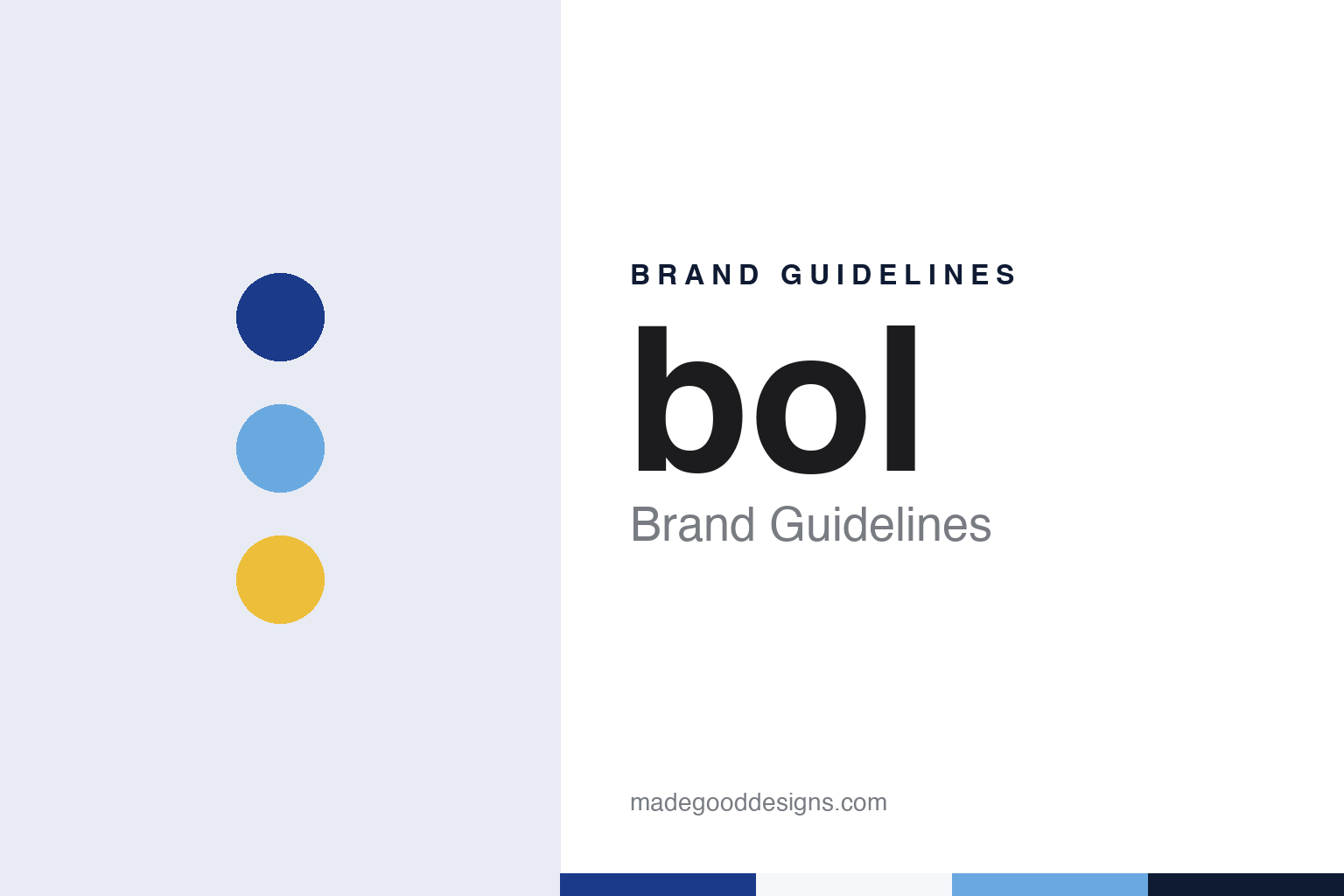
bol Brand Guidelines
Bertelsmann’s 1999 BOL, Ahold since 2012 and a name without .com.
Aa
Two constants: a deep blue, sky blue and warm yellow palette and a rounded sans register. Abstract homage — not a bol asset; no logo, box or app screen is reproduced.
Bertelsmann On-Line
A German media group’s online bookshop, kept alive in the Netherlands.
bol began as part of a German media group’s move into selling books online. English Wikipedia says Bertelsmann decided to build its own online bookstore after an approach to Amazon about a partnership came to nothing in late 1997, and that the business launched in March 1999 as BOL, short for Bertelsmann On-Line. It opened storefronts in several countries; English Wikipedia lists Germany, the United Kingdom, the Netherlands, Sweden, Italy and China. In markets such as the United Kingdom, Bertelsmann backed the launch with a large marketing budget and television advertising. Dutch Wikipedia dates the Dutch company, bol.com, to the same year.
The Dutch business plan came from Daniel Ropers, then a junior consultant at McKinsey, Ecommerce News recounted in June 2012. English Wikipedia says he helped write the plan in 1998 and became chief executive in 2000, a post he held until October 2017. When the dot-com bubble burst, Bertelsmann decided in 2002 to leave e-commerce. Its other BOL shops were closed or sold, English Wikipedia says, but the Dutch shop had done better than expected, helped by the option to pay by invoice after delivery with an acceptgiro, a pre-printed Dutch paper bank-transfer form.
In 2003 the Dutch company passed to three German investors, Weltbild, Holtzbrinck Networks and T-Online Venture Funds; Ecommerce News wrote that an early step under the new owners was to double the staff to about fifty people. In 2009 they sold it to Cyrte Investments, an investment firm later largely owned by the insurer Delta Lloyd, Ecommerce News reported. On 9 May 2012 the Dutch supermarket group Koninklijke Ahold completed its acquisition, according to English Wikipedia and Ecommerce News. Since the merger of Ahold and the Belgian Delhaize Group in July 2016, bol has been part of Ahold Delhaize, Dutch Wikipedia says.
Colour
From one shop to a platform with its own vans.
The company’s addresses moved as it grew. Dutch Wikipedia says bol.com started in the head office of ECI in Vianen, moved to Nieuwegein and has been based in Utrecht since 2010, on the Papendorp business park since late 2014; it lists distribution centres in Waalwijk, Nieuwegein and Oosterhout. Since 2010, it adds, Belgian customers have been able to order from the whole range.
The larger change was the marketplace. In 2011 bol opened its site to other sellers, English Wikipedia says, and Ecommerce News named the model Plaza. Since then the shop has worked as two businesses at once: a retailer selling its own stock and a platform for partner sellers. Ecommerce News reported in November 2026 that the number of sales partners peaked at about 52,000 in mid-2023, by bol’s own count, and that bol gave a figure of 43,095 on 30 June 2026, while it was also recruiting sellers from outside the Benelux.
Delivery moved in-house step by step. bol launched its subsidiary Ampère in the summer of 2022 to collect parcels from sales partners, Ecommerce News reported in July 2026. Ampère later began delivering from depots in Rotterdam and Utrecht, then Zwolle, Amsterdam, Nijmegen and Eindhoven, and its blue vans became a familiar sight on Dutch streets, the same report said. Since 1 July 2026 every parcel with the “Vandaag Bezorgd” (delivered today) label has gone through Ampère, replacing a same-day service bol had launched with PostNL in 2016, when the label also became one of the customer benefits of its new Select loyalty programme. In 2026 bol also opened its fulfilment programme to outside logistics firms, among them Bleckmann, CEVA Logistics, Monta and QLS.
Typography
How Dutch and Belgian chains present themselves.
The Netherlands and Belgium have a dense network of discount, home, fashion and grocery chains, and many of them present themselves first through the shop front. A fascia on a shopping street is often the most visible part of the brand: when Blokker restarted in 2025, NOS reported that the old logo, in block capitals and without its full stop, went back up on the fronts of the reopened shops, and in April 2024 RetailDetail reported that Xenos would put its logo on eight former Casa shops it had taken back.
Websites carry the rest of the identity. Xenos groups its range online into departments such as furniture, garden, cooking and table, household and party goods, with trend pages and a customer club called Xtra Xenos; both Blokker and Xenos publish a folder, the retail leaflet, on their sites next to a shop finder. Xenos says it follows trends closely and buys new ranges in large volumes, so the assortment changes quickly.
Ownership is part of the story, and the companies describe it plainly. Some of these chains grew up inside family groups: Blokker Holding, built by the descendants of a couple who opened a shop in Hoorn in 1896, once owned Xenos, Leen Bakker, Bart Smit and Intertoys before selling them off between 2017 and 2019, and Xenos now describes its owner, Nieuwgeluk Group, as a Dutch family office. Restructurings, bankruptcies and restarts have reshaped several familiar names, and corporate pages and the trade press record those changes with dates.
This guide sets out what can be checked about each brand: who founded it, who owns it, how its shops, ranges and logos have changed, and what has happened to it. Company statements are marked as such, and counts of shops and countries are given with the date of the source.
Aa
A rounded sans for a short lower-case name. (Specimen set in Nunito, a sans STAND-IN; NOT the bol logo.)
bol
A web address that became a name.
The name itself was shortened in 2023. In October that year bol.com said it would drop the “.com,” which at the start had been needed to show that it was an online shop, HLN reported on 9 October 2023, citing the company’s announcement. The house style was refreshed with more playful shapes and colour, while the recognisable blue stayed dominant, the paper said, and packaging with the old name would be used up gradually. Dutch Wikipedia describes the same gradual introduction of the shorter name bol.
Before Ampère, bol relied on outside carriers for its fastest deliveries. In 2018 it moved the cut-off time for same-day orders later in the day through a partnership with the delivery firm Red je Pakketje, which no longer exists, Ecommerce News reported in July 2026. Ampère itself began as a collection service: initially it picked up parcels from sales partners and handed them to Budbee, which delivered them to customers the same day. In 2025 it introduced its own delivery service, Same Day Last Mile, and it also built a drop-off network in which fulfilment companies, shops and webshops with warehouse space act as hand-in points for smaller sales partners, the same report said. By bol’s own account, quoted there, the Ampère network covered 85 percent of the country in July 2026, and customers outside its area see the same-day option disappear at checkout. Dutch Wikipedia adds that bol works with Rabobank on short-term credit for its sellers.
For a design guide, bol shows how a web address can turn into a brand name, and how one colour can carry a company through changes of name and owner. Compare Etos, another Dutch chain with an online shop, and Delhaize, the Belgian half of the 2016 merger that formed bol’s parent group. For this guide we use a deep blue, a sky blue, a warm yellow and cloud white with a rounded sans, an unofficial interpretation; no product or logo is reproduced.
Explore & save
Keep bol’s identity on hand — save it to a board in the Made Good inspiration library.
bol identity set
Pin the bol deep blue, sky blue and warm yellow palette and the rounded sans register to your own board.
Source & notes
Frequently Asked Questions
What font can I use to match the bol look?
This guide describes bol’s type as “A rounded sans for a short lower-case name”. Its type specimen is set in Nunito from Google Fonts as a stand-in; Nunito is not bol’s own lettering.
What colours are in the bol palette?
This guide’s bol palette is Deep blue #1B3A8A, Ink #0F1A33, Sky blue #6AA9E0, Warm yellow #EDBE3A and Cloud white #F5F7FB. The tones are the guide’s own unofficial interpretation, not official bol hex codes.
When was bol founded?
bol was founded in 1999 (as BOL, Bertelsmann On-Line), in Netherlands.
Who owns bol?
bol is owned by Bertelsmann; German investors; Cyrte; Ahold (2012).


