Camaïeu Brand Guidelines
A Roubaix womenswear chain that closed in 2022 and came back as a line inside another shop.
Aa
Two constants: a one-hue rose palette and a geometric sans register. Abstract homage — not a Camaïeu product or mark; no garment, logo or shop sign is reproduced.
Four men from the Mulliez world
A Roubaix chain built on small runs and quick restocking.
Camaïeu was founded in 1984 and grew into a women’s clothing chain with about 650 shops in France before it closed in 2022. French Wikipedia, drawing on a 2014 history of the brand in La Saga des marques, names four founders: Jean-Pierre Torck, Éric Vandendriessche, Jean Duforest and Dominique Debruyne. All four had worked for businesses in the Mulliez family association, the group behind Auchan and Kiabi; Debruyne came from the discount grocer Miniper, Duforest from Auchan and Kiabi, and Vandendriessche and Torck had trained at Auchan.
The name is a French word for a picture made in several tints of a single colour; English Wikipedia describes camaïeu as a technique that uses two or three tints of one hue to build a monochrome image. This guide borrows that idea for its palette.
The founders’ method, as French Wikipedia describes it, was to compete with older chains such as Pimkie and Promod by working on short supply circuits: Camaïeu bought popular pieces in small, low-priced runs and restocked its shelves according to demand. Ten years after the start it had about 200 shops, French Wikipedia says.
The early business was broader than the women’s chain it became. A men’s line, Camaïeu Homme, followed in 1991, and a children’s line, Camaïeu Enfant, in 1994. In 1993 the company bought the business Tandy and opened a new head office with a logistics warehouse in Roubaix. From 1996 it narrowed its focus to clothing and accessories for women aged roughly 20 to 40. The men’s chain went to the Mulliez group and was renamed Jules in 2000, and the children’s chain went to Duforest, who renamed it Okaïdi; French Wikipedia gives both 1996 and 2000 for that change in different passages.
Colour
From founders to funds, and a long debt.
From 2000 the chain opened shops elsewhere in Europe and signed agreements with partners in Russia and the Middle East, according to French Wikipedia. In March 2011 it opened eight shops in Hungary, six of them in Budapest. By 2015 the company said it was present in 15 countries with more than 900 shops, nearly 650 of them in France. Franchise partners later carried the name into Africa: a shop opened in Cameroon in April 2017 with the Mercure International group, and a shop in Libreville, Gabon, in December 2018, alongside shops in Tunisia and Senegal.
Ownership changed several times. The founders sold their shares in 2005, when the investment firm Financière Addax, linked to Axa Private Equity, took over; in 2007 the fund Cinven bought a majority stake, and the company was taken off the Paris stock exchange in 2011, French Wikipedia says. The 2007 buyout left a heavy debt that shaped the next decade. A restructuring in September 2016 turned half of it into shares, and in 2017 the chain refreshed its brand and launched a new website.
The debt did not go away. On 15 October 2018 the Lille commercial court placed Modacin, the chain’s holding company, under a safeguard procedure to frame talks with creditors. The court ended the procedure on 19 December 2018, when the remaining debt was converted into equity and the shares passed to a group of creditor funds. French Wikipedia notes that online sales were still a small part of the business at that point.
In early 2020 the company was preparing to close shops in the European countries where it ran its own stores outside France. On 26 May 2020 the Lille court placed Camaïeu in receivership. On 17 August 2020 the court chose the offer of the Financière immobilière bordelaise (FIB), through its subsidiary Hermione People & Brands, which took on 511 shops and about 2,600 staff, including the Roubaix head office, according to French Wikipedia. A cyberattack in June 2021 disrupted the chain’s logistics, French Wikipedia says.
Typography
France’s womenswear chains.
France’s mass-market fashion and childrenswear chains grew up mostly in retail parks and shopping centres rather than on high streets. Kiabi opened its first store at Roncq, outside Lille, in 1978, and Gémo was created by the Éram group in 1991 to sell shoes and clothing for the whole family in stores on the edges of towns. For these chains the shop fascia, the logo on the bag and the label inside the garment are often the same name, because most of what they sell is their own.
Own-label ranges carry much of the identity. The International Directory of Company Histories traces Kiabi’s house brands back to its first store, with Winch and Decade, and later children’s labels; Le Journal des Entreprises reported in 2021 that own-label products made up 85 to 90 per cent of Gémo’s offer. Catalogues, websites, apps and seasonal campaigns present those ranges, and logos are redrawn from time to time: Kiabi unveiled a new single-letter K in December 2025, CB News reported.
Many of the chains belong to family-owned groups, and their corporate pages say so plainly. Kiabi sits in the Mulliez family’s retail group alongside Auchan and Decathlon; Gémo belongs to Éram, based at Saint-Pierre-Montlimart in Maine-et-Loire; French Wikipedia describes Groupe Beaumanoir as a family group founded in 1981 by Roland Beaumanoir. Founders, owners and changes of control are part of each brand’s story, and receiverships and sales have reshaped several of these names in recent years.
This guide sets out what can be checked about each brand: who founded it, who owns it, how its stores, labels and logos have changed, and what has happened to it. Company statements are marked as such, and counts of stores and countries are given with the date of the source.
Aa
A geometric sans for a chain named after tints of one colour. (Specimen set in Jost, a sans STAND-IN; NOT the Camaïeu logo.)
Liquidation and Be Camaïeu
The shops closed in 2022; the name moved to Celio.
The chain went back before the Lille court in 2022: it was placed under a mandat ad hoc in June and in receivership in July, French Wikipedia says. On 28 September 2022 the court ordered its liquidation, ending about 2,600 jobs, and the shops closed for good on the evening of 1 October 2022. Camaïeu’s stock was sold at auction to trade buyers in November 2022.
The name survived the company. In December 2022 the brand was bought at auction by Laurent and Marc Grosman, the owners of the menswear chain Celio, Capital reported in August 2024. In September 2023 an influencer video announced that Camaïeu would return a year later. It did so on 29 August 2024, under a new name, Be Camaïeu, sold inside Celio shops rather than in a chain of its own.
Capital described the relaunch: a range of about 700 pieces built on essentials and basics such as T-shirts, trousers and blouses, offered in many colours and cuts. The pieces were made by Celio’s suppliers, whose factories are mainly in Asia, alongside a capsule of six Breton striped tops made with a French partner near Roanne in the Loire. The line started in 13 points of sale — eleven Celio shops, one of them in Belgium, and two shops dedicated to Be Camaïeu at Compiègne and Vélizy 2 — and on Celio’s website.
The arrangement changed again in 2026. In March 2026 the trade title Ecommerce Mag reported that Celio, founded in 1978 and owned by the Grosman brothers, was launching Celio Women, a women’s line under its own name, after testing that market as Be Camaïeu. It said the women’s line would be sold in 27 points of sale, 19 of them mixed men’s and women’s stores, and that capsules from Be Camaïeu would continue, the first made in France with a knitwear maker in Roanne. As of November 2026 the old camaieu.fr address forwards to the women’s section of Celio’s website.
So the Camaïeu that traded from 1984 to 2022 no longer exists as a company; what remains is a name owned by another retailer and used for part of its womenswear.
For a design guide, Camaïeu shows how a brand name can outlast the company that built it and move into a host shop. Compare Okaïdi, the children’s chain that began as Camaïeu Enfant, and Pimkie, another northern French womenswear chain. For this guide we use tints of one rose, from deep mulberry to pale rose, with a geometric sans, an unofficial interpretation; no product or logo is reproduced.
Explore & save
Keep Camaïeu’s identity on hand — save it to a board in the Made Good inspiration library.
Camaïeu identity set
Pin the Camaïeu one-hue rose palette and the geometric sans register to your own board.
Source & notes
Frequently Asked Questions
What font can I use to match the Camaïeu look?
This guide describes Camaïeu’s type as “A geometric sans for a chain named after tints of one colour”. Its type specimen is set in Jost from Google Fonts as a stand-in; Jost is not Camaïeu’s own lettering.
What colours are in the Camaïeu palette?
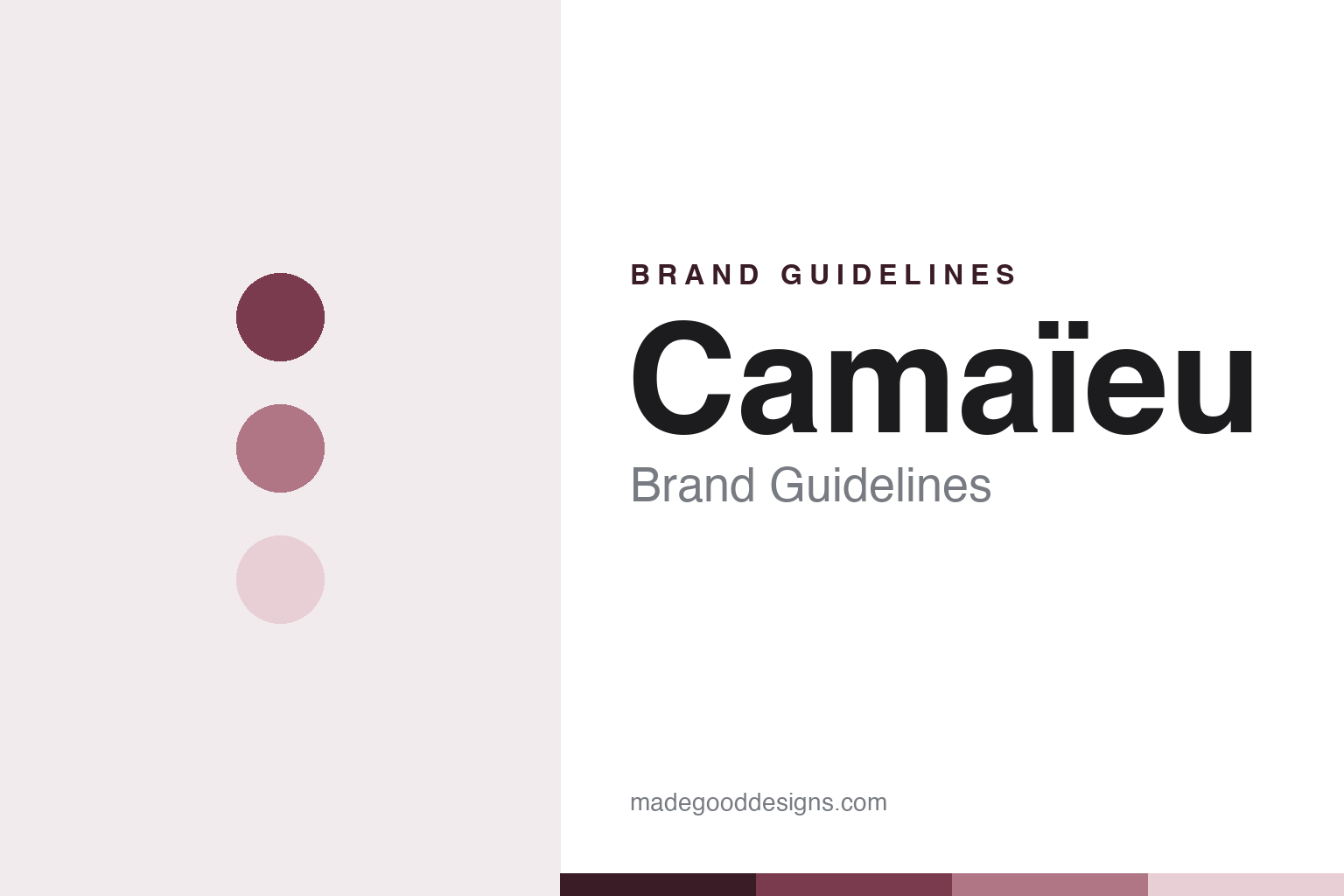
This guide’s Camaïeu palette is Deep mulberry #3A1C26, Plum rose #7A3B4E, Dusty rose #B07686, Pale rose #E8CFD5 and Chalk #F8F4F3. The tones are the guide’s own unofficial interpretation, not official Camaïeu hex codes.
When was Camaïeu founded?
Camaïeu was founded in 1984, in France.
Who founded Camaïeu?
Camaïeu was founded by Jean-Pierre Torck, Éric Vandendriessche, Jean Duforest and Dominique Debruyne in 1984.
Who owns Camaïeu?
Camaïeu today: Name owned by Celio’s owners; relaunched as Be Camaïeu in 2024.