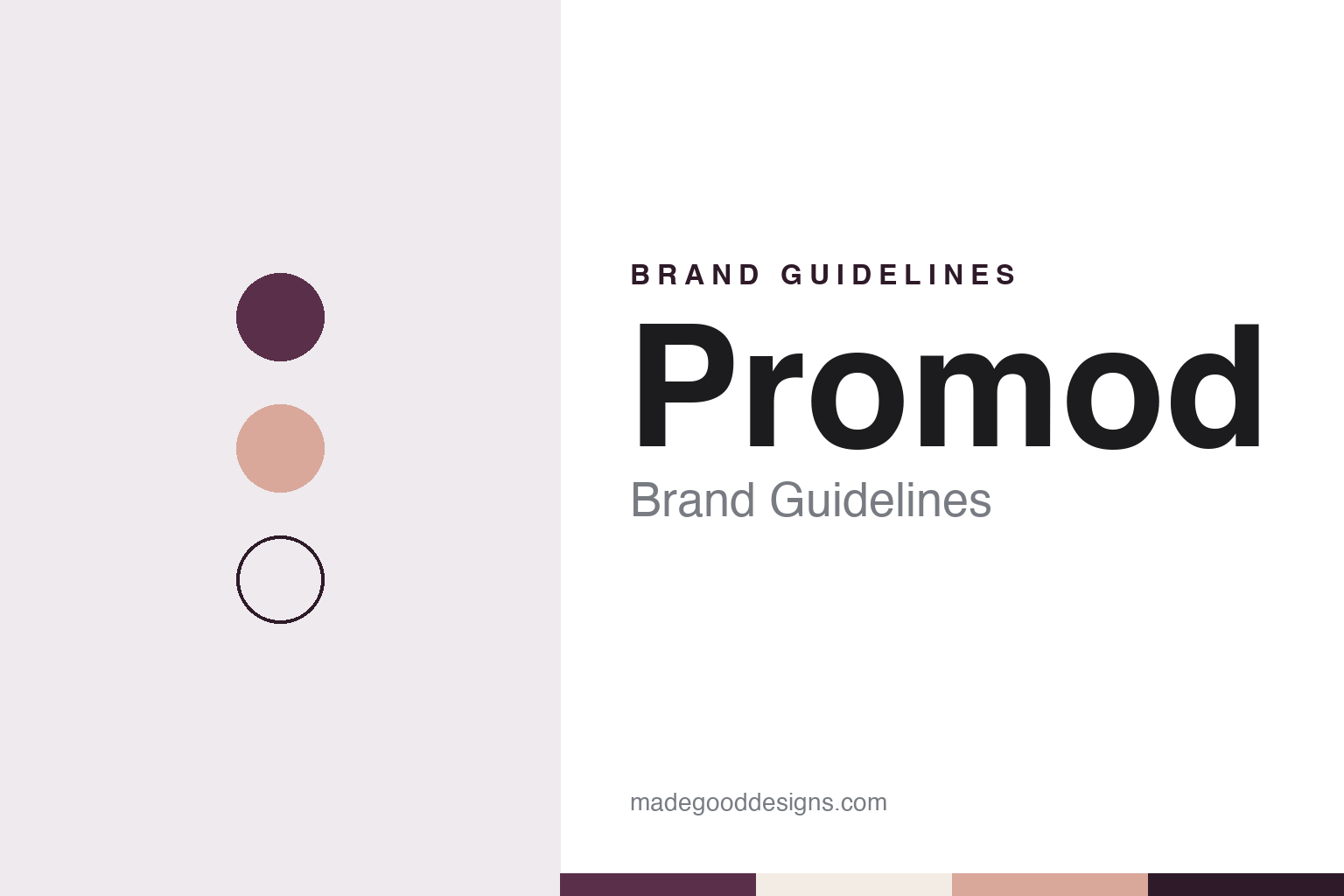
Promod Brand Guidelines
A family boutique from the Lille area that reached fifty.
Aa
Two constants: a plum, clay and linen palette and a boutique serif register. Abstract homage — not a Promod product or mark; no garment, logo or shop fascia is reproduced.
A family boutique
From one shop to subsidiaries across Europe.
Promod is a French chain of women’s ready-to-wear. English and French Wikipedia both date it to 1975, when Francis-Charles Pollet started it as a family boutique; French Wikipedia describes him as one of the heirs of the founder of La Redoute, the mail-order company in the same trade, where he spent the first part of his career. The company’s head office is at Marcq-en-Barœul, in the Lille metropolitan area of northern France, and it sells through its own shops, partner shops and concessions inside larger stores, the encyclopaedia says.
For its first fifteen years Promod traded only in France and Belgium. In 1990, French Wikipedia says, it opened a subsidiary in Spain, and through the 1990s and 2000s it added subsidiaries in the main countries of the European Union and in Central Europe, alongside an early online shop. From 1999 it added “partnerships” to its own shops, signing distribution contracts in the Middle East and, a few years later, in Russia.
The trade press tracked that growth. In September 2013 L’Observatoire de la Franchise described Promod as a family company with more than 1,000 points of sale in 55 countries and over 6,000 staff, and dated its moves abroad to 1990 for Europe, 2000 for the Middle East and Russia, and 2006 for Asia. The same report said Promod had opened its first shop in the United States on 29 August that year, in the Crossgates shopping centre at Albany, New York; had opened three corners in Debenhams department stores in Manchester, Cardiff and Glasgow; and had four corners in Ireland. It also reported a first menswear collection, sold online and in about ten French shops.
English Wikipedia gives a peak of more than 1,066 stores in 52 countries in 2014.
Colour
Fewer shops, fewer pieces, a new president.
The expansion did not last. In 2016, English Wikipedia says, falling profitability abroad led Promod to cut jobs (130 in English Wikipedia, 133 in French Wikipedia, which dates the decision to April 2016) and to end international franchise partnerships, closing about 500 stores, mainly in Europe — around half of the network. French Wikipedia adds that the shops were renamed “Promod Boutique Française” in 2015.
In September 2018 the chief executive Patrice Lepoutre left, and Julien Pollet, the founder’s son, took charge of the group, according to both encyclopaedias. From 2019, French Wikipedia says, the company moved from a mass model to what it called a “precision” model under the phrase “moins, mieux, plus durable” (less, better, more lasting): fewer collections, about a fifth fewer product references, higher quality, more sourcing closer to Europe, and round tables and co-creation events in which customers helped design pieces. It tested pre-orders, sold fabric remnants cut from its own offcuts, and began reselling second-hand clothing, while cutting stock and the number of shops in what it described as a market with too many mid-range chains.
The brand’s look changed with it. French Wikipedia says that in 2022 Promod introduced a new logo and an advertising campaign, “PRO-FEMMES,” built on its own name: words beginning with “pro” that point to women’s solidarity and commitment. That year it counted 418 shops, 380 of them in France. The encyclopaedia also lists design collaborations, among them a Promod x Pantone collection in 2021, work with La Gentle Factory in 2023 and a collaboration with Alexandra De Assunçao in 2022.
Typography
Design and documentation.
France’s mass-market fashion and childrenswear chains grew up mostly in retail parks and shopping centres rather than on high streets. Kiabi opened its first store at Roncq, outside Lille, in 1978, and Gémo was created by the Éram group in 1991 to sell shoes and clothing for the whole family in stores on the edges of towns. For these chains the shop fascia, the logo on the bag and the label inside the garment are often the same name, because most of what they sell is their own.
Own-label ranges carry much of the identity. The International Directory of Company Histories traces Kiabi’s house brands back to its first store, with Winch and Decade, and later children’s labels; Le Journal des Entreprises reported in 2021 that own-label products made up 85 to 90 per cent of Gémo’s offer. Catalogues, websites, apps and seasonal campaigns present those ranges, and logos are redrawn from time to time: Kiabi unveiled a new single-letter K in December 2025, CB News reported.
Many of the chains belong to family-owned groups, and their corporate pages say so plainly. Kiabi sits in the Mulliez family’s retail group alongside Auchan and Decathlon; Gémo belongs to Éram, based at Saint-Pierre-Montlimart in Maine-et-Loire; French Wikipedia describes Groupe Beaumanoir as a family group founded in 1981 by Roland Beaumanoir. Founders, owners and changes of control are part of each brand’s story, and receiverships and sales have reshaped several of these names in recent years.
This guide sets out what can be checked about each brand: who founded it, who owns it, how its stores, labels and logos have changed, and what has happened to it. Company statements are marked as such, and counts of stores and countries are given with the date of the source.
Aa
A boutique serif for a fifty-year-old women’s label. (Specimen set in DM Serif Display, a serif STAND-IN; NOT the Promod logo.)
Promod
Second-hand, sewing kits and a fiftieth birthday.
The later years added services rather than countries. In 2023, French Wikipedia says, Promod launched a new online store, built on a modular “API first” e-commerce architecture, offered clothing in sizes 34 to 48, and bought two brands of sewing-pattern kits to go with the fabric remnants it was selling from dormant stock. In May 2024 FashionUnited reported that the company had opened a pilot circular-fashion shop in Calais: a “laboratory” selling second-hand pieces, items with small repairable faults, the Promod Couture do-it-yourself range and the brand’s staple pieces, with flea markets, sewing kits and workshops on sewing and upcycling. The same report described Promod as a French, family-owned and independent company with 403 shops in five countries.
In 2024, French Wikipedia adds, Promod brought its second-hand take-back service, Promod reprise, in house: customers return used pieces to a shop in exchange for loyalty points, and the collected clothes are resold in its shops, including the Calais one. English Wikipedia lists the countries it trades in as France, Belgium, Switzerland and Luxembourg.
In 2025, French Wikipedia says, the company marked its fiftieth anniversary with a pop-up store in Paris and an “Archives” collection drawn from its past. As of February 2026, Actu.fr reported, Promod had eight shops in Paris, with others in nearby towns such as Montreuil, Levallois-Perret and Arcueil.
The founding family still runs it: Julien Pollet has been president since 2018, and the company describes itself as family-owned and independent.
For a design guide, Promod shows how a mid-range fashion chain can redraw its logo and its offer at the same time, moving from volume to fewer pieces, repairs and resale. Compare Etam, another French family group in women’s fashion, and Camaïeu, another French mid-range fashion chain. For this guide we use plum, clay and linen with a serif, an unofficial interpretation; no product or logo is reproduced.
Explore & save
Keep Promod’s identity on hand — save it to a board in the Made Good inspiration library.
Promod identity set
Pin the Promod plum, clay and linen palette and the boutique serif register to your own board.
Source & notes
Frequently Asked Questions
What font can I use to match the Promod look?
This guide describes Promod’s type as “A boutique serif for a fifty-year-old women’s label”. Its type specimen is set in DM Serif Display from Google Fonts as a stand-in; DM Serif Display is not Promod’s own lettering.
What colours are in the Promod palette?
This guide’s Promod palette is Ink plum #5A2F4A, Deep aubergine #2E1A28, Blush clay #D9A89B, Linen #F3ECE4 and Washed denim #5D7690. The tones are the guide’s own unofficial interpretation, not official Promod hex codes.
When was Promod founded?
Promod was founded in 1975, in Lille area, France. Promod is known for Women’s ready-to-wear, Promod Couture, Promod reprise.
Who founded Promod?
Promod was founded by Francis-Charles Pollet in 1975. Promod is known for Women’s ready-to-wear, Promod Couture, Promod reprise.