Toyworld Brand Guidelines
One toy-shop name over many independently owned stores.
Aa
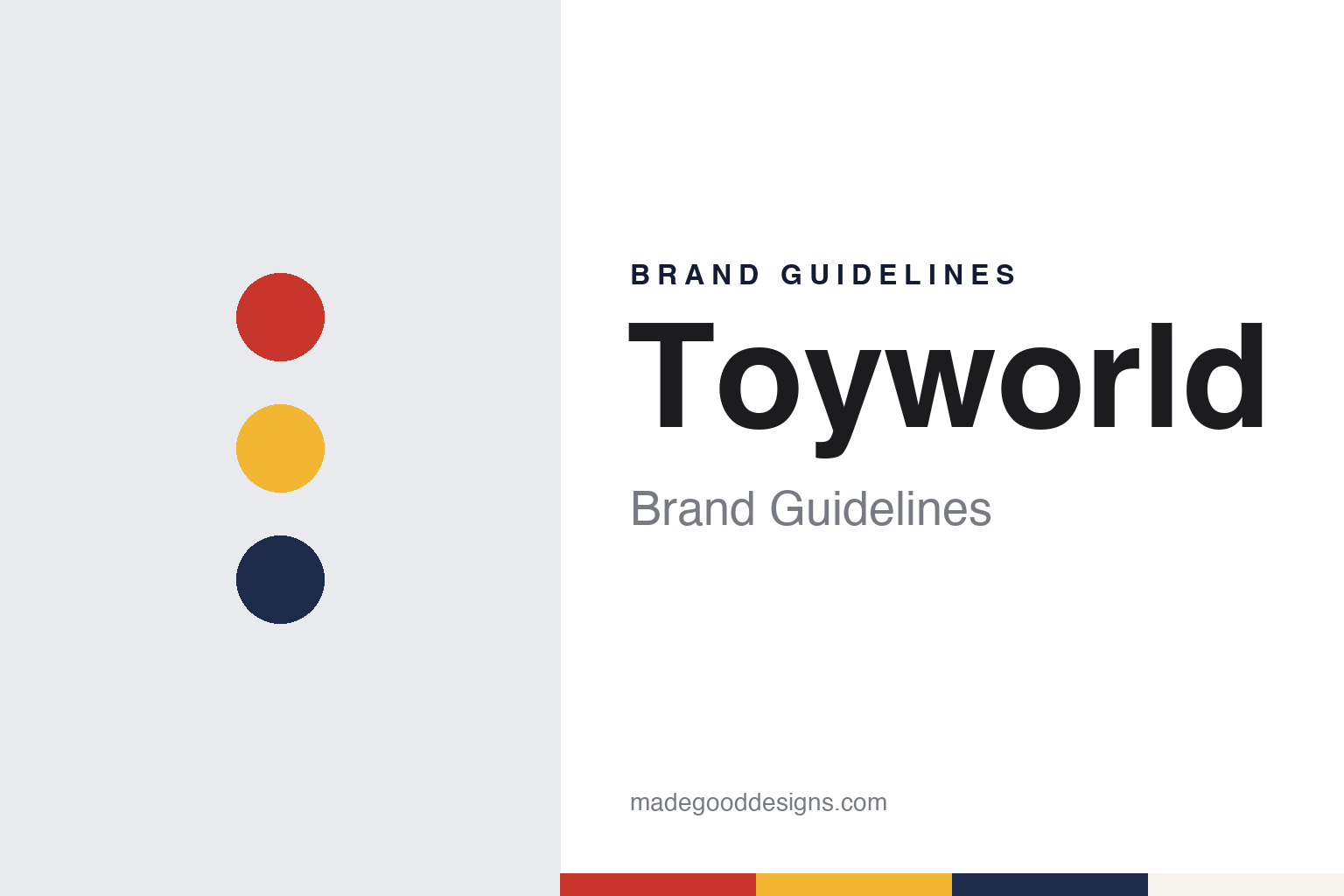
Two constants: a red, yellow and ink-blue palette and a rounded sans register. Abstract homage — not a Toyworld asset or mark; no logo, shop sign or product is reproduced.
A banner, not a chain
A co-operative buying group and its toy name.
Toyworld is not a chain in the usual sense. It is a shared shop name used by independently owned toy shops in Australia and New Zealand, and the name belongs to Associated Retailers Limited (ARL), a co-operative buying group. ARL says it was established in 1959 to provide services and benefits to independent retailers, and that its members can trade under trademarks the co-operative owns while drawing on its buying relationships with large suppliers.
Toyworld’s own history is short and comes from the company. Its Australian and New Zealand websites both say that Toyworld began as the toy arm of ARL in the mid-1970s, and that it has served local communities for more than 50 years. The toy name sits beside other ARL banners: the co-operative lists Toyworld with sports, outdoor and footwear names including SportsPower, Camping World, Compleat Angler and Shoex, and describes its work as licensing those brands to members and providing retail and marketing services. ARL names those services as campaign marketing, promotions, brand support and a centralised accounting system, run from what it calls a National Support Office.
The arrangement shapes what a shopper sees. Toyworld’s help centre says each store is independently owned and operated by local families and business owners, and that product ranges, prices and promotions may therefore vary from store to store.
Local newspapers show how that works in practice. In July 2023 the Bairnsdale Advertiser, in Victoria’s East Gippsland, reported that Toyworld Bairnsdale had changed hands on 1 July after 39 years with the same owners, who had taken it over on the same date in 1984; the paper noted the changes they had seen over that time, from cash to card payments to online shopping. In July 2024 the Shepparton Adviser reported that a new Toyworld had opened in Shepparton, run by the owners of the Toyworld in nearby Benalla, under the same roof as a Sportspower store — two ARL banners side by side.
Colour
Two countries, one name, many owners.
The network reaches across the Tasman. As of November 2026 Toyworld’s Australian website described more than 120 locally owned member stores across Australia and New Zealand, and its New Zealand website listed more than 30 locations in that country; both figures are the company’s own. The independent count is from RNZ, New Zealand’s public broadcaster, which reported on 17 December 2024 that Toyworld had opened five new stores that year, in Whangarei, Milford, Whitianga, Rotorua and Nelson, and then had 32 stores across New Zealand.
RNZ’s report gives a rare view of how the banner sees its customers. Toyworld’s general manager told the broadcaster that interest in locally owned and operated shops had risen. She said the biggest group of customers was people aged 65 and over buying for grandchildren in store, and that men over 40 buying collectables and LEGO were another important group, alongside the brand’s work on its online shop.
Not every store lasts. In January 2018 the Otago Daily Times reported that Toyworld Dunedin, owned and run by the same person since 2004, was closing when its lease ended. The owner told the paper that there had been 12 Toyworld stores in New Zealand’s South Island when she started and only five by then — three in Christchurch, one in Invercargill and one in Westport — and pointed to competition from chain stores and internet retailers.
Typography
Toy store chains and their signs.
Toy-shop chains in Europe, Latin America and Australia usually introduce themselves through a shop sign and a seasonal catalogue. Some of their names began as something else entirely: the Belgian chain DreamLand started as a neighbourhood supermarket called LIMA in Liedekerke in 1956 and turned to toys in 1978, according to Dutch Wikipedia. Logos, colour schemes and shop signs change over time, and each guide in this series describes the current sign only as the company itself shows it.
Store networks take several forms: high-street shops, large stores on retail parks, franchise branches and online shops. Branch, staff and country counts in these guides are given only with their source and date, because toy-shop networks grow and shrink through takeovers, rebrands, bankruptcies and closures, and a chain that has closed is described as closed.
A number of chains began as buying groups or associations of independent toy shops. Intertoys in the Netherlands grew out of a purchasing organisation that started buying toys in 1976, and NRC reported in October 2024 that about half of its shops were still run by franchisees. Where a name covers a network of independently owned shops rather than branches of one company, these guides say so plainly, and they describe owners, from retail groups and investors to founding families, as dated facts.
Chains also name their own ranges, catalogues and seasonal campaigns, such as the Intertoys Speelboek, published each September since 1987, and these guides name them only as the companies do. Corporate pages and company histories describe founders and owners; each guide sets out what can be checked against dated, independent sources, with any gap in the record stated plainly.
Aa
A rounded, friendly sans for a shared shop name. (Specimen set in Baloo 2, a rounded sans STAND-IN; NOT the Toyworld logo.)
Toyworld
A name shared by owner-run shops.
The Toyworld name does a particular job. Because every shop is separately owned, the banner is what ties a store in a regional Victorian town to one in a New Zealand shopping centre. The company’s websites present the same story on both sides of the Tasman — the Australian site calls the business proudly Australian owned and operated, the New Zealand site proudly New Zealand owned and operated — and both sites sell online with click and collect, while the New Zealand site also shows real-time stock availability.
The sites name the kinds of toys the stores carry rather than any own-label range: collectables, games, STEM kits and outdoor play sets, from suppliers the company names as LEGO, Fisher-Price, Hasbro and Ravensburger. A shared catalogue and a Toyworld Club email list are the other common threads, alongside the services ARL says it provides to members. The local papers add the details a website leaves out: lay-by at the counter in Shepparton, and a shop in Bairnsdale that stayed with one owning couple for almost four decades before passing to new owners in 2023.
That mix — a co-operative behind the scenes, a common name on the sign and an owner in each shop — is shared with other buying groups of independent toy retailers, such as JouéClub in France.
For a design guide, Toyworld shows how one shared shop name can hold together a network of separately owned businesses across two countries. Compare JouéClub, a French cooperative of independent toy shops, and Toys “R” Us. For this guide we use a toy-box red, a sunshine yellow and an ink blue with a rounded sans, an unofficial interpretation; no product or logo is reproduced.
Explore & save
Keep Toyworld’s identity on hand — save it to a board in the Made Good inspiration library.
Toyworld identity set
Pin the Toyworld red, yellow and ink-blue palette and the rounded sans register to your own board.
Source & notes
Frequently Asked Questions
What font can I use to match the Toyworld look?
This guide describes Toyworld’s type as “A rounded, friendly sans for a shared shop name”. Its type specimen is set in Baloo 2 from Google Fonts as a stand-in; Baloo 2 is not Toyworld’s own lettering.
What colours are in the Toyworld palette?
This guide’s Toyworld palette is Toy-box red #C8352B, Sunshine yellow #F2B632, Ink blue #1E2A4A, Paddock green #2F6B4F and Chalk #F6F3EC. The tones are the guide’s own unofficial interpretation, not official Toyworld hex codes.
When was Toyworld founded?
Toyworld was founded in Mid-1970s, as the toy arm of ARL (the company says), in Australia.