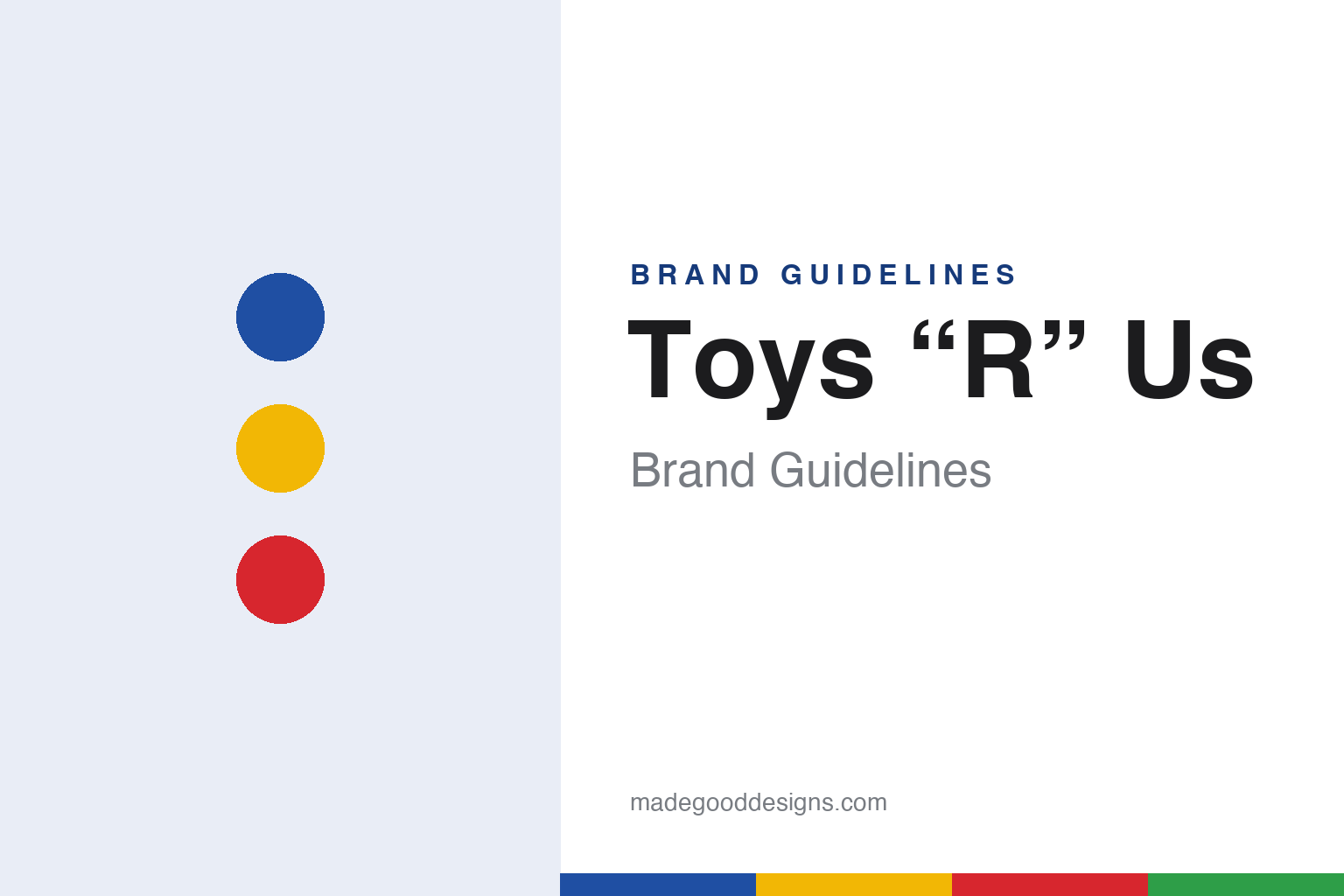
Toys “R” Us Brand Guidelines
A backwards R, a giraffe called Geoffrey and a name that outlived its stores.
Aa
Two constants: a letter blue, star yellow and toy-box red palette and a rounded toy-box sans register. Abstract homage — not a Toys “R” Us product or mark; no logo, giraffe or storefront is reproduced.
Children’s Bargain Town
A furniture store, a reversed letter and a supermarket idea.
Toys “R” Us began as a baby-furniture shop. English Wikipedia dates the business to April 1948, when Charles Lazarus opened a store in Washington, D.C., during the postwar baby boom; its lead calls that store Children’s Supermart, while the Associated Press, in a March 2018 report carried by FOX 4, named it Children’s Bargain Town and said Lazarus opened it in his hometown after returning from the Second World War. The AP said he began selling toys after a couple of years because customers asked for them, and concluded that in the baby-boom years toys were a better business than furniture.
In 1957, the AP reported, Lazarus opened a store selling only toys and called it Toys R Us, with the “R” spelled backward to give the impression that a child had written the name. Wikipedia places that store in Rockville, Maryland, dates the switch to June 1957, and says Lazarus designed and stylised the logo himself, reversed letter included. The name is still written with the turned R, set between quotation marks in the official spelling, Toys “R” Us.
The format borrowed from groceries. Lazarus modelled the business on the self-service supermarkets that were spreading in the 1950s, the AP said, stacking merchandise high so that shoppers felt the store held an endless supply of toys, and leaving shopping carts by the door for customers to fill themselves. Wikipedia records that the business was acquired in 1966 by Interstate Department Stores, and that the toy chain spread across the United States in the 1970s and expanded abroad in the mid-1980s, with Canadian and British divisions. Lazarus stepped down as chief executive in 1994, according to the AP, which also noted his induction into the Toy Industry Association’s Hall of Fame in 1990.
The name became a family of names. Wikipedia lists Kids “R” Us, a children’s clothing chain whose stores opened in February 1983 in Paramus, New Jersey, and Brooklyn, and Babies “R” Us, whose stores opened from April 1996, each repeating the reversed R and the quoted letter. A store format called Concept 2000, introduced in July 1996 at Raritan, New Jersey, gave the shops blue facades with yellow-lined windows, Wikipedia says. In November 2001 the company opened a flagship in New York’s Times Square with themed zones and an indoor Ferris wheel.
Colour
Private equity, a liquidation and a brand-management owner.
In 2005 a consortium of Bain Capital, Kohlberg Kravis Roberts and Vornado Realty Trust took the company private, Wikipedia records. Toys “R” Us, Inc. filed for Chapter 11 protection in September 2017 and closed its remaining US stores the following year, as Fox Business summarised in September 2026. Outside the United States some divisions kept trading, and Wikipedia notes that the Canadian business was sold separately in 2018 and continued under the Toys “R” Us name.
The intellectual property went on. Wikipedia says the company’s lenders chose in October 2018 to revive the Toys “R” Us and Babies “R” Us names rather than auction them, and that a wholesale store-within-a-store concept called Geoffrey’s Toy Box was shown at the Toy Industry Association’s Fall Toy Preview that year. The business emerged from bankruptcy as Tru Kids on 20 January 2019. Retail Dive reported in March 2021 that Tru Kids had been formed from the intellectual property and international operations, that its two new US stores — opened in late 2019 as a joint venture with the retail-platform company b8ta, renting space to toy brands rather than buying stock — had closed early in 2021, and that its website had sent buyers to Target and later to Amazon.
On 15 March 2021 Retail Dive reported that Tru Kids had sold a controlling stake to WHP Global, the New York brand-management firm that owns Anne Klein and Joseph Abboud, and that WHP would manage the global Toys “R” Us business. WHP’s chairman and chief executive, Yehuda Shmidman, had been vice chairman of Tru Kids since 2019. WHP Global has controlled the brand since then. On 19 August 2021, Fox Business reported, WHP announced a partnership with Macy’s, Inc. to put Toys “R” Us shops inside Macy’s department stores from 2022 and a Toys “R” Us section on Macys.com.
Standalone stores have followed. Wikipedia records a two-storey flagship at the American Dream complex in East Rutherford, New Jersey, opened in December 2021, and a store in Mexico City through the department-store group Liverpool in October 2023. In September 2026, Fox Business reported, the brand announced new standalone US stores for the holiday season through a partnership with Go! Retail Group, with some locations planned to include candy shops, cafés and “Creator Studios” for content and product launches. Jamie Uitdenhowen, executive vice president of Toys “R” Us at WHP Global, said the brand now reaches shoppers through standalone stores, Macy’s shops, airport locations and Navy Exchanges.
Typography
Design and documentation.
A toy store’s identity is rarely carried by a single object. It sits in the sign above the door, in the lettering on a shopping bag, in a printed catalogue that arrives before the holidays and, for some chains, in a mascot drawn to be recognised by children before they can read the name beside it. Each of those pieces is made to be seen at a different distance — across a car park, on a shelf, at a kitchen table — and each tends to be redrawn as owners, formats and printing methods change.
Many toy-store names have also outlived the shops that first carried them. A name can pass through mergers, administrations and sales, and may return as a website, a brand licensed to another retailer or a section inside a larger store, so the mark a shopper sees today may belong to a different company from the one that opened the original branches.
Each guide in this group separates what independent, dated sources record from what a company says about itself: who opened the first store and when, who has owned the name since, what became of the shops, and how the signs, bags, catalogues and characters have been drawn — marking plainly what rests only on the company’s own word.
Aa
A rounded toy-box sans — the register of a shop fascia and a price card. (Specimen set in Baloo 2, a rounded sans-serif STAND-IN; NOT the Toys “R” Us logo.)
Toys “R” Us
A reversed letter, a giraffe and a jingle.
The Toys “R” Us identity rests on a letter, an animal and a song. The letter is the backwards R, which the AP described as a device to make the name look as if a child had written it; Fox Business captioned a 2026 photograph of a classic store front with a reference to its multicoloured logo, the letters set in different colours above the entrance. The reversed R has carried across every spin-off name, from Kids “R” Us to Babies “R” Us, so the letter works as a family mark as much as a spelling.
The animal is Geoffrey the Giraffe. Wikipedia says a giraffe called “Dr. G. Raffe” appeared in 1950s print advertising for the furniture store, and that the character changed in name and appearance over the following decade. The AP dated Geoffrey’s role as company mascot to 1965 and his television debut to 1973. Wikipedia says the design went through several phases before a star-spotted version was settled in November 2007, and the Tru Kids era kept the giraffe in the name of Geoffrey’s Toy Box and in the holding company Geoffrey LLC. In 2024 the brand released a commercial made with OpenAI’s Sora video tool that showed Lazarus as a boy dreaming of Geoffrey in a surreal toy shop; Wikipedia notes that it drew criticism online, and that Ars Technica pointed out visual errors in it.
The song is the jingle the AP quoted, “I’m a Toys R Us kid”, which the AP said became an anthem for children across the country in the 1980s and early 1990s. Under WHP Global the name, the giraffe and the reversed letter have been licensed into Macy’s shops, airport stores and new standalone stores.
For a design guide, Toys “R” Us shows how a single deliberate mistake in a logotype, backed by a mascot and a jingle, can hold a brand together through private equity, liquidation and a second life as a licensed name in other retailers’ stores. Compare it with FAO Schwarz, the New York toy store it owned from 2009 to 2016, and Macy’s, whose department stores have housed Toys “R” Us shops since 2022. For this guide we use letter blue, star yellow and toy-box red with a rounded sans, an unofficial interpretation; no product or logo is reproduced.
Explore & save
Keep Toys “R” Us’s identity on hand — save it to a board in the Made Good inspiration library.
Toys “R” Us identity set
Pin the Toys “R” Us letter blue, star yellow and toy-box red palette and the rounded toy-box sans register to your own board.