KB Toys Brand Guidelines
Two brothers’ initials, a mall toy chain and a name revived for merchandise.
Aa
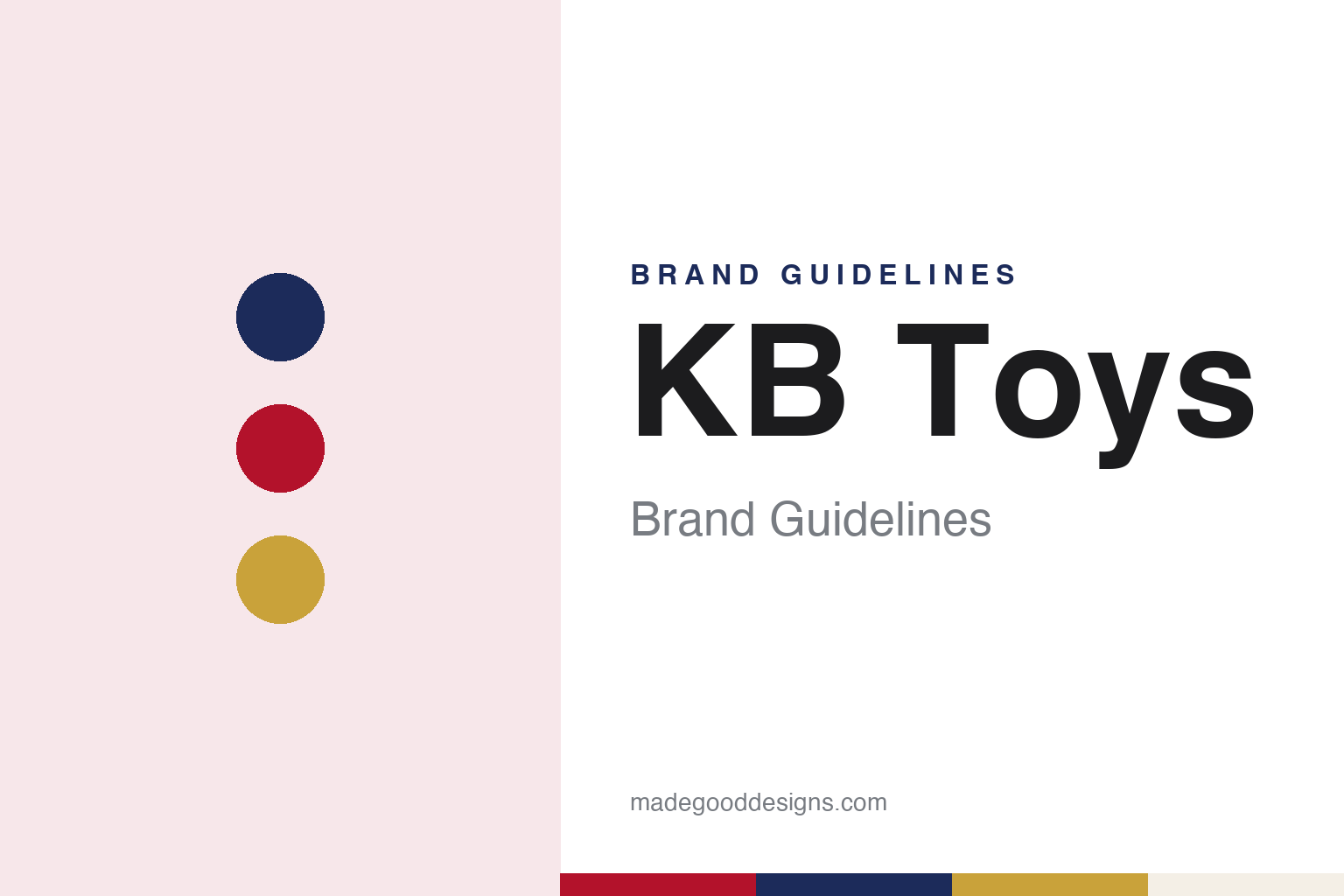
Two constants: a mall red, soldier navy and brass gold palette and a bold mall-sign sans register. Abstract homage — not a KB Toys product or mark; no logo, soldier or storefront is reproduced.
Kaufman Brothers
Candy, a debt paid in toys and two initials.
KB Toys began as a candy business in western Massachusetts. English Wikipedia, drawing on reports in the Berkshire Eagle, says the brothers Harry and Joseph Kaufman opened a wholesale candy and soda-fountain supply firm, Kaufman Brothers, in Pittsfield on 1 April 1922. The Toy Book gave the same founders, year and trade in November 2024. The letters that later became the brand were simply the initials of that partnership: K and B, spoken as Kay-Bee.
The move into toys came by accident, Wikipedia says. In the 1940s the brothers took over a wholesale toy company from a candy customer who owed them money, and on 21 September 1946 Kaufman Brothers opened a wholesale toy business on Columbus Avenue in Pittsfield. Wartime shortages of sugar had made candy harder to supply, and in 1948 the brothers sold the candy side to concentrate on toys. Family members joined the business over the following years, and Wikipedia says its retail stores also arrived through debts: a shop in Winsted, Connecticut, came to the company in 1960 in lieu of payment.
Retail took over in the 1960s and 1970s. Wikipedia records a store called Playworld in Pittsfield in 1963, a mall store in Springfield, Massachusetts, in 1968, and a move of headquarters to Lee, Massachusetts, in 1970. In 1973 the company left wholesaling altogether and became a shopping-mall toy retailer named Kay-Bee Toy & Hobby, the name built from the initials of Kaufman Brothers. The Kaufman family sold the business to the Melville Corporation in 1981, Wikipedia says, and it later added Circus World and K&K Toys stores, converting them to its own name. By 1990, Wikipedia records, the chain advertised itself as “The Toy Store in the Mall”, a line that described its format as much as its location.
The spelling changed with the owners. PolitiFact, reviewing an old KB Toys commercial in January 2012, said the “Kay-Bee” name on its logo was abandoned by the company in 1981; Wikipedia dates the change of the store logo to “KB” to 1998, the year the company launched a merchandise website. The Toy Book lists the banners the company used over the years as K•B Toys, Kaybee Toys, KB Toy Works, KB Toy Outlet, KB Toy Liquidators and KB Toy Express — a family of formats running from regular mall shops to larger strip-mall stores, outlet-mall clearance stores and temporary holiday units.
Colour
Consolidated Stores, Bain Capital and two bankruptcies.
Melville sold the chain to Consolidated Stores Corporation in 1996, Wikipedia says, and in 1999 Consolidated relaunched the company’s website as KBKids.com. In December 2000 Bain Capital bought KB Toys in partnership with its management team, ending two decades as a subsidiary of larger retail groups. From 2001, Wikipedia records, the company ran temporary stores within Sears department stores at Christmas, initially called “KB Toys at Sears”; The Toy Book mentions the same KB-branded toy departments at Sears. Headquarters had moved back to Pittsfield by then, where a new building was begun in 1986.
The chain filed for Chapter 11 protection in January 2004, as PolitiFact recounted from an Associated Press report of that month, and emerged in August 2005 majority-owned by PKBT Holdings, an affiliate of Prentice Capital Management, Wikipedia says. On 11 December 2008 KB Toys filed for bankruptcy protection a second time, in Delaware, and began going-out-of-business sales, the Associated Press reported that day; Wikipedia dates the end of those sales, and of the company’s website, to 9 February 2009.
What remained was the name. Wikipedia says the KB Toys brand, logo, website and trademarks were sold to Toys “R” Us in September 2009, and that Toys “R” Us used the KB logo on some of its own toys under the name “KB Classics”. FOX Business reported in March 2018 that Strategic Marks, a company founded by Ellia Kassoff, owned the rights to KB Toys and was considering a return to stores; Wikipedia says Strategic Marks had registered the trademark in 2016 after Toys “R” Us let the earlier registration lapse. The Toy Book wrote in November 2024 that those pop-up stores never materialised.
The 2024 revival is a licensing one. On 19 November 2024 The Toy Book reported that Firefly Brand Management had signed a multicategory licensing agreement with MH Enterprises on behalf of KB Toys and its owner, Strategic Marks. MH Enterprises, run by Marc and Marianna Heon — a couple who met while working at KB Toys — became master toy partner, with rights extending to apparel, decor, enamel goods, paper goods and drinkware, and to the KB Toys name and logo in comic books, at conventions and in a newsletter. A website, kbtoysverse.com, opened with print-on-demand apparel and gifts carrying classic KB graphics. KB Toys has had no stores of its own since 2009; Strategic Marks has owned the name since 2016.
Typography
Design and documentation.
A toy store’s identity is rarely carried by a single object. It sits in the sign above the door, in the lettering on a shopping bag, in a printed catalogue that arrives before the holidays and, for some chains, in a mascot drawn to be recognised by children before they can read the name beside it. Each of those pieces is made to be seen at a different distance — across a car park, on a shelf, at a kitchen table — and each tends to be redrawn as owners, formats and printing methods change.
Many toy-store names have also outlived the shops that first carried them. A name can pass through mergers, administrations and sales, and may return as a website, a brand licensed to another retailer or a section inside a larger store, so the mark a shopper sees today may belong to a different company from the one that opened the original branches.
Each guide in this group separates what independent, dated sources record from what a company says about itself: who opened the first store and when, who has owned the name since, what became of the shops, and how the signs, bags, catalogues and characters have been drawn — marking plainly what rests only on the company’s own word.
Aa
A bold mall-sign sans — the register of a shop fascia in a shopping-centre corridor. (Specimen set in Rubik, a sans-serif STAND-IN; NOT the KB Toys logo.)
KB Toys
Initials, puppets and a toy soldier.
The KB Toys identity was never far from its origin: two letters standing for Kaufman Brothers. As Kay-Bee, the initials were spelled out as a word; as K•B and then KB, they were set as letters on a sign, short enough to read along a shopping-mall corridor. Wikipedia dates the bare “KB” logo to 1998, and The Toy Book said the 2024 merchandise carries classic KB Toys graphics.
Advertising gave the brand a voice. PolitiFact described a KB Toys commercial in which puppets sang about a place with all the “hottest toys”, ending on the line “Hot we got at KB Toys!”, with a logo still showing the old Kay-Bee name. Wikipedia records “The Toy Store in the Mall” as the chain’s advertising line by 1990, a description of the format rather than a promise about prices.
The character that leads the revival is a soldier. The Toy Book introduced its November 2024 report on the licensing deal with the line that “the Toy Soldier is suited up”, and said MH Enterprises could also use the KB Toys store design for immersive experiences.
For a design guide, KB Toys shows how a brand built from two founders’ initials can outlive both its family owners and its stores, passing through sale, bankruptcy and a decade without shops before returning as a licensed name on apparel and gifts. Compare it with Toys “R” Us, which bought the KB Toys name in 2009, and FAO Schwarz, another American toy-store name that changed hands several times. For this guide we use mall red, soldier navy and brass gold with a sans, an unofficial interpretation; no product or logo is reproduced.
Explore & save
Keep KB Toys’s identity on hand — save it to a board in the Made Good inspiration library.
KB Toys identity set
Pin the KB Toys mall red, soldier navy and brass gold palette and the bold mall-sign sans register to your own board.