FAO Schwarz Brand Guidelines
A Baltimore toy bazaar, a Fifth Avenue piano and a clock tower rebuilt at Rockefeller Plaza.
Aa
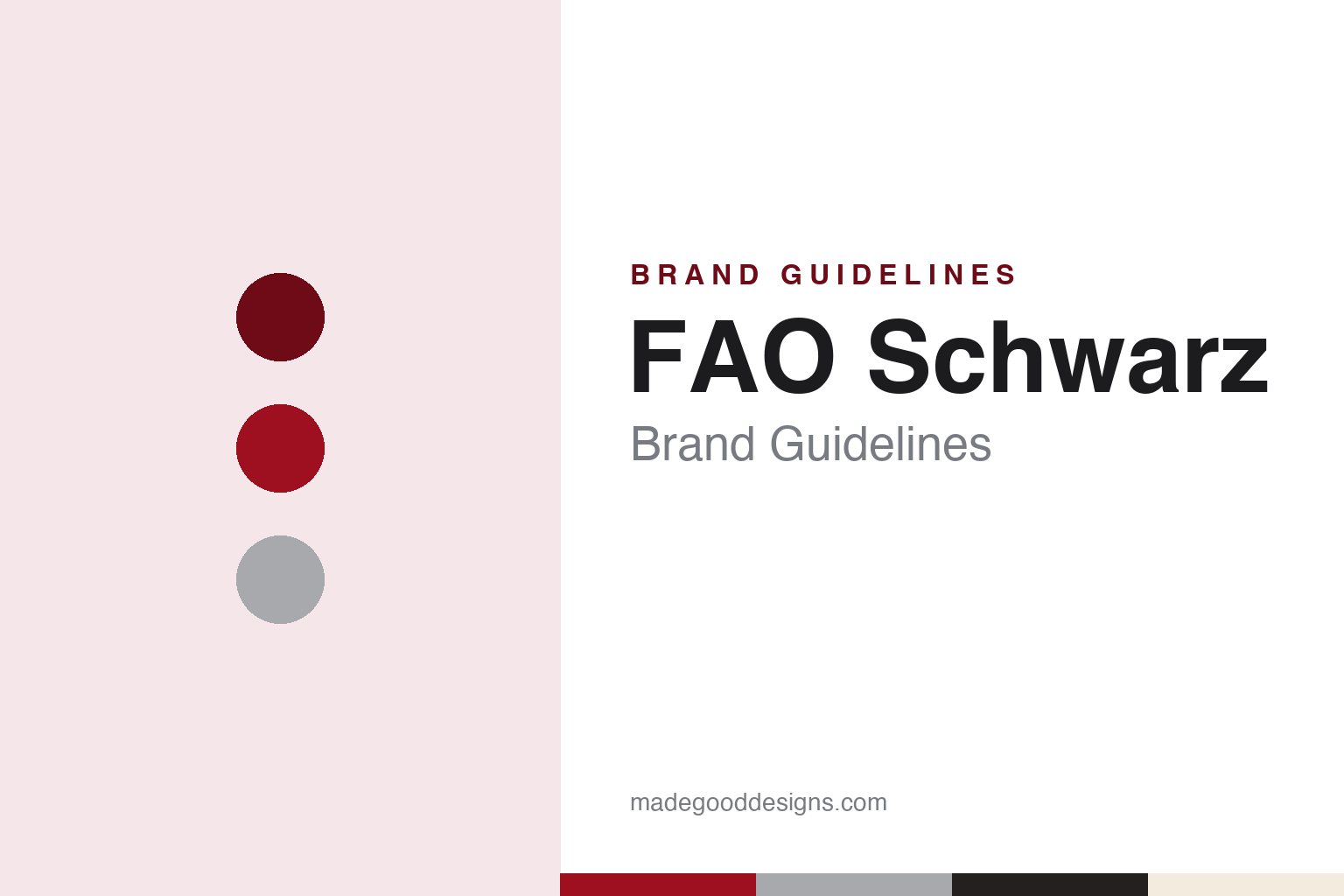
Two constants: a bazaar red, silver and plush cream palette and a display serif register. Abstract homage — not an FAO Schwarz product or mark; no logo, clock tower or piano is reproduced.
Toy Bazaar
Three brothers, Baltimore and a move to Broadway.
FAO Schwarz takes its name from its founder’s initials. Frederick August Otto Schwarz emigrated from Germany to Baltimore in 1856, the New York site 6sqft wrote in July 2015, and six years later he and his two older brothers opened Toy Bazaar, a small fancy-goods shop selling stationery and toys. English Wikipedia dates the founding to 1862 in Baltimore, as did the Associated Press in November 2018. 6sqft says the brothers went on to open stores in Boston and Philadelphia.
New York came next. In 1870, 6sqft wrote, Frederick moved to the city and opened Schwarz Brothers-Importers at 765 Broadway, stocking it with toys made in Europe; Wikipedia calls the store the Schwarz Toy Bazaar. A second location followed, along with a catalogue — Wikipedia says the store’s holiday catalogue has been published annually since 1876. In 1880 the business consolidated at 42 East 14th Street on Union Square, and in 1897 it moved to West 23rd Street. By 1890, according to 6sqft, the store had taken the name FAO Schwarz, and in 1910 it moved to Fifth Avenue at 31st Street.
Fifth Avenue became the address that defined the brand. In 1931 the store moved to 745 Fifth Avenue near 58th Street and stayed there for 55 years, 6sqft wrote. Ownership changed repeatedly over the following decades: Wikipedia lists Parents’ Magazine Enterprises from 1963, W. R. Grace from 1970 and the Zurich toy retailer Franz Carl Weber from 1974. In 1986 the company was sold to Peter Harris and Peter Morse, who moved the store across 58th Street into the General Motors Building at 767 Fifth Avenue. The Associated Press described that store in 2018 as a fantasyland with its own theme song, doormen dressed like palace guards and a musical clock tower. Wikipedia records a sale to the Dutch retailer Royal Vendex in 1990 and new FAO Schwarz stores across the United States in the 1990s.
Colour
Right Start, Toys “R” Us and ThreeSixty Group.
The 2000s brought further changes. Wikipedia says the Calabasas toy retailer Right Start bought the Fifth Avenue store and other locations in 2001, and the Associated Press reported in 2018 that Right Start, which took the corporate name FAO Inc., filed for bankruptcy twice. Wikipedia says the investment firm D. E. Shaw & Co. acquired the New York and Las Vegas stores, with the catalogue and internet business, in February 2004, and that the Fifth Avenue store reopened, redesigned, on Thanksgiving Day 2004.
In 2009 Toys “R” Us took over, 6sqft wrote, turning FAO Schwarz into a brand sold across its own stores; Wikipedia records FAO Schwarz boutiques inside Toys “R” Us stores from 2009 and FAO-branded infant and toddler goods in Babies “R” Us. The Fifth Avenue store closed in July 2015, with its owner citing rising rents, 6sqft reported that month. On 4 October 2016 ThreeSixty Group of Irvine, California, announced in a Business Wire release that it had acquired FAO Schwarz, which Toys “R” Us had owned since 2009. Co-founder Kirk McLean said the company would invest in the brand, and the release promised a new FAO Schwarz toy collection and in-store experiences for other retailers from 2017. English Wikipedia says the name and trademarks belong to the FAO Schwarz Family Foundation and are licensed exclusively to ThreeSixty Group, which owns and operates the stores.
The New York store returned on 16 November 2018 at 30 Rockefeller Plaza, about ten blocks from the old Fifth Avenue site, the Associated Press reported that day. The two-level shop brought back the clock tower at its entrance, filled its shelves with the plush animals that the AP said had long defined the brand, and added a toy grocery store, a baby-doll adoption station, live magic shows and a rocket ship crewed by stuffed bear astronauts. “We are about experiences,” chief merchandising officer David Niggli told the AP. The law firm Watson Farley & Williams, which advised ThreeSixty Brands on the store’s construction contract, described it in December 2018 as a 2.5-storey emporium built against the deadline of the holiday season.
The brand has since travelled. The AP reported holiday pop-ups in England, Spain and Australia in 2018 and a planned store in Beijing; Wikipedia records shops at Midway International Airport in Chicago from 2019, inside Arnotts in Dublin and Selfridges in London, in Milan from 2021 and at Galeries Lafayette Haussmann in Paris from 2024. ThreeSixty Group has run the brand since 2016, and its online store remained open in October 2026.
Typography
Design and documentation.
A toy store’s identity is rarely carried by a single object. It sits in the sign above the door, in the lettering on a shopping bag, in a printed catalogue that arrives before the holidays and, for some chains, in a mascot drawn to be recognised by children before they can read the name beside it. Each of those pieces is made to be seen at a different distance — across a car park, on a shelf, at a kitchen table — and each tends to be redrawn as owners, formats and printing methods change.
Many toy-store names have also outlived the shops that first carried them. A name can pass through mergers, administrations and sales, and may return as a website, a brand licensed to another retailer or a section inside a larger store, so the mark a shopper sees today may belong to a different company from the one that opened the original branches.
Each guide in this group separates what independent, dated sources record from what a company says about itself: who opened the first store and when, who has owned the name since, what became of the shops, and how the signs, bags, catalogues and characters have been drawn — marking plainly what rests only on the company’s own word.
Aa
A display serif — the register of a Fifth Avenue window card and a gift box. (Specimen set in Playfair Display, a serif STAND-IN; NOT the FAO Schwarz logo.)
FAO Schwarz
Initials, a clock tower and a piano underfoot.
The FAO Schwarz identity is built from a founder’s initials and the furniture of a store. Wikipedia says versions of the logo over the years have included a teddy bear, toy blocks, a toy soldier, a rocking horse and an animated clock tower. In 2010, under Toys “R” Us, the logo was redesigned in red and silver, putting the emphasis on the initials of Frederick August Otto Schwarz, and a company mascot named Wit was introduced. In 2017, Wikipedia says, ThreeSixty hired the design studio Mattson Creative to rebrand the logo and packaging, and the studio wrote the reopening tagline and hashtag, “Return to Wonder”.
One of the store’s signature objects is one visitors stand on. In the 1988 film Big, Tom Hanks and Robert Loggia dance “Heart and Soul” and “Chopsticks” on a giant floor piano in the Fifth Avenue store, Wikipedia says; 6sqft called it the giant floor piano immortalised by the film. When the store reopened at Rockefeller Plaza in 2018, the AP reported, a giant piano keyboard mat was installed on the upper level and reflected on the ceiling so that people in the plaza below could watch, and smaller replica mats were sold in the shop. Watson Farley & Williams said the keyboard and the clock tower had been brought back as an homage to the old store.
Wikipedia lists the piano dance mat and large plush animals among the things the brand is known for, and the store has carried Steiff and Build-A-Bear Workshop as in-store partners. Its appearance in films from Big to Home Alone 2: Lost in New York, whose fictional toy shop Wikipedia says the store’s interior inspired, kept the Fifth Avenue rooms on screen for decades.
For a design guide, FAO Schwarz shows how a shop can carry its identity in fixtures — a clock tower, a keyboard on the floor, a wall of plush — so that a new owner at a new address can rebuild the experience rather than just reprint the logo. Compare it with Toys “R” Us, which owned it from 2009 to 2016, and Build-A-Bear, one of its in-store partners. For this guide we use bazaar red, silver and plush cream with a serif, an unofficial interpretation; no product or logo is reproduced.
Explore & save
Keep FAO Schwarz’s identity on hand — save it to a board in the Made Good inspiration library.
FAO Schwarz identity set
Pin the FAO Schwarz bazaar red, silver and plush cream palette and the display serif register to your own board.