Juguetron Brand Guidelines
A Mexico City toy chain of 1989 that also runs another company’s stores.
Aa
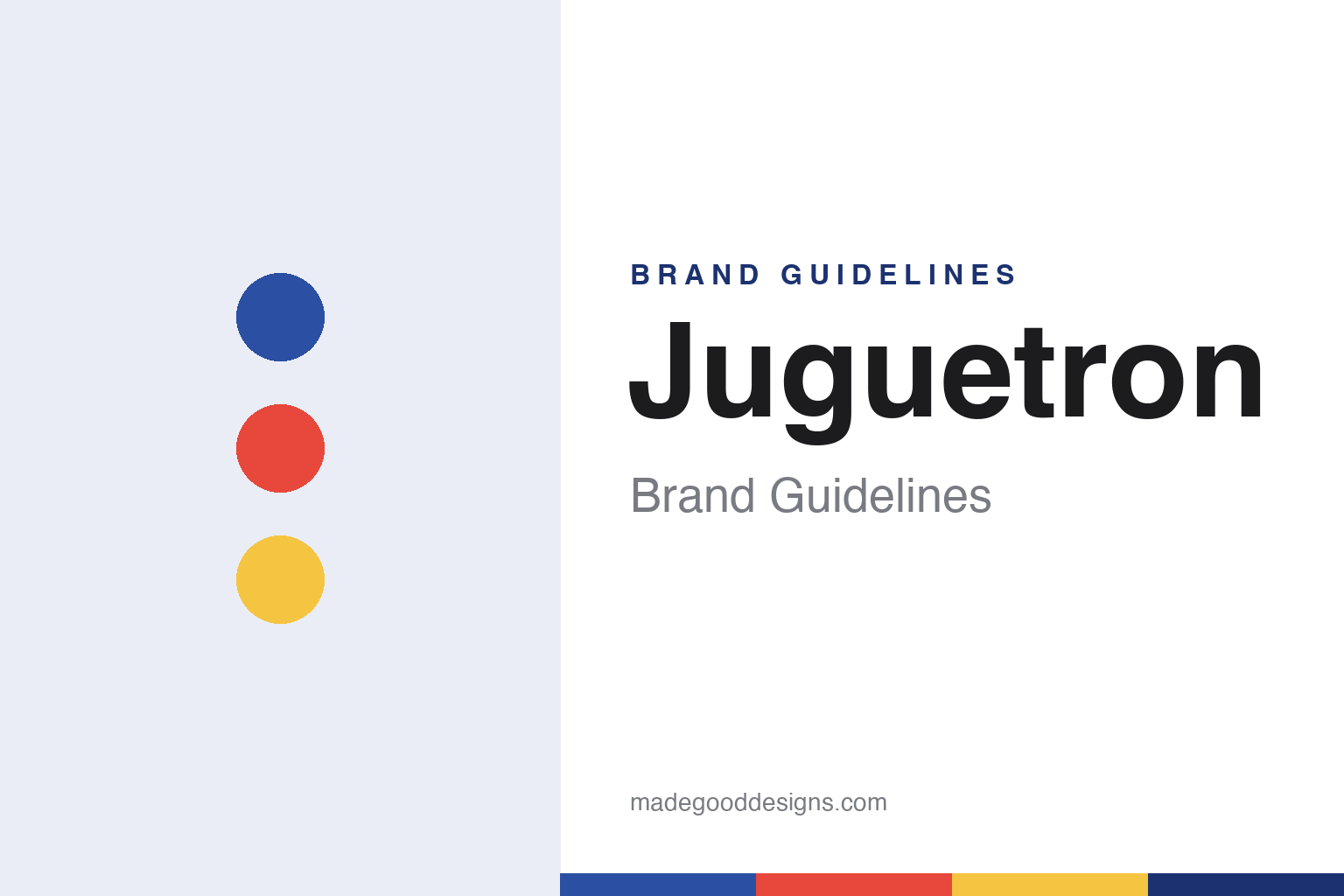
Two constants: a cobalt, red and marigold palette and a bold rounded sans register. Abstract homage — not a Juguetron product or mark; no logo, shop sign or LEGO asset is reproduced.
Juguetron
Five shops in Mexico City, 1989.
Juguetron was founded in 1989 by a group of Mexican entrepreneurs who, according to company information reported by the marketing trade site InformaBTL in May 2018, came from toy businesses with more than 50 years in the trade. It opened with five stores in Mexico City, the company says, and drew attention early for the way it displayed goods, served customers and mixed its product range.
In the company’s account, its directors then set out to take toys to markets across the country, and the chain added formats beyond the standard shop. InformaBTL lists three, all in the company’s own description: chain stores, warehouse-style bodegas and outlets. It names Bandai, Mattel and Hasbro among the main suppliers, alongside other toy makers, and placed the stores in the main cities of the Bajío, central Mexico and the south of the country.
Store counts depend on the source and the date. In October 2017 the business paper El Financiero reported that Juguetron had opened at least 23 new branches that year, reaching 123, according to its director general; the paper gave earlier counts of 80 units in 2014, close to 90 a year later and 100 in 2016. InformaBTL’s profile of May 2018, drawn from company information, gave a lower figure of more than 80 points of sale, so the two accounts do not match.
The company trades as Grupo Juguetron, the name used for it in Mexican business coverage. On its own website, juguetron.mx, it writes its name without an accent, as Juguetron, although Mexican newspapers often print it as Juguetrón. This guide follows the company’s spelling.
Colour
Running LEGO’s stores in Mexico.
Juguetron is also the operator of LEGO’s branded stores in Mexico. Forbes México reported in May 2019 that the Danish toy company had spent at least two years finding a Mexican partner, and that in February 2019 its alliance with Juguetron completed its first year with three LEGO stores open: at the Perisur and Santa Fe shopping centres in Mexico City and at Galerías Guadalajara. Juguetron operates those stores.
The manager of the LEGO project at Juguetron told Forbes México that, as operators, the company had to guarantee the same experience a customer would find in a LEGO store in China or Europe, and that the stores were meant as destinations for play rather than a mass roll-out. The magazine described building stations, displays of finished models, a counter for making personalised figures and loose bricks sold by volume.
The partnership kept growing. On 4 July 2023 El CEO reported that LEGO had opened its 21st store in Mexico, at Plaza Satélite in the State of Mexico, in alliance with Juguetron, which the paper described as the Mexican company chosen as operating partner for LEGO stores in the country. The new store offered more than 500 sets, a service that turns photographs into brick mosaics and a station for building a minifigure, the paper said.
Typography
How toy chains present themselves.
Toy-shop chains in Europe, Latin America and Australia usually introduce themselves through a shop sign and a seasonal catalogue. Some of their names began as something else entirely: the Belgian chain DreamLand started as a neighbourhood supermarket called LIMA in Liedekerke in 1956 and turned to toys in 1978, according to Dutch Wikipedia. Logos, colour schemes and shop signs change over time, and each guide in this series describes the current sign only as the company itself shows it.
Store networks take several forms: high-street shops, large stores on retail parks, franchise branches and online shops. Branch, staff and country counts in these guides are given only with their source and date, because toy-shop networks grow and shrink through takeovers, rebrands, bankruptcies and closures, and a chain that has closed is described as closed.
A number of chains began as buying groups or associations of independent toy shops. Intertoys in the Netherlands grew out of a purchasing organisation that started buying toys in 1976, and NRC reported in October 2024 that about half of its shops were still run by franchisees. Where a name covers a network of independently owned shops rather than branches of one company, these guides say so plainly, and they describe owners, from retail groups and investors to founding families, as dated facts.
Chains also name their own ranges, catalogues and seasonal campaigns, such as the Intertoys Speelboek, published each September since 1987, and these guides name them only as the companies do. Corporate pages and company histories describe founders and owners; each guide sets out what can be checked against dated, independent sources, with any gap in the record stated plainly.
Aa
A bold, rounded sans with a shop-front weight. (Specimen set in Baloo 2, a sans STAND-IN; NOT the Juguetron logo.)
The season
From Guadalupe to the Three Kings.
The calendar shapes the business. In December 2019 El CEO reported that the period from 12 December to 5 January, which Mexicans call the Guadalupe-Reyes season and which ends on the eve of Three Kings’ Day, is the most important stretch of the year for Juguetron. One of the chain’s seasonal tools at the time was Expo Tus Juguetes, a large toy exhibition at the Palacio de los Deportes in Mexico City where it put its range on show.
In the same interview the company’s vice-president said the category growing fastest inside Juguetron was collectibles, meaning action figures, collectible vehicles and figures of characters from films and series, bought by older customers who know what they want. Besides collectibles, he said, the chain relied each season on licensed toys tied to the year’s major films and on the experience inside its stores, with attractive shop windows as the first hook for passers-by.
For design purposes, the published record centres on the shop rather than on a documented identity system: InformaBTL’s company-based profile stresses display, service and product mix, and El CEO’s 2019 interview stresses windows and the experience in store. In Forbes México’s account of the LEGO stores, the operator’s task was to match the experience of LEGO stores in other countries, with building stations, model displays and counters for personalised figures.
Today the company sells online as well as in its shops. Its website, juguetron.mx, offers delivery across Mexico, a store locator and a loyalty programme called Club Juguetron. The palette in this guide is our own reading of a toy-shop register, not a company specification.
For a design guide, Juguetron shows how a national toy chain can keep its own sign while running another company’s stores in a format set by that company. Compare LEGO, whose stores Juguetron operates in Mexico, and Ri Happy, the Brazilian toy chain. For this guide we use cobalt, a piñata red and marigold with a bold rounded sans, an unofficial interpretation; no product or logo is reproduced.
Explore & save
Keep Juguetron’s identity on hand — save it to a board in the Made Good inspiration library.
Juguetron identity set
Pin the Juguetron cobalt, red and marigold palette and the bold rounded sans register to your own board.
Source & notes
Frequently Asked Questions
What font can I use to match the Juguetron look?
This guide describes Juguetron’s type as “A bold, rounded sans with a shop-front weight”. Its type specimen is set in Baloo 2 from Google Fonts as a stand-in; Baloo 2 is not Juguetron’s own lettering.
What colours are in the Juguetron palette?
This guide’s Juguetron palette is Cobalt #2B4FA3, Ink blue #1C3270, Piñata red #E8483B, Marigold #F5C542 and Paper #FAF7F0. The tones are the guide’s own unofficial interpretation, not official Juguetron hex codes.
When was Juguetron founded?
Juguetron was founded in 1989, in Mexico City, Mexico.