Ri Happy Brand Guidelines
A São Paulo toy shop of 1988 that kept its name through a merger and three owners.
Aa
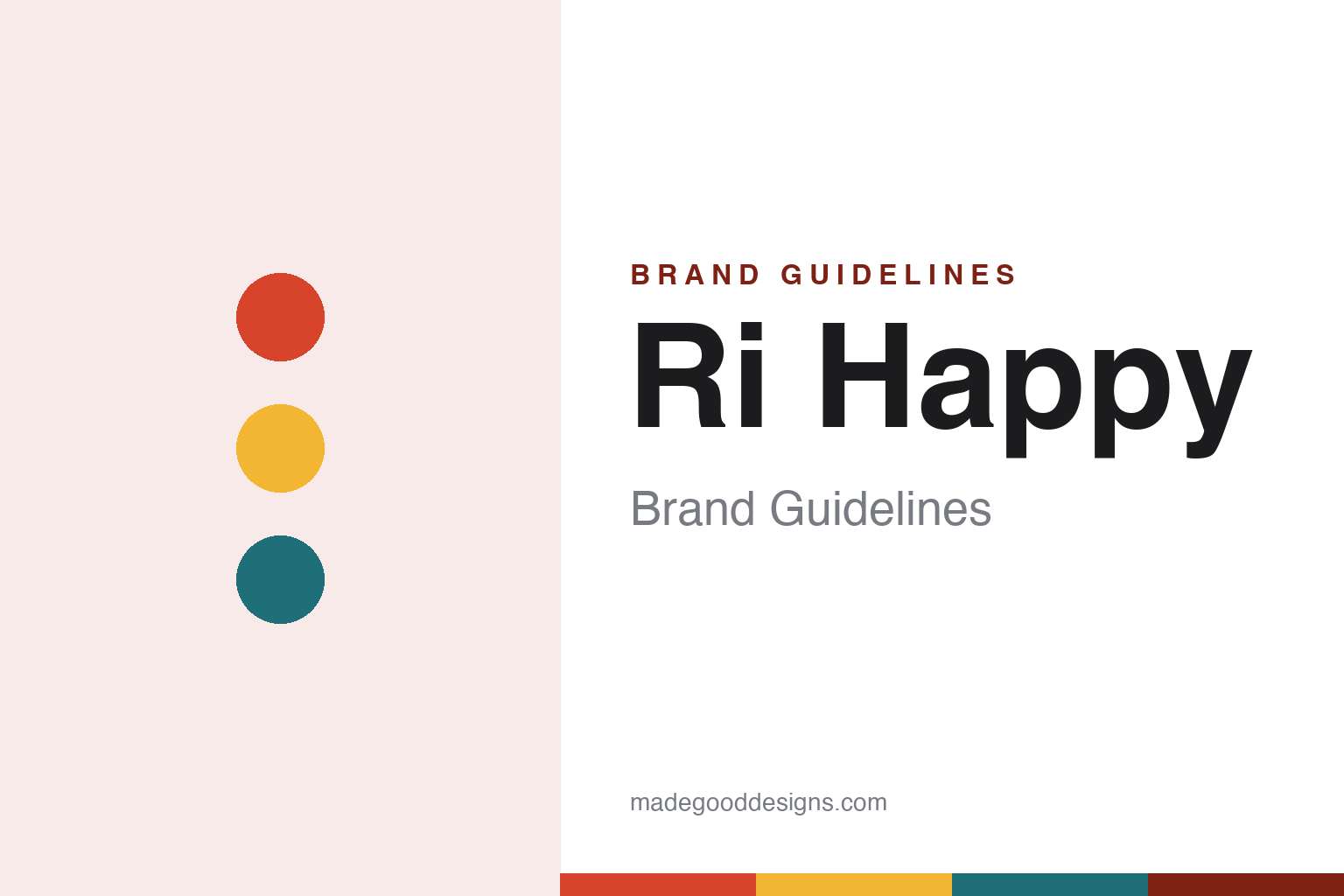
Two constants: a red, yellow and teal palette and a rounded sans register. Abstract homage — not a Ri Happy product or mark; no logo, mascot or shop sign is reproduced.
Ri Happy
A paediatrician, his wife and a partner in São Paulo.
Ri Happy began in São Paulo in 1988. Its founders were the paediatrician Ricardo Sayon, his wife Juanita Sayon and the business administrator Roberto Saba, according to English and Portuguese Wikipedia and a November 2018 profile by the Brazilian financial site Suno. The name joins “Ri,” the opening syllable of Ricardo, with the English word “happy”; Suno describes it as Juanita Sayon’s play on her husband’s name.
The start was hard. Suno reported that the shops lost money at first and that, after the fourth store opened, the partners decided to close. When they tried to return stock to the Brazilian toy maker Estrela, its director would not take it back, and Sayon chose to carry on instead, changing the shops from plain self-service to a model built on staff advice and services. In the early 1990s, the same profile says, the stores were turned into playful, interactive spaces with walls painted red and yellow, and the chain spread from the city into the interior of São Paulo state and on to other regions.
The company also built its own media around the shops. Suno says Ri Happy put its website online in 1997 and soon afterwards launched a magazine of its own, the Revista do Solzinho. It started an in-store television channel, TV Ri Happy, on 4 December 2006, and from 2009 that channel carried 40 hours a week of programming signed by the children’s channel Cartoon Network. Portuguese Wikipedia says the sun character Solzinho was adopted as the brand’s official mascot in its advertising in 2002.
Colour
Carlyle, PBKids and two later owners.
In March 2012 the US asset manager Carlyle bought control. Latin Lawyer reported on 8 March 2012 that Carlyle had acquired an 85 per cent stake, the figure English Wikipedia also gives; the Brazilian magazine Consumidor Moderno wrote in April 2015 that Carlyle had bought all of the company’s capital, so the sources differ on the size of the holding. Suno says Ricardo Sayon stayed on as an adviser and left the company in 2014.
The same year Ri Happy moved to buy its rival PBKids. The deal, covering all of the voting capital of PBKids, PBKids Brinquedos and PBKids.com, was submitted to Brazil’s competition authority, CADE, on 19 June 2012. On 20 November 2012 CADE’s General Superintendence recommended approval, finding enough rivalry from large multi-product retailers that also sell toys and no significant barriers to entry, and passed the case to a reporting commissioner for judgment, according to CADE’s own notice. English Wikipedia records the purchase as made in 2012. The two chains kept their own names: in August 2026 InvestNews described Grupo Ri Happy as the owner of both the Ri Happy and PBKids networks.
The group added formats along the way. English Wikipedia says Ri Happy opened Ri Happy Baby, a shop for children under three, in 2013. Portuguese Wikipedia says the company opened a concept flagship at Shopping Cidade São Paulo in 2015 and bought the Planeta Brinquedo chain in Ceará in 2016. In April 2015 Consumidor Moderno counted more than 150 stores in state capitals and inland cities, selling over 10,000 items, including an exclusive line of about 200 products.
Ownership changed twice more. According to InvestNews, the asset manager SPX Capital took over the business in 2021, when it inherited the assets Carlyle held in Brazil. On 31 August 2026 InvestNews reported that BluSun Capital Partners had completed the purchase of 100 per cent of Grupo Ri Happy, with financial terms not disclosed, and that the executive who had led the company from 2012 to 2020 was returning to run it. At that date the Ri Happy and PBKids banners counted 293 stores between them, the same report said.
Typography
How toy chains present themselves.
Toy-shop chains in Europe, Latin America and Australia usually introduce themselves through a shop sign and a seasonal catalogue. Some of their names began as something else entirely: the Belgian chain DreamLand started as a neighbourhood supermarket called LIMA in Liedekerke in 1956 and turned to toys in 1978, according to Dutch Wikipedia. Logos, colour schemes and shop signs change over time, and each guide in this series describes the current sign only as the company itself shows it.
Store networks take several forms: high-street shops, large stores on retail parks, franchise branches and online shops. Branch, staff and country counts in these guides are given only with their source and date, because toy-shop networks grow and shrink through takeovers, rebrands, bankruptcies and closures, and a chain that has closed is described as closed.
A number of chains began as buying groups or associations of independent toy shops. Intertoys in the Netherlands grew out of a purchasing organisation that started buying toys in 1976, and NRC reported in October 2024 that about half of its shops were still run by franchisees. Where a name covers a network of independently owned shops rather than branches of one company, these guides say so plainly, and they describe owners, from retail groups and investors to founding families, as dated facts.
Chains also name their own ranges, catalogues and seasonal campaigns, such as the Intertoys Speelboek, published each September since 1987, and these guides name them only as the companies do. Corporate pages and company histories describe founders and owners; each guide sets out what can be checked against dated, independent sources, with any gap in the record stated plainly.
Aa
A rounded, friendly sans for a name stylised in capitals. (Specimen set in Fredoka, a sans STAND-IN; NOT the Ri Happy logo.)
From shelves to play
A restructuring called Reset, and Divertudo.
The 2026 sale came in the middle of a restructuring. InvestNews reported that from 2024 Ri Happy closed its distribution centre, began sending online orders from its stores and cut stock space to make room for playrooms, cafés, game rooms and party areas, a programme the company calls Reset. By August 2026, 13 stores had been converted, the report said.
In June 2026 the retail trade site Mercado&Consumo interviewed the then chief executive about Divertudo, the company’s entertainment brand, which brings together playrooms, children’s parties, cafés and other activities. He said the idea grew out of tests at EcoVilla in Rio de Janeiro, a mix of children’s theatre, workshops, party venue and toy shop, and from December 2024 at a small store at Shopping Bourbon in São Paulo, where retail space was reduced to fit a playroom. Portuguese Wikipedia adds that the cafés in the new format work with Biscoitê on their selection of products.
For design, the record is short but clear. Suno’s account of red and yellow walls in the early 1990s, a sun mascot called Solzinho and a name that folds a founder’s nickname into an English word give the brand a warm, primary register, and English Wikipedia notes that the name is stylised in capitals, as RI HAPPY. The palette in this guide is our own reading of that register, not a company specification.
For a design guide, Ri Happy shows how a founder-named shop can carry one name through private-equity owners, a merger and a move from shelves to play spaces. Compare Juguetron, the Mexican toy chain that also operates LEGO stores, and Toys “R” Us. For this guide we use a tomato red, a sunflower yellow and a deep teal with a rounded sans, an unofficial interpretation; no product or logo is reproduced.
Explore & save
Keep Ri Happy’s identity on hand — save it to a board in the Made Good inspiration library.
Ri Happy identity set
Pin the Ri Happy red, yellow and teal palette and the rounded sans register to your own board.
Source & notes
Frequently Asked Questions
What font can I use to match the Ri Happy look?
This guide describes Ri Happy’s type as “A rounded, friendly sans for a name stylised in capitals”. Its type specimen is set in Fredoka from Google Fonts as a stand-in; Fredoka is not Ri Happy’s own lettering.
What colours are in the Ri Happy palette?
This guide’s Ri Happy palette is Tomato red #D8432C, Sunflower yellow #F2B632, Deep teal #1F6F78, Brick #7E2114 and Cream #FBF5E9. The tones are the guide’s own unofficial interpretation, not official Ri Happy hex codes.
When was Ri Happy founded?
Ri Happy was founded in 1988, in São Paulo, Brazil.
Who founded Ri Happy?
Ri Happy was founded by Ricardo Sayon, Juanita Sayon and Roberto Saba in 1988.
Who owns Ri Happy?
Ri Happy is owned by BluSun Capital Partners (from August 2026).