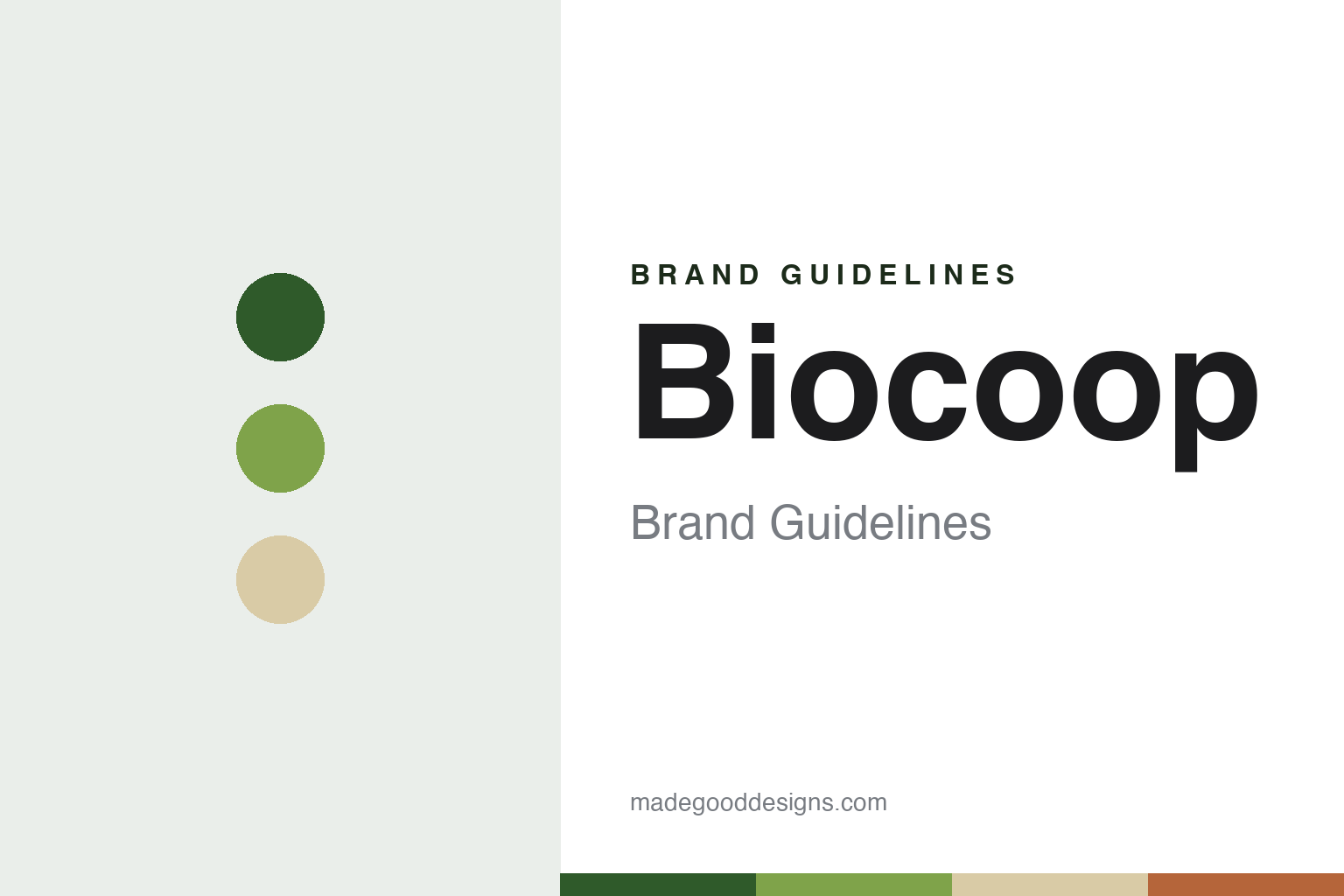
Biocoop Brand Guidelines
A 1986 charter, a cooperative of shops and farmers, and bulk aisles.
Aa
Two constants: a field green, leaf and oat palette and a rounded sans register. Abstract homage — not a Biocoop product or mark; no shopfront, logo or packaging is reproduced.
Coops and a charter
Consumer co-ops of the 1970s, a national meeting in 1986.
Biocoop grew out of the consumer cooperatives that French shoppers and growers formed in the late 1970s to buy organic food together. The company’s history page says these “coops” first grouped into two regional bodies, Intercoop in the west in 1983 and Biopaïs in the south-east in 1984, and then held their first national meeting in 1986. There they adopted a founding charter and set up Biocoop as an association under France’s 1901 law on associations, with about 40 shops, the company says. Que Choisir, the consumer magazine, wrote in June 2021 that Biocoop had been founded in 1986 by “a handful of ecologists” as a cooperative network that was at once campaigning and commercial. Its investigation, titled “Biocoop – la forteresse assiégée” (“the besieged fortress”), asked whether double-digit growth was drawing the cooperative into the logic of competitiveness.
The network grew in steps that the company dates itself: 100 shops in 1992; a common set of specifications in 1993 that brought cooperative and non-cooperative businesses under the same rules on product choice, management and staff; and 200 shops in 1997. In 2000 it signed an agreement with the FNAB, the national federation of organic farmers, and began building supply chains with producer groups. In 2002 new statutes turned the member shops into shareholders, and Biocoop became a société anonyme coopérative, a cooperative limited company. In 2005 it absorbed its logistics platforms, with a single catalogue for the shops, and in 2010 it moved its south-eastern warehouse from Cavaillon to Sorgues, the company says.
The official French business register lists the cooperative, Biocoop SA, with its head office in Paris. Biocoop says it had more than 400 shops in 2016, its thirtieth year, and more than 750 in 2026, its fortieth.
Colour
Four colleges, four warehouses and a bulk aisle.
Biocoop describes itself as a cooperative with four colleges: the shops, of which it says about 40 percent are cooperatives and 60 percent family-run limited companies; the producers, organised in an agricultural section; the employees; and a consumers’ association. Farmers sit on the board beside the shops, the staff and a consumer representative, the company says. Its website lists 19 partner producer groups, among them Biolait, Bretagne Viande Bio, Norabio and Les Miels Bio des Limousins; the farming trade paper Réussir gave a figure of 21 groups covering about 3,000 farms in March 2024.
Goods move through a central buying office and four regional platforms, which Biocoop lists at Tinténiac in Brittany, Noves in Provence, Damazan in Lot-et-Garonne and Ollainville, south of Paris. Its own haulier, the Société de Transports Biocoop, was set up in 2006 and has used combined rail-and-road transport between Noves and the Paris region since May 2010, the company says. A catering arm, Biocoop Restauration, supplies canteens and restaurants from a catalogue of more than 900 products.
Inside the shops, loose goods are central. Que Choisir called bulk sales “the backbone” of Biocoop stores in its 2021 report, which opened at a 650-square-metre shop in Pont-l’Abbé, in Finistère, with fresh produce, groceries, a butcher’s counter, bread and a wine section. Biocoop says it stocks more than 10,000 products, around 370 of them sold loose or in large containers, and that it stopped selling water in plastic bottles in 2017. Its published rules exclude air-freighted goods and keep fruit and vegetables to the season, with seasonal calendars published on its website.
Typography
Design and documentation.
French home, culture, organic and city-grocery chains tend to present themselves through the shop before anything else. The store format carries the identity: the edge-of-town retail park with its large single sign, the town-centre supermarket with a narrow shopfront, the neighbourhood grocer on a street corner, or the specialist shop built around loose goods and counters. Many of these companies publish their formats on their own sites, with store counts, opening dates and maps that change from year to year, so any figure in a guide like this one is given with the date of the source.
Print and own label do much of the remaining work. Furniture and home chains publish catalogues and seasonal collections; grocery and organic retailers sell ranges under their own names, with packaging rules that the companies describe in their own words; culture chains organise shelves, workshops and events around books, music and hobbies. Campaigns appear in the French trade press, which usually names the agency, the photographer and the poster network, and those reports are a better record of a brand’s voice than any slogan.
Structure matters as much as style. Several of these names are cooperatives, buying groups or family-controlled holdings rather than single companies: shops may be run by independent members or franchisees under a shared charter, while a central body handles buying, logistics and advertising. Others sit inside larger listed or private groups and have changed hands more than once. Corporate pages on founders and owners, and the official French business register, set out who runs the network and where it is based.
Not every story is one of steady growth. French retail has seen receiverships, rescue plans, sales of store networks and closures, decided by commercial courts and reported with dates. Planning decisions on new stores are taken by departmental and national commissions. Where those events belong to a brand’s history, this series states them plainly, with dates and outcomes.
Aa
A rounded, friendly sans for a shop-front register. (Specimen set in Nunito, a sans STAND-IN; NOT the Biocoop logo.)
Biocoop
From a consensual image to campaigning posters.
The French organic market went through a hard period from 2022. Réussir reported on 7 March 2024 that Biocoop had closed 39 shops in 2023 and opened 13, out of 298 specialist organic shop closures in France that year, and that it had 739 shops at the end of 2023. The cooperative said it was supporting about a hundred shops, chiefly with cash advances; the same report named Henri Godron as its new president and Patrick Ribot as interim managing director. The company’s history page records that Franck Poncet became managing director in 2024.
Its advertising is well documented in the French trade press. In May 2022, CB News reported a television campaign by the agency Hungry and Foolish, which the brand presented as a break with its consensual image; it ran on TV from 2 to 22 May. In February 2025 the agency Altavia Disko produced three posters photographed by Robert Billington, with lines built on the word “OUI,” shown on JCDecaux sites across France from 12 February, CB News reported. On 14 September 2026 the same magazine described a new brand platform from The Good Company and The Good Design, “Pour un monde qui a du cœur” (“for a world with a heart”), with a graphic identity whose lettering was partly made from organic potatoes, a 50-second manifesto film, five posters on 10,795 JCDecaux faces and murals painted with Global Street Art in ten cities.
For a design guide, Biocoop shows how a cooperative can carry one name across hundreds of independently run shops, with a charter, a shared catalogue and national campaigns doing the work that a single owner would do elsewhere. Compare Carrefour, the French hypermarket group, and Monoprix, a city-centre grocery chain in this series. For this guide we use a field green, a leaf green, oat and clay with a rounded sans, an unofficial interpretation; no product or logo is reproduced.
Explore & save
Keep Biocoop’s identity on hand — save it to a board in the Made Good inspiration library.
Biocoop identity set
Keep the Biocoop field green, leaf and oat palette and the rounded sans register for your own board.
Source & notes
Frequently Asked Questions
What font can I use to match the Biocoop look?
This guide describes Biocoop’s type as “A rounded, friendly sans for a shop-front register”. Its type specimen is set in Nunito from Google Fonts as a stand-in; Nunito is not Biocoop’s own lettering.
What colours are in the Biocoop palette?
This guide’s Biocoop palette is Field green #2F5A2A, Leaf #7FA34A, Oat #D9CBA6, Clay #B5653A and Paper #F7F4EC. The tones are the guide’s own unofficial interpretation, not official Biocoop hex codes.
When was Biocoop founded?
Biocoop was founded in 1986 (as an association), in France.


