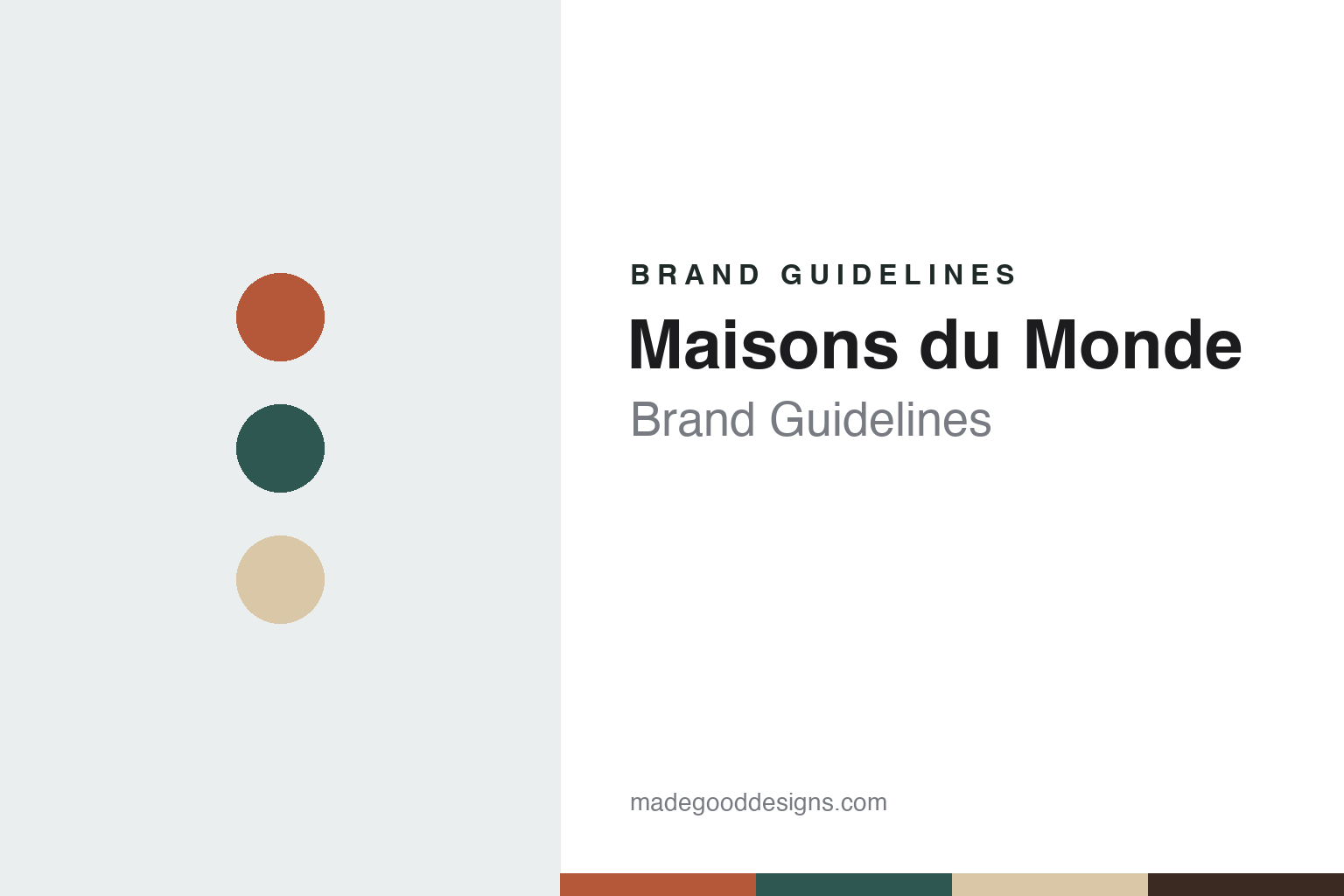
Maisons du Monde Brand Guidelines
A Brest idea, a Bordeaux shop and a house of many styles.
Aa
Two constants: a terracotta, deep teal and sand palette and a travel-journal serif register. Abstract homage — not a Maisons du Monde product or mark; no furniture, catalogue page or logo is reproduced.
From Brest to Bordeaux
A shop of objects, then a chain of decorative worlds.
Maisons du Monde was created in 1996 by Xavier Marie. French Wikipedia says the company was set up in Brest, in Brittany, and opened its first shop in Bordeaux in April 1996. In an October 2026 interview with INfluencia, the brand’s executive director said Marie had earlier run a small shop in Brest called “M Chose,” selling objects from many countries, and that the idea behind the new chain was to sell whole decorative “worlds” rather than single objects. The head office today is in Vertou, near Nantes, Le Journal des Entreprises reported in June 2026.
The chain grew beyond France in the 2000s. Euronext, in its notice for the 2016 listing, said the group had expanded across Europe since 2003 and that at the end of 2015 it ran 262 stores in seven countries: France, Italy, Spain, Belgium, Germany, Switzerland and Luxembourg. French Wikipedia says the online shop launched in 2006, offering the whole furniture catalogue and a large part of the decoration range. By the end of 2015, the Euronext notice added, online sales reached customers in eleven countries, including Austria, the Netherlands, Portugal and the United Kingdom, where the group then had no stores.
Ownership changed several times. French Wikipedia says the American investment firm Bain Capital bought 80 percent of the group in 2013. On 27 May 2016 Maisons du Monde began trading on Euronext Paris, in compartment B of the regulated market, under the ticker MDM, according to a Euronext press release of that date. French Wikipedia says Bain Capital sold its remaining 15.8 percent stake in May 2017, that in March 2022 Majorelle Investments said it held more than 16 percent, and that in June 2022 the Swiss fund Teleios Capital Partners raised its holding to 24.84 percent.
Colour
Stores, catalogues and a 2026 refinancing.
Abroad, the record is mixed. English Wikipedia says the company opened its first United States store in Wynwood, Miami, in 2018, then in late 2021 sold most of its shares in Modani, its American subsidiary, to refocus on Europe. It also says Maisons du Monde stopped taking new online orders in the United Kingdom from 24 May 2023, and that franchise stores operate in Algeria, Morocco, Réunion and Martinique. French Wikipedia lists its European stores in 2024 in France, Switzerland, Luxembourg, Belgium, Germany, Austria, Italy, Spain and Portugal.
The range mixes furniture and decoration. English Wikipedia says decoration makes up roughly 58 percent of what the company sells and furniture about 42 percent, and that a catalogue presenting each new collection appears early in the year. The company’s corporate site names its Louis and Mauricette chairs and its decorative pineapples among familiar pieces, and says it launched Seconde chance, an offer of second-hand products, in 2023. Euronext’s 2016 profile described a group selling through stores, websites and catalogues together. Le Journal des Entreprises gave the size of the business in June 2026 as about 8,000 staff and 338 stores.
The mid-2020s brought a restructuring. EUWID Wood Products and Panels reported on 7 July 2026 that conciliation proceedings had been under way since January, and that on 18 June 2026 the company, its banks and a consortium of two London-based investment firms, Alteri Investors and Eicos Investment Group, had signed an agreement, then still subject to approval by the commercial court in Nantes. Le Journal des Entreprises reported in June that the deal could leave the two investors with up to 95 percent of the capital, and that without it the company would have had to seek a court-supervised restructuring. RetailDetail reported on 11 August 2026 that the rescue plan had been finalised, with the two funds taking about 95 percent of the capital and existing debt converted into shares. The company’s share price was still shown on its corporate site in November 2026.
Typography
Design and documentation.
French home, culture, organic and city-grocery chains tend to present themselves through the shop before anything else. The store format carries the identity: the edge-of-town retail park with its large single sign, the town-centre supermarket with a narrow shopfront, the neighbourhood grocer on a street corner, or the specialist shop built around loose goods and counters. Many of these companies publish their formats on their own sites, with store counts, opening dates and maps that change from year to year, so any figure in a guide like this one is given with the date of the source.
Print and own label do much of the remaining work. Furniture and home chains publish catalogues and seasonal collections; grocery and organic retailers sell ranges under their own names, with packaging rules that the companies describe in their own words; culture chains organise shelves, workshops and events around books, music and hobbies. Campaigns appear in the French trade press, which usually names the agency, the photographer and the poster network, and those reports are a better record of a brand’s voice than any slogan.
Structure matters as much as style. Several of these names are cooperatives, buying groups or family-controlled holdings rather than single companies: shops may be run by independent members or franchisees under a shared charter, while a central body handles buying, logistics and advertising. Others sit inside larger listed or private groups and have changed hands more than once. Corporate pages on founders and owners, and the official French business register, set out who runs the network and where it is based.
Not every story is one of steady growth. French retail has seen receiverships, rescue plans, sales of store networks and closures, decided by commercial courts and reported with dates. Planning decisions on new stores are taken by departmental and national commissions. Where those events belong to a brand’s history, this series states them plainly, with dates and outcomes.
Aa
A travel-journal serif. (Specimen set in DM Serif Display, a serif STAND-IN; NOT the Maisons du Monde logo.)
Maisons du Monde
Houses of the world, in several styles at once.
English Wikipedia glosses the name as “houses of the world.” In its INfluencia interview, the brand described its approach as “multistyle,” with stores laid out as several decorative worlds that customers can mix and match, and it said its Christmas collections for the 30th anniversary in 2026 were organised around travel, from Paris and London to Chamonix and Québec. Euronext’s 2016 notice described the offer as affordable decoration and furniture collections showing multiple styles. Its corporate site, in 2026, says the brand also runs a marketplace and a turnkey 3D decoration service alongside the stores, framing the business as one omnichannel offer built on multi-style home universes inspired by travel.
Logo colours and typefaces are not documented in the sources used for this guide, so the palette here is our own. It takes its cue from the travel theme: a warm terracotta, a deep teal, a sand neutral and an ink brown, on a paper white ground, with a serif chosen to suggest a printed catalogue.
For a design guide, Maisons du Monde shows how a retailer can build an identity around a range of styles rather than one house look, with the catalogue, the shop floor and the website carrying the same idea of travel. Compare it with IKEA, the Swedish home-furnishing retailer, and with Alinéa, another French furniture and decoration chain. For this guide we use terracotta, deep teal, sand and ink brown with a serif, an unofficial interpretation; no product or logo is reproduced.
Explore & save
Keep Maisons du Monde’s identity on hand — save it to a board in the Made Good inspiration library.
Maisons du Monde identity set
Pin the terracotta, deep teal and sand palette and the travel-journal serif register to your own board.
Source & notes
Frequently Asked Questions
What font can I use to match the Maisons du Monde look?
This guide describes Maisons du Monde’s type as “A travel-journal serif”. Its type specimen is set in DM Serif Display from Google Fonts as a stand-in; DM Serif Display is not Maisons du Monde’s own lettering.
What colours are in the Maisons du Monde palette?
This guide’s Maisons du Monde palette is Terracotta #B5583A, Deep teal #2F5752, Sand #D9C7A7, Ink brown #3A2A22 and Paper #F7F3EC. The tones are the guide’s own unofficial interpretation, not official Maisons du Monde hex codes.
When was Maisons du Monde founded?
Maisons du Monde was founded in 1996, in Brest, France.
Who founded Maisons du Monde?
Maisons du Monde was founded by Xavier Marie in 1996.


