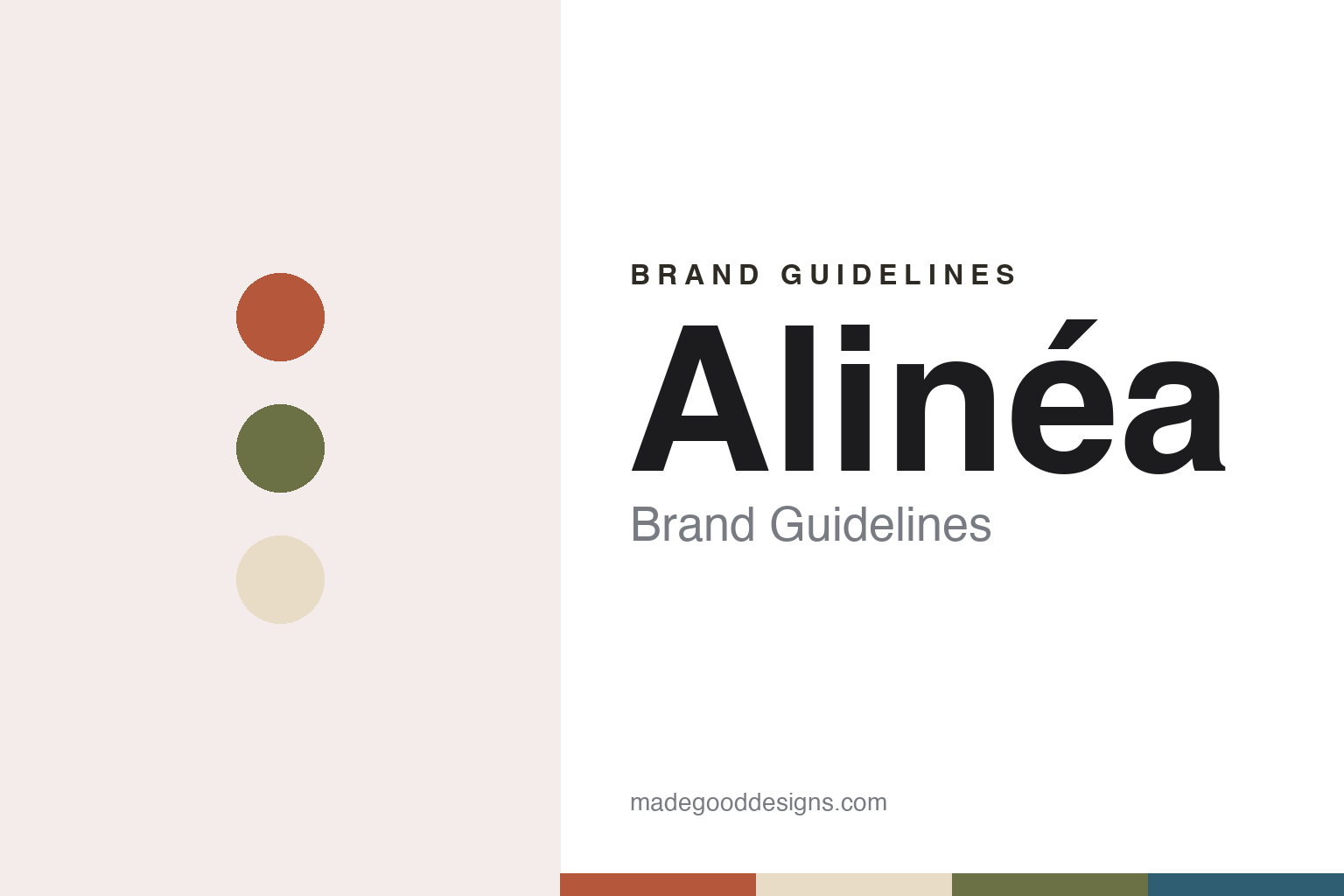
Alinéa Brand Guidelines
An Avignon furniture chain with a Mediterranean voice, closed in 2026.
Aa
Two constants: a terracotta, olive and sand palette and a Mediterranean serif register. Abstract homage — not an Alinéa product or mark; no furniture, logo or shopfront is reproduced.
Avignon, 1988
A furniture and decoration chain from Provence.
Alinéa was a French furniture and home-decoration retailer from Provence. French Wikipedia dates the creation of the business to 29 June 1988 in Avignon and the opening of its first store to November 1989 at Le Pontet, on the edge of Avignon. The Journal des Entreprises wrote in 2020 that the company was born in Avignon in 1988, while Le Figaro gave 1989 as its founding year in 2026. For its first years it was a single shop: French Wikipedia says the chain had one store from 1989 to 1996, then opened a second in Montpellier in 1997 and a third in Aubagne, east of Marseille, where the head office settled.
The chain sat within the orbit of the Mulliez family, the shareholders behind Auchan, Decathlon and Leroy Merlin, as franceinfo described the group in 2026. In May 2020 Le Figaro described Alinéa as run by the Mulliez family within the Auchan group, with its head office in Aubagne, close to 2,000 employees and around thirty stores; the paper called it “cet Ikea à la française”, a French take on IKEA. French Wikipedia says the family took Alinéa out of the Auchan group in October 2017, set up a new company that was still based in Aubagne, and began a deep change of direction under a new brand platform.
Its stores were large. In September 2025 the trade paper Le Courrier du Meuble described the classic Alinéa store as covering roughly 2,000 to 2,500 square metres and showing about 3,500 references, set out in several “universes” that shared Mediterranean inspirations. In April 2025, French Wikipedia says, the network counted 35 stores in mainland France, from Aubagne, Avignon and Montpellier in the south to Lille, Caen, Reims and Tours in the north and west.
Colour
Receivership, a family buy-back and “La maison française”.
In May 2020, after its stores had been closed for nearly two months, Alinéa was placed in redressement judiciaire, the French court-supervised recovery procedure, by the commercial court in Marseille, Le Figaro reported on 16 May 2020, citing the regional daily La Provence. The company had declared that it could no longer meet its payments. The Journal des Entreprises dated the court’s decision to 13 May and reported that summer that the retailer’s existing shareholders were bidding to take it back. A temporary change to French insolvency rules, made by an ordinance of 20 May 2020, allowed the managers of a company in recovery to bid for it, the paper explained; until then the commercial code had required the bidder to be a third party.
French Wikipedia says the court accepted that offer in September 2020. It was made through Néomarché, a holding owned by the Mulliez family, kept only part of the network — nine stores, mainly in the south of France, according to French Wikipedia — and wrote off the company’s debts. Trade unions and some elected officials criticised the arrangement, the encyclopedia adds.
The relaunched Alinéa leaned on its southern roots. From 2022 it signed itself “Alinéa – La maison française”, French Wikipedia says.
The network grew again. French Wikipedia records new stores at Villefranche-sur-Saône in September 2022 and Le Havre in May 2023. The larger step was Zôdio, a decoration and tableware chain belonging to Adeo, another Mulliez-family group: Le Figaro reported in 2026 that 19 Zôdio stores were turned into Alinéa stores in 2023, while Le Courrier du Meuble dated the start of the conversions to spring 2024. On 1 August 2025 the brand opened its first franchised “Alinea Déco” concept store, in the Les Terrasses shopping centre at Sarrebourg in Moselle: 330 square metres and 900 references of textiles, tableware, mirrors and lighting, the trade paper reported, making it the 36th store in France and the ninth run by a franchisee.
Typography
How the chains present themselves.
French home, culture, organic and city-grocery chains tend to present themselves through the shop before anything else. The store format carries the identity: the edge-of-town retail park with its large single sign, the town-centre supermarket with a narrow shopfront, the neighbourhood grocer on a street corner, or the specialist shop built around loose goods and counters. Many of these companies publish their formats on their own sites, with store counts, opening dates and maps that change from year to year, so any figure in a guide like this one is given with the date of the source.
Print and own label do much of the remaining work. Furniture and home chains publish catalogues and seasonal collections; grocery and organic retailers sell ranges under their own names, with packaging rules that the companies describe in their own words; culture chains organise shelves, workshops and events around books, music and hobbies. Campaigns appear in the French trade press, which usually names the agency, the photographer and the poster network, and those reports are a better record of a brand’s voice than any slogan.
Structure matters as much as style. Several of these names are cooperatives, buying groups or family-controlled holdings rather than single companies: shops may be run by independent members or franchisees under a shared charter, while a central body handles buying, logistics and advertising. Others sit inside larger listed or private groups and have changed hands more than once. Corporate pages on founders and owners, and the official French business register, set out who runs the network and where it is based.
Not every story is one of steady growth. French retail has seen receiverships, rescue plans, sales of store networks and closures, decided by commercial courts and reported with dates. Planning decisions on new stores are taken by departmental and national commissions. Where those events belong to a brand’s history, this series states them plainly, with dates and outcomes.
Aa
A Mediterranean serif for a chain that called itself “La maison française”. (Specimen set in DM Serif Display, a serif STAND-IN; NOT the Alinéa logo.)
Liquidation, 2026
Thirty-six stores closed for good.
The recovery did not last. The economic activities court in Marseille placed Alinéa in receivership again on 20 November 2025, 20 Minutes reported. In February 2026 the main candidate for a takeover of the whole business, the Romanian group SDC Holding, withdrew its offer, the paper reported on 14 February, and dozens of staff gathered outside the Aubagne head office; the remaining offers, a union representative told the paper, covered only store buildings. Le Figaro and franceinfo later described a single offer for the whole business from a Romanian group as rejected by management and staff.
On 31 March 2026 the Marseille court placed Alinéa in liquidation judiciaire, franceinfo and Le Figaro reported. The chain’s 36 stores had closed for good the previous Sunday, about 1,200 jobs were lost, and only seven franchisees could carry on trading, under another name. Franceinfo pointed to inflation and to competition from furniture chains with denser store networks and from discount variety stores. Alinéa no longer trades as a retail chain. French Wikipedia notes that fraudulent websites posing as the retailer and advertising clearance discounts appeared in the months after the closure.
For a design guide, Alinéa shows how a furniture retailer rebuilt its look around a region — Mediterranean inspirations, a stated preference for production in France, Europe and the Mediterranean, and a “maison française” signature — and how quickly such a chain can close: two court procedures in under six years. Compare IKEA, the Swedish group Le Figaro measured it against, and Maisons du Monde, another French home-decoration chain. For this guide we use terracotta, olive, sand and a sea blue with a serif, an unofficial interpretation; no product or logo is reproduced.
Explore & save
Keep Alinéa’s identity on hand — save it to a board in the Made Good inspiration library.
Alinéa identity set
Pin the Alinéa terracotta, olive and sand palette and the Mediterranean serif register to your own board.
Source & notes
Frequently Asked Questions
What font can I use to match the Alinéa look?
This guide describes Alinéa’s type as “A Mediterranean serif for a chain that called itself “La maison française””. Its type specimen is set in DM Serif Display from Google Fonts as a stand-in; DM Serif Display is not Alinéa’s own lettering.
What colours are in the Alinéa palette?
This guide’s Alinéa palette is Terracotta #B5573A, Olive #6B7045, Sand #E8DCC6, Sea blue #2F5E73 and Chalk #FAF6EF. The tones are the guide’s own unofficial interpretation, not official Alinéa hex codes.
When was Alinéa founded?
Alinéa was founded in 1988 (first store 1989), in Avignon, France.