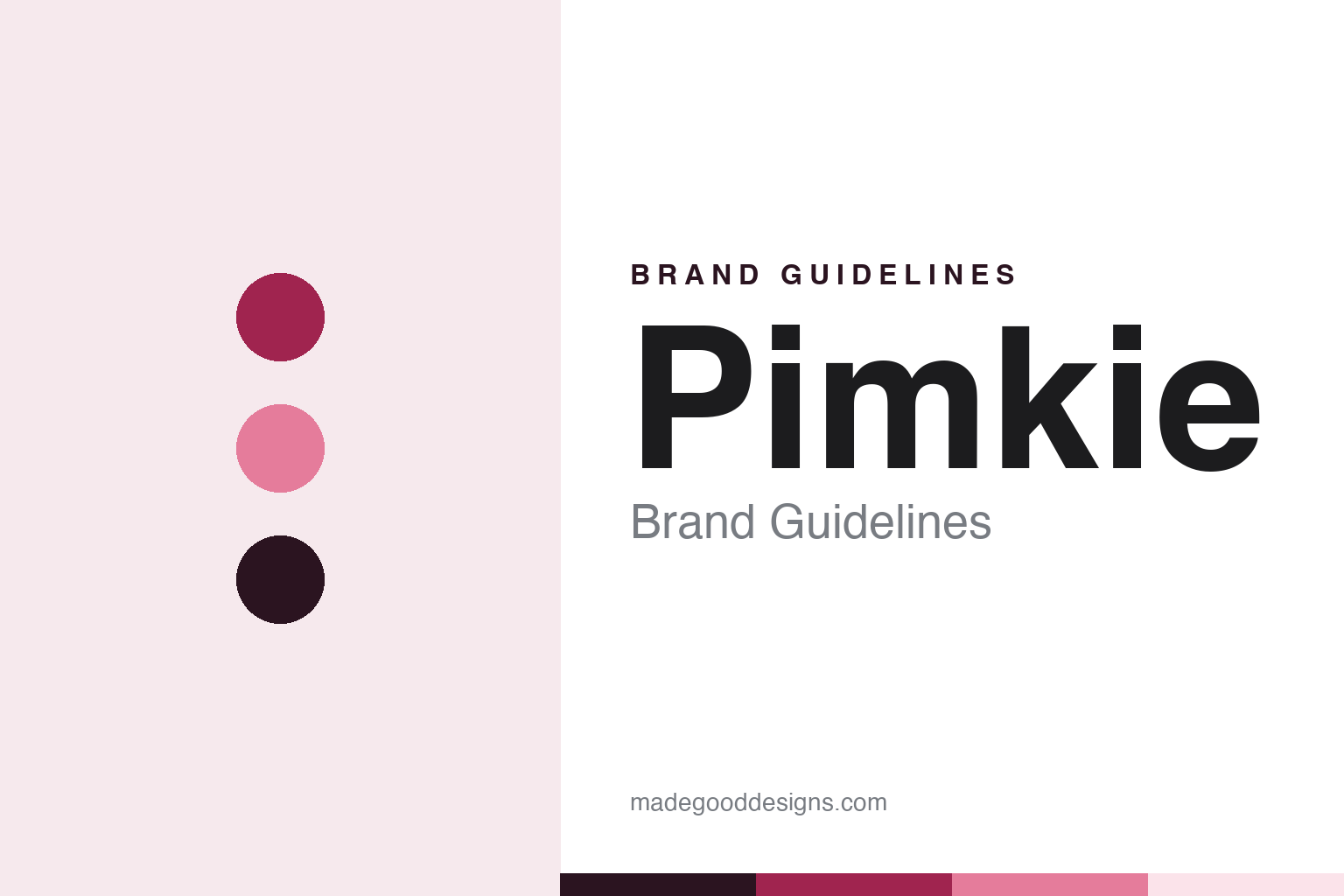
Pimkie Brand Guidelines
A Lille trousers shop of 1971 that became a European chain for young women.
Aa
Two constants: a raspberry and blush palette and a rounded geometric sans register. Abstract homage — not a Pimkie product or mark; no garment, logo or shop sign is reproduced.
Pimckie
Trousers for women, in a shop in central Lille.
Pimkie began in 1971 with a single idea: trousers for women. French and English Wikipedia both describe a group of French fashion entrepreneurs who decided that year to work on what was then a new trend, women’s trousers. The range did well enough to grow into ready-to-wear for young women aged about 15 to 25, and the first shop opened in the centre of Lille.
That shop did not carry the present name. It traded as Pimckie, and the spelling changed to Pimkie later: English Wikipedia gives 1983, while French Wikipedia places the change more broadly in the 1980s. The company is based today at Villeneuve-d’Ascq, on the edge of Lille, Le Journal des Entreprises reported in November 2024.
For most of its history Pimkie belonged to the Mulliez family association, the northern French family group behind Auchan, Leroy Merlin and Decathlon, as Capital put it in 2024. French Wikipedia says the chain sat within the Roubaix ready-to-wear group Fashion Cube until it was sold, and that it was run through two legal entities, Diramode and Promotion du Prêt à Porter.
The customer has shifted over the decades. Pimkie was built around teenagers and women in their early twenties; in 2015, English Wikipedia says, it widened its target from 15–25-year-olds to 18–35-year-olds. Its shops have sold fashion for young women throughout, and from 2006 it has also sold online.
Colour
A hundred French shops, then Europe.
By the end of the 1980s Pimkie had about 100 shops across France, French Wikipedia says, and then spent some twenty years expanding abroad. Its chronology lists the first shop outside France at Heidelberg in Germany in 1988, a first shop in Spain at Seville in 1990, and a first in Italy at Turin in 1994.
The French online shop launched in 2006, when Pimkie counted 699 shops in sixteen countries. In 2007 it developed an international collection and pushed into the Middle East and eastern Europe, and in 2011 it opened online shops in Spain and Italy. French Wikipedia gives 693 shops in 28 countries in 2014.
The peak came in 2018, with 716 shops in 30 countries, mainly in Europe. By then the business had an international head office in France, a main warehouse in Germany, five distribution warehouses in Europe and five buying and sourcing offices, in Morocco, Tunisia, Turkey, China and Hong Kong, according to both Wikipedia editions.
French Wikipedia dates the start of the chain’s difficulties to late 2009. In 2017 Pimkie announced it would close around 50 shops in Germany and Austria, and in August 2018 it cut 208 jobs in France and closed 37 shops, English Wikipedia says. In 2021 its Belgian subsidiary was declared bankrupt by the court at Tournai in March, and its Swiss subsidiary in December.
Typography
France’s womenswear chains.
France’s mass-market fashion and childrenswear chains grew up mostly in retail parks and shopping centres rather than on high streets. Kiabi opened its first store at Roncq, outside Lille, in 1978, and Gémo was created by the Éram group in 1991 to sell shoes and clothing for the whole family in stores on the edges of towns. For these chains the shop fascia, the logo on the bag and the label inside the garment are often the same name, because most of what they sell is their own.
Own-label ranges carry much of the identity. The International Directory of Company Histories traces Kiabi’s house brands back to its first store, with Winch and Decade, and later children’s labels; Le Journal des Entreprises reported in 2021 that own-label products made up 85 to 90 per cent of Gémo’s offer. Catalogues, websites, apps and seasonal campaigns present those ranges, and logos are redrawn from time to time: Kiabi unveiled a new single-letter K in December 2025, CB News reported.
Many of the chains belong to family-owned groups, and their corporate pages say so plainly. Kiabi sits in the Mulliez family’s retail group alongside Auchan and Decathlon; Gémo belongs to Éram, based at Saint-Pierre-Montlimart in Maine-et-Loire; French Wikipedia describes Groupe Beaumanoir as a family group founded in 1981 by Roland Beaumanoir. Founders, owners and changes of control are part of each brand’s story, and receiverships and sales have reshaped several of these names in recent years.
This guide sets out what can be checked about each brand: who founded it, who owns it, how its stores, labels and logos have changed, and what has happened to it. Company statements are marked as such, and counts of stores and countries are given with the date of the source.
Aa
A rounded geometric sans for a chain aimed at young women. (Specimen set in Poppins, a sans STAND-IN; NOT the Pimkie logo.)
After Mulliez
A sale, two job plans, a safeguard and a court-approved plan.
The Mulliez family association then sold the chain. French Wikipedia dates the sale to October 2022; Capital reported in November 2024 that the chain had been acquired in February 2023 by three groups, Lee Cooper France, Kindy and the Turkish textile firm Ibisler Tekstil. French Wikipedia says Lee Cooper held 75 per cent through a holding company called Pimkinvest.
The new owners cut the network. On 29 March 2023 Pimkie announced the closure of 64 shops over four years, and a second job plan followed in January 2024; together, Capital reported, the two plans meant closing about a hundred shops. A large cyberattack also hit the business during 2023, Le Journal des Entreprises reported, quoting the firm’s advisers.
At the end of May 2024 Pimkie was placed in a safeguard procedure. On 30 October 2024 the Lille Métropole commercial court approved a two-year continuation plan, letting the chain avoid receivership or liquidation, and its chief executive became its sole shareholder, Capital and Le Journal des Entreprises reported. At the end of July 2024, according to the court’s judgment as cited by Capital, Pimkie had 154 of its own shops and about 1,300 staff. French Wikipedia’s count for 2024 is 196 shops run by the company in France, plus 80 franchised shops and 71 abroad.
In September 2025 Pimkie signed a partnership with the online retailer Shein, under which collections made by Shein in China would be sold online under the Pimkie name, English Wikipedia says. The deal drew criticism across the French clothing trade. On 19 September 2025 the Fédération des enseignes de l’habillement and the Alliance du Commerce voted unanimously to exclude Pimkie from their ranks, saying it had stepped away from the collective commitments of the trade, Le Journal des Entreprises reported, adding that the chain had 184 shops in France in mid-2025.
As of September 2025, then, Pimkie was still trading, under a single owner and a court-approved plan, with a network much smaller than its 2018 peak; its website, pimkie.fr, was live in November 2026, and pimkie.com forwards to it.
For a design guide, Pimkie shows how a youth fashion name built in one northern French city spread across Europe and then contracted. Compare Camaïeu, a Roubaix chain that set out to compete with it, and Promod, another womenswear chain from the Lille area. For this guide we use raspberry, candy pink and blush on a night plum with a rounded sans, an unofficial interpretation; no product or logo is reproduced.
Explore & save
Keep Pimkie’s identity on hand — save it to a board in the Made Good inspiration library.
Pimkie identity set
Pin the Pimkie raspberry and blush palette and the rounded geometric sans register to your own board.
Source & notes
Frequently Asked Questions
What font can I use to match the Pimkie look?
This guide describes Pimkie’s type as “A rounded geometric sans for a chain aimed at young women”. Its type specimen is set in Poppins from Google Fonts as a stand-in; Poppins is not Pimkie’s own lettering.
What colours are in the Pimkie palette?
This guide’s Pimkie palette is Night plum #2B1420, Raspberry #A0244F, Candy pink #E57C9B, Blush #FBE3EA and Milk #FAF7F6. The tones are the guide’s own unofficial interpretation, not official Pimkie hex codes.
When was Pimkie founded?
Pimkie was founded in 1971 (as Pimckie), in Lille, France.
Who owns Pimkie?
Pimkie is owned by Mulliez family association until 2023; consortium 2023; sole shareholder from 2024.


