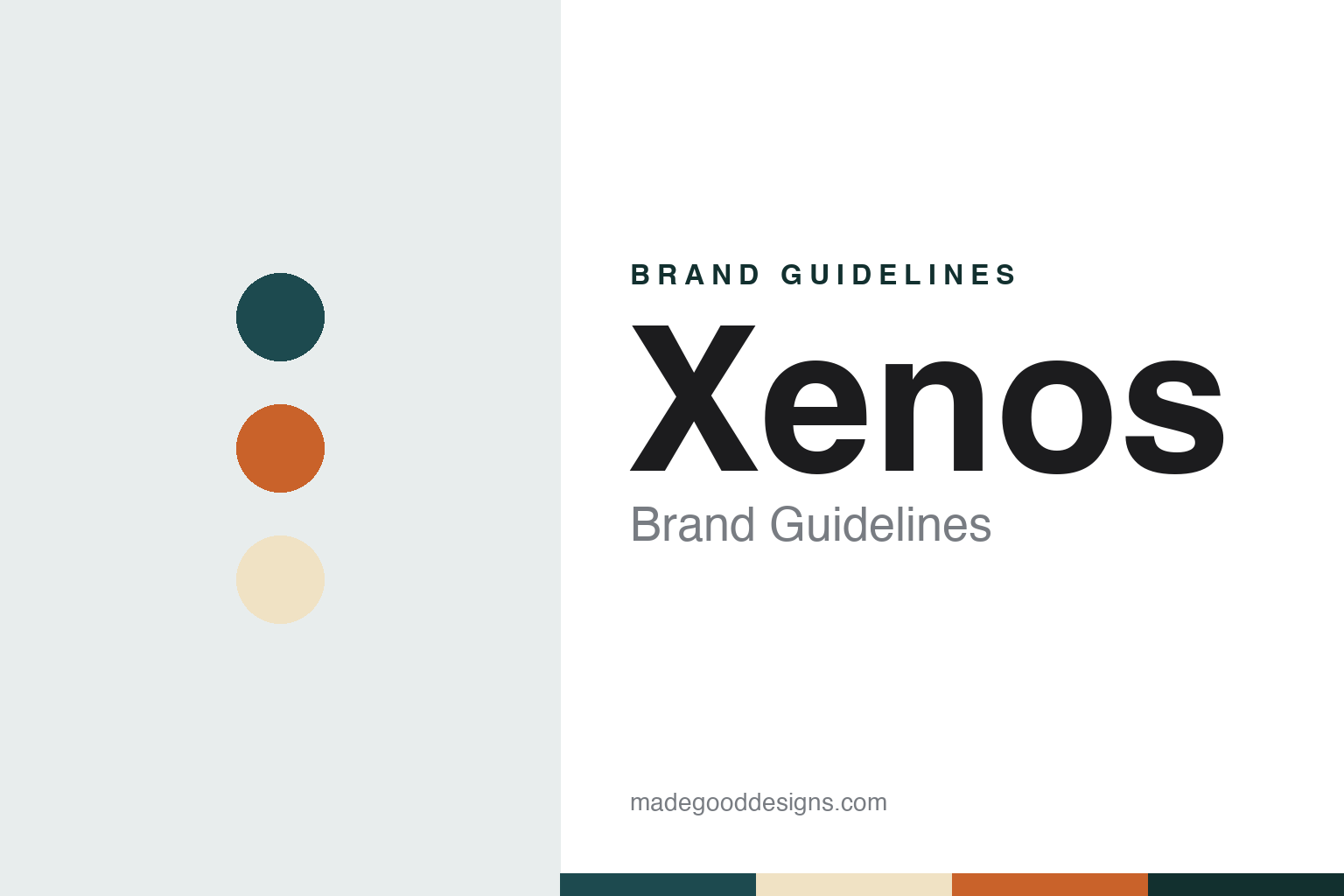
Xenos Brand Guidelines
A 1973 Dutch shop for things from elsewhere, named after the Greek word for stranger.
Aa
Two constants: a deep teal, spice orange and saffron cream palette and an open geometric sans register. Abstract homage — not a Xenos asset; no logo, shop fascia or product is reproduced.
The stranger in the shopping street
A grocer’s offshoot with a Greek name.
Xenos started in 1973 in ’s-Hertogenbosch, in North Brabant. Dutch Wikipedia says it was set up as part of the SHV group after SHV had taken over the grocery business De Gruyter in 1971, and that it was first run on a grocer’s formula. Its first three shops, according to the same source, opened in Eindhoven, in the Hoog Catharijne shopping centre in Utrecht and on the Nieuwendijk in Amsterdam. Xenos itself speaks of a history of more than 50 years in Dutch retail on its website.
The name is part of the idea. Both Dutch Wikipedia and the company explain that xenos is Greek for a stranger or foreigner; Dutch Wikipedia adds that it can also mean a guest. On its “Over Xenos” page the company says it looks around the world for products that are fun or taste different. Dutch Wikipedia describes the range as more or less exotic mass-market goods, and lists tableware, glassware, candles, furniture, household items and food among what the chain sells, wholesale as well as in its own shops.
In 1989, Dutch Wikipedia says, Xenos was taken over by Blokker Holding, the family retail group that grew out of a shop opened in Hoorn in 1896. Inside that group Xenos sat alongside the household chain Blokker, the toy shops of Bart Smit and Intertoys, and the furniture chain Leen Bakker. Its own base moved to Waalwijk, also in North Brabant: Dutch Wikipedia says about 75 people worked at the head office there and that a distribution centre of 40,000 square metres opened on the site in 2000, with a further hall of about 50,000 square metres added in 2014.
By then Xenos had crossed the border. Dutch Wikipedia says that in 2014 five to six thousand products went out from Waalwijk to more than 300 shops in the Netherlands and Germany. In January 2016 DutchNews reported that Xenos had some 250 shops, about 200 of them in the Netherlands and the rest in Germany, with a workforce of around 3,500, and that Blokker Holding was its owner.
Colour
Germany sold, a Casa plan and a family office.
The Blokker years ended with the breakup of the group. In May 2017, DutchNews reported, Blokker Holding announced that it would sell all of its operations that did not carry the Blokker name, Xenos among them, as part of a reorganisation that also closed about 100 Blokker shops.
Germany went first. On 27 December 2017 RetailDetail reported that Blokker Holding had sold Xenos’s German business, 63 shops, to the German discount chain TEDi, which would convert them all to its own name. The holding said at the time that the deal let it give extra attention to the Dutch Xenos business and to preparing that business for a later sale, the trade newsletter wrote.
The Dutch shops were next. On 13 March 2018 Omroep Brabant, the regional broadcaster, reported a plan to sell 110 Dutch Xenos shops to Casa, an interior chain which like Xenos was owned by the Blokker family; the Waalwijk head office and distribution centre were to close, with 180 jobs going, and the Blokker family would itself take charge of the remaining sixty Xenos shops, which would keep the name for the time being. RetailDetail later described the 2018 deal as a sale of 110 shops that left Xenos with about sixty branches and gave Casa its first steps into the Dutch market.
Xenos continued on a larger scale than that plan suggested. Dutch Wikipedia counts nearly 150 Xenos shops across the Netherlands in 2019, some of them former Big Bazar shops that Xenos took over and refitted, and says the head office and distribution centre stayed at Waalwijk. Since 2019 Xenos has been part of Nieuwgeluk Group, which RetailDetail described in April 2024 as a Dutch family vehicle and which Xenos calls a Dutch family office.
Typography
Fascias, folders and family names.
The Netherlands and Belgium have a dense network of discount, home, fashion and grocery chains, and many of them present themselves first through the shop front. A fascia on a shopping street is often the most visible part of the brand: when Blokker restarted in 2025, NOS reported that the old logo, in block capitals and without its full stop, went back up on the fronts of the reopened shops, and in April 2024 RetailDetail reported that Xenos would put its logo on eight former Casa shops it had taken back.
Websites carry the rest of the identity. Xenos groups its range online into departments such as furniture, garden, cooking and table, household and party goods, with trend pages and a customer club called Xtra Xenos; both Blokker and Xenos publish a folder, the retail leaflet, on their sites next to a shop finder. Xenos says it follows trends closely and buys new ranges in large volumes, so the assortment changes quickly.
Ownership is part of the story, and the companies describe it plainly. Some of these chains grew up inside family groups: Blokker Holding, built by the descendants of a couple who opened a shop in Hoorn in 1896, once owned Xenos, Leen Bakker, Bart Smit and Intertoys before selling them off between 2017 and 2019, and Xenos now describes its owner, Nieuwgeluk Group, as a Dutch family office. Restructurings, bankruptcies and restarts have reshaped several familiar names, and corporate pages and the trade press record those changes with dates.
This guide sets out what can be checked about each brand: who founded it, who owns it, how its shops, ranges and logos have changed, and what has happened to it. Company statements are marked as such, and counts of shops and countries are given with the date of the source.
Aa
An open geometric sans for a colourful shop front. (Specimen set in Sora, a sans STAND-IN; NOT the Xenos logo.)
Xenos today
Shops back from Casa, and a webshop alongside.
In April 2024 the roles of 2018 were reversed. RetailDetail reported on 10 April 2024 that Xenos was taking over eight shops from Casa, a return to familiar ground because it had sold those branches to Casa itself five years earlier, while Casa was cutting back in the Dutch market. The Xenos logo was to go up on the fronts of the eight shops in May 2024, starting with the furniture boulevard in Breda and the Trefcenter in Venlo and followed by Eindhoven, Terneuzen, Maastricht, Heerlen, Leeuwarden and Apeldoorn, according to the same report. Xenos said at the time that it had more than 165 shops that year, the trade newsletter wrote.
On its own site in November 2026 the company describes a colourful, quickly changing range of things for the home, mixing non-food and food, for indoors and out. It says it spots trends early and buys new ranges in large volumes, and that it sells them through its colourful shops and its webshop. The same page gives more than 160 shops in the Netherlands, all supplied daily from the distribution centre at Waalwijk. The website groups the range into furniture, home accessories, garden, cooking and table, food and drink, household, party and hobby, and adds trend pages, room ideas and a folder.
The company frames its offer around themed “worlds” inside the stores, which it says make shopping feel festive and adventurous. Its customer club is called Xtra Xenos, and the site carries pages on the range, the shops and the company’s Waalwijk base. Its German shops were to become TEDi shops after the 2017 sale, RetailDetail reported at the time, and the company’s own shop count today covers the Netherlands only.
For a design guide, Xenos shows how a foreign word can become a shop name that explains the range: things from elsewhere, sold as small surprises for the home. Compare Blokker, the household chain whose group owned Xenos for three decades, and IKEA, another home-goods retailer with its own range. For this guide we use a deep teal, a spice orange and a saffron cream with a geometric sans, an unofficial interpretation; no product or logo is reproduced.
Explore & save
Keep Xenos’s identity on hand — save it to a board in the Made Good inspiration library.
Xenos identity set
Pin the Xenos deep teal, spice orange and saffron cream palette and the open geometric sans register to your own board.
Source & notes
Frequently Asked Questions
What font can I use to match the Xenos look?
This guide describes Xenos’ type as “An open geometric sans for a colourful shop front”. Its type specimen is set in Sora from Google Fonts as a stand-in; Sora is not Xenos’ own lettering.
What colours are in the Xenos palette?
This guide’s Xenos palette is Deep teal #1D4A4F, Dark teal #12302F, Spice orange #C9622A, Saffron cream #F0E2C4 and Paper #F8F6F1. The tones are the guide’s own unofficial interpretation, not official Xenos hex codes.
When was Xenos founded?
Xenos was founded in 1973. Xenos is known for Tableware, glassware, candles, furniture and food.


