CeX Brand Guidelines
A Tottenham Court Road swap shop turned red high-street chain.
Aa
Two constants: a red, black and white palette and a heavy grotesque sans register. Abstract homage — not a CeX product or mark; no logo, sign or shopfront is reproduced.
Computer Exchange
A second-hand shop near Tottenham Court Road.
CeX began in London in 1992 as the Computer Exchange. The Guardian reported in January 2024 that the business was started that year by a group that included the writer and broadcaster Charlie Brooker, then a games journalist, and that its first branch opened near Tottenham Court Road. English Wikipedia places that first shop on Whitfield Street, close to Tottenham Court Road, and lists the founders as Robert Dudani, Paul Farrington, Hugh Man, Charlie Brooker, Oli Smith and Oliver Ball, citing the company’s own history page.
An early profile gives a sense of how the business took shape. In April 1999 The Guardian included Robert Dudani in a feature on young British entrepreneurs, describing him as a computer retailer who had run a second-hand computer games shop on Tottenham Court Road. The paper said the Computer Exchange (CEX) group, a chain of second-hand computer stores, was created in 1996, and that by then there were ten CEX stores in the London area selling second-hand software and hardware. It reported that a turning point came in 1997, when Dudani developed software for testing second-hand hardware to check it was fit for resale, and that an online store was about to launch. Companies House records show the trading company, C.E.X. Limited, was incorporated in May 1996 under another name and took its present name that August.
Brooker’s part in the story was as much about pictures as shelves. In a 2013 interview with Rock Paper Shotgun, he said he had been working in the games department of Music and Video Exchange in Notting Hill Gate when a colleague left to set up CEX; he went to work there too, and when the new firm found out he was a cartoonist it asked him to draw comic-strip adverts. Those strips ran in magazines including PC Zone, which was based nearby, and the magazine then asked him to draw for it and to write reviews.
Colour
Buy, sell and exchange, graded and guaranteed.
The name kept its letters while its meaning widened. English Wikipedia says the “CeX” initials moved away from Computer Exchange to stand for Complete Entertainment Exchange, as the shops took in more than computer parts. The Guardian described CeX in 2024 as a “bright red secondhand technology shop” found in more or less every UK town centre, with long runs of metal shelving, and its stock now spans video games, consoles, mobile phones, computers, tablets, DVDs and Blu-rays.
The model is an exchange. Customers bring in goods to sell and CeX offers either cash or a voucher to spend in its shops, according to English Wikipedia, citing the company. Prices are fixed by the company rather than haggled: in the 2024 Guardian piece a member of staff explained that the main thing affecting a price was how many copies the chain had in stock, so popular titles in long-running series sold cheaply while collectable games held their value. Phones and laptops were sold by grade, from A for mint to F for non-working, and consoles as boxed, unboxed or discounted, the paper reported. Stock from all of the UK shops could also be bought online.
Guarantees became part of the offer. The Guardian reported a 24-month warranty on what CeX sold in January 2024; by March 2025 Eurogamer was reporting a five-year warranty. That same month Eurogamer reported that CeX had started selling through the Just Eat delivery app, offering games, consoles, controllers and cables from local stores, with the company saying orders would arrive in around half an hour. English Wikipedia also records a console-repair service launched in November 2017 as CeX Clinic, later renamed Tech Centre.
The look has its own origin story. English Wikipedia credits the CeX logo to Charlie Brooker, citing a 2024 interview with him, alongside the cartoons he drew for the early adverts.
Typography
Design and documentation.
Second-hand and resale chains present themselves in two broad ways. Some, such as Savers and its Value Village banner in North America, run large thrift stores stocked with donated goods that the company buys from charity partners; in Australia, Savers signs its larger shops as “thrift superstores” and has added a smaller inner-city “thrift boutique.” Others run buy-and-sell counters, where shoppers bring in their own clothes, games or equipment and are paid on the spot, as Plato’s Closet describes its stores.
Ownership shapes how these names look. Franchise systems such as Winmark’s resale brands, among them Plato’s Closet and Once Upon A Child, keep one name, one buying routine and one website across hundreds of shops that are each independently owned, as Plato’s Closet’s own pages state. Company-run chains can instead carry several regional names under one owner: Savers trades as Savers, Value Village, Village des Valeurs and Unique in different markets.
The companies in this group, in North America, the United Kingdom, Australia and Japan, range from family-founded businesses to franchisors and listed groups with private-equity owners. Their corporate pages usually tell a founding story, name the current owner and explain how the buy or donation counter works; logos, shop signs and colour schemes are shown as the companies publish them on their own sites and storefronts.
These guides set out what can be checked about each chain — who founded it, who owns it now, how its stores and counters are described, and which of those descriptions rest only on the company’s own word — and suggest an unofficial palette and a stand-in typeface for designers studying the category.
Aa
A heavy, compact sans for price cards and shelf labels. (Specimen set in Archivo Black, a sans STAND-IN; NOT the CeX logo.)
CeX
Franchises, new countries and a new holding company.
Growth beyond London came through franchising as well as company shops. English Wikipedia says CeX began issuing franchise licences in 2005, and Companies House shows a separate company, CeX (Franchising) Limited, incorporated in October of that year. The Guardian counted 390 UK stores and a further 230 worldwide in January 2024, including a shop in the Canary Islands. In June 2025 the Dutch retail title RetailTrends put the total at more than 600 stores, over half of them in the United Kingdom, and named Poland, Spain, Italy, Mexico and India among its other markets; English Wikipedia also lists Ireland, Portugal, Australia and Malaysia.
Not every country lasted. CeX opened its first Dutch store in Arnhem in 2014, and on 5 June 2025 RetailTrends reported that it was closing all nine of its shops in the Netherlands, in Amsterdam, Arnhem, Leeuwarden, Leiden, Breda, Eindhoven, Nijmegen, Rotterdam and Zaandam, during June 2025, while keeping its Dutch website open. English Wikipedia, citing the company, says the Dutch online shop closed in November 2025 as well, and lists the United States as a former market.
CeX remains a private company. Companies House records show that since 31 October 2025 a holding company, Webuy Holdings Ltd, has held 75 per cent or more of the shares in both C.E.X. Limited and CeX (Franchising) Limited, taking over from an individual shareholder recorded since 2016. Its website trades as webuy.com, and Eurogamer quoted David Butler as the chain’s boss in 2025.
For a design guide, CeX shows how a plain, repeated shopfront and a short set of initials can carry a chain from one London street to several continents. Compare Cash Converters, the Perth second-hand chain that also franchised its way abroad, and Hard Off, a Japanese reuse chain that began as an audio shop. For this guide we use a red, a near-black and an off-white with a heavy sans, an unofficial interpretation; no product or logo is reproduced.
Explore & save
Keep CeX’s identity on hand — save it to a board in the Made Good inspiration library.
CeX identity set
Pin the CeX red, black and white palette and the heavy grotesque sans register to your own board.
Source & notes
Frequently Asked Questions
What font can I use to match the CeX look?
This guide describes CeX’s type as “A heavy, compact sans for price cards and shelf labels”. Its type specimen is set in Archivo Black from Google Fonts as a stand-in; Archivo Black is not CeX’s own lettering.
What colours are in the CeX palette?
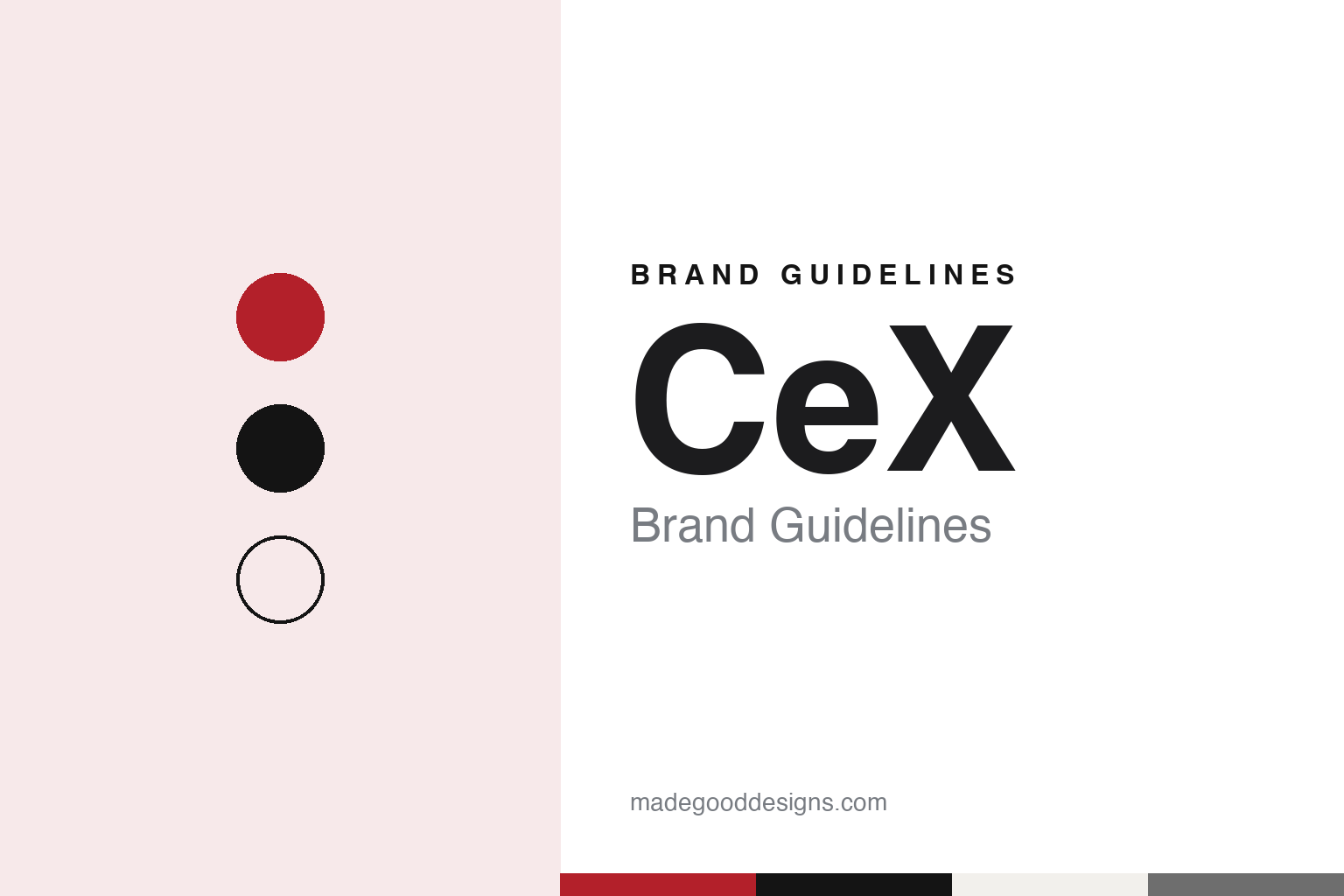
This guide’s CeX palette is Shopfront red #B3202A, Shelf black #141414, Receipt white #F2F0EC, Console grey #6E6E6E and Paper #FAF8F5. The tones are the guide’s own unofficial interpretation, not official CeX hex codes.
When was CeX founded?
CeX was founded in 1992 (as the Computer Exchange), in London, United Kingdom.
Who owns CeX?
CeX is owned by Webuy Holdings Ltd (since October 2025).