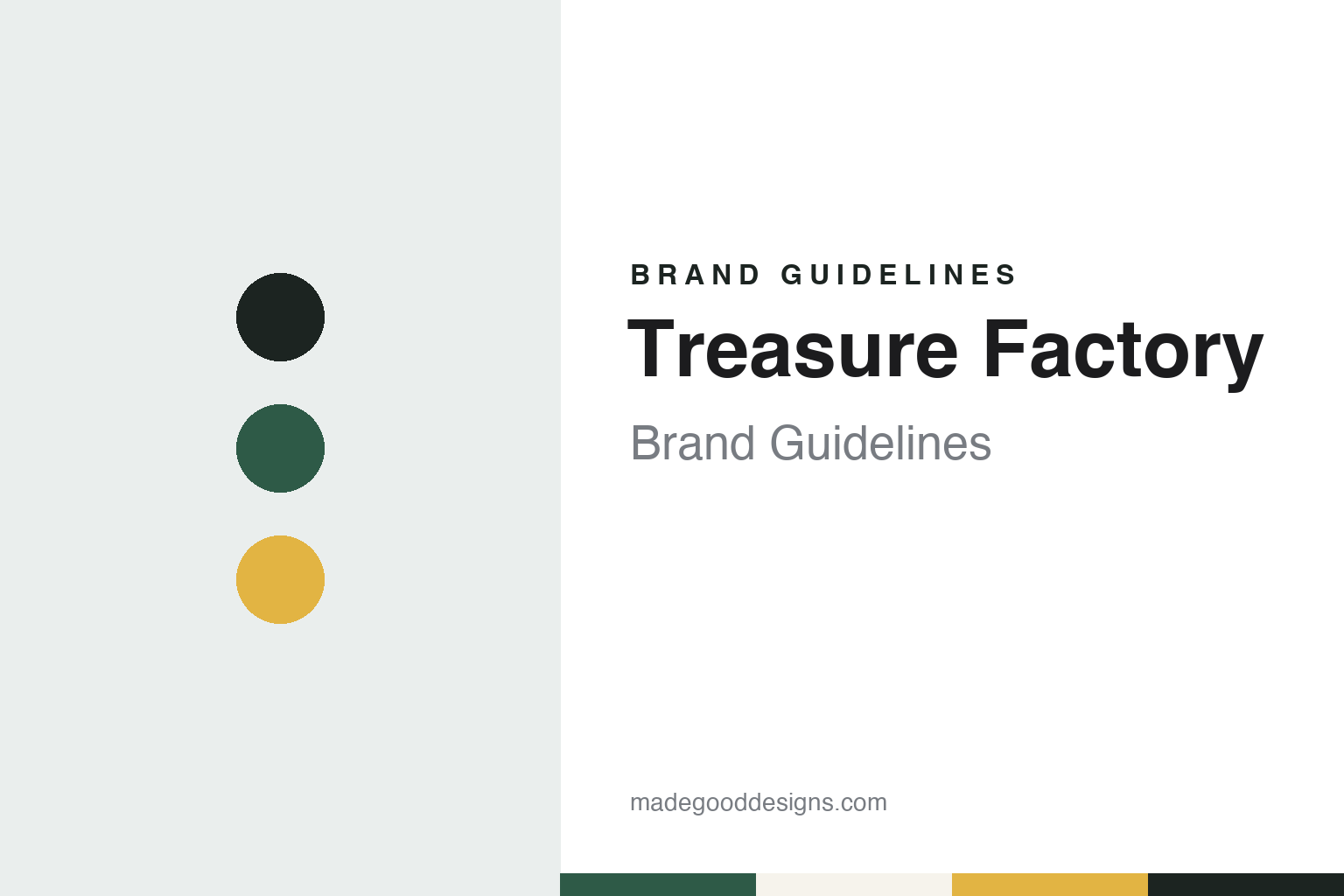
Treasure Factory Brand Guidelines
A 1995 Adachi recycle shop and the Trefac family of formats.
Aa
Two constants: a green, yellow and kraft palette and a rounded geometric sans register. Abstract homage — not a Treasure Factory product or mark; no sign, logo or shopfront is reproduced.
Adachi, 1995
A student’s idea and a recycle shop in Adachi.
Treasure Factory began as a limited company set up in Yokohama on 25 May 1995, according to the company’s profile. Five months later, in October 1995, it opened its debut shop, the general recycle shop Treasure Factory Adachi Honten, in Toneri in Tokyo’s Adachi ward. The founder is Eigo Nosaka, who still leads the company as president. The company says he started the business after seeing, as a student, furniture and household appliances that were still usable being thrown out every day because nobody was there to take them.
The name is meant literally. The company explains “Treasure Factory” as a factory of treasures, or a “factory for regenerating value”: once an owner no longer needs something, it says, the object loses its value, and the business set out to give such things value again and send them back out into the world. In its English investor pages the company says that, from the start, it brought in item-by-item stock control, clearly marked prices, cleaning of goods, careful service and product guarantees, which it describes as unusual in the trade at that time.
Growth followed a steady line, according to the company history. Online sales began in August 1999, and in December that year the firm became a joint-stock company. A store in Soka, Saitama, opened in 1998 as its move beyond Tokyo, and Tsurumi in Yokohama followed in 2003. A franchise business began in July 2004 with a franchised store in Iwaki, Fukushima, and a clothing-only format, Treasure Factory Style, opened in Chiba in October 2006.
The company listed on the Tokyo Stock Exchange Mothers market in December 2007, moved to the exchange’s First Section in December 2014 and, after the market reorganisation of April 2022, to the Prime market. Japanese Wikipedia, which gives the same dates, notes that TV Tokyo’s business programme Cambria Kyuden featured the company and its president in 2013 and again in 2023, and that Nosaka published a book on starting a company in 2017.
Colour
Many formats under one short name.
Treasure Factory’s design story is less about one sign than about a family of formats. The company shortens its own name to Trefac and uses that prefix across most of them. Japanese Wikipedia lists the general store Treasure Factory; Trefac Style for clothing; Trefac Sports Outdoor, begun in Yokohama in 2014; Brand Collect for high-end brands, taken over by business transfer in October 2014; the used-clothing outlet Usedlet, from 2013; and Trefac Market, a large-store format for furniture and appliances, from 2016. Musical instruments joined with Trefac Gakki in Musashino in July 2025, and an anime and character-goods format, Trefac Anime Lab, began in June 2026.
Acquired businesses keep their own names. The company bought the used designer-clothing chain Kind Off in September 2016, the golf-shop operator Golf Kids, now GK Factory, in March 2018 and Pickup Japan in October 2020, its history page records. Around the shops sit services that mostly carry the same prefix: Trefac Hikkoshi, a moving service begun in 2014 that combines removals with buying unwanted goods; the online shop Trefac Online, from 2017; a business-to-business auction now called Trefac Auction, from 2020; the rental service Cariru, from 2010; and Regacy, a service for sorting household belongings, from November 2020.
Independent coverage shows how the formats meet on the shop floor. In June 2024 Time Out Tokyo described the large Nerima store as a combination of the company’s formats under one roof, with clothing, designer bags, home appliances, instruments, electronics, furniture, home decor, tableware, golf equipment and camping gear, and noted that the company runs several versions of its store around Japan, including Trefac Style for fashion and Trefac Sports Outdoor for sporting goods. In May 2025 the rental-housing trade paper Zenkoku Chintai Jutaku Shimbun reported on a service that packages used appliances bought in at its reuse shops, more than 300 nationwide by its count, into ready-made sets matched to the age of the goods and the size of the household, from a two-item fridge and washing machine set to a seven-item set that adds a kettle and a rice cooker, ordered through a dedicated website.
Typography
Signs, counters and families of shops.
Second-hand and resale chains present themselves in two broad ways. Some, such as Savers and its Value Village banner in North America, run large thrift stores stocked with donated goods that the company buys from charity partners; in Australia, Savers signs its larger shops as “thrift superstores” and has added a smaller inner-city “thrift boutique.” Others run buy-and-sell counters, where shoppers bring in their own clothes, games or equipment and are paid on the spot, as Plato’s Closet describes its stores.
Ownership shapes how these names look. Franchise systems such as Winmark’s resale brands, among them Plato’s Closet and Once Upon A Child, keep one name, one buying routine and one website across hundreds of shops that are each independently owned, as Plato’s Closet’s own pages state. Company-run chains can instead carry several regional names under one owner: Savers trades as Savers, Value Village, Village des Valeurs and Unique in different markets.
The companies in this group, in North America, the United Kingdom, Australia and Japan, range from family-founded businesses to franchisors and listed groups with private-equity owners. Their corporate pages usually tell a founding story, name the current owner and explain how the buy or donation counter works; logos, shop signs and colour schemes are shown as the companies publish them on their own sites and storefronts.
These guides set out what can be checked about each chain — who founded it, who owns it now, how its stores and counters are described, and which of those descriptions rest only on the company’s own word — and suggest an unofficial palette and a stand-in typeface for designers studying the category.
Aa
A rounded geometric sans for a family of shop names. (Specimen set in Outfit, a sans STAND-IN; NOT the Treasure Factory logo.)
Treasure Factory
A new corporate logo in the 30th year.
The company counted 319 stores in 13 formats in Japan and abroad as of the end of February 2026, its investor pages say; Japanese Wikipedia gives 320 for the same date. Work abroad began in Thailand, where a subsidiary was set up in March 2016 and the Sukhumvit 39 store opened in Bangkok in July 2016. A Taiwan subsidiary followed in April 2021, with a store in Xinzhuang, New Taipei, in December 2022 and a Trefac Style shop in Taipei’s Gongguan area in December 2025, the Style format’s debut outside Japan. A US company, Treasure Factory USA Inc., was set up in September 2025, the company history says.
Inside Japan the chain spread region by region: Kansai in 2013 with a store in Kobe, the Chubu region and Nagoya in May 2016, Kyushu in July 2016, the Chugoku region with Okayama in March 2025 and, for directly run stores, Tohoku with a Trefac Style shop in Sendai in July 2025. The head office has moved several times within Tokyo, from Adachi to Kanda in 2016 and to Sotokanda, near Akihabara, in January 2025. That same month the company replaced its corporate logo, its history page records, ahead of its 30th anniversary in May 2025.
For a design guide, Treasure Factory shows how a reuse retailer can stretch one name across many shop types: a single short prefix, Trefac, lets clothing, sports, instrument and furniture formats read as one family, while acquired chains such as Kind Off keep their own signs. Compare 2nd Street, another Japanese recycle-shop chain, and Komehyo, the Nagoya reseller. For this guide we use a deep green, a warm yellow and a kraft brown with a sans, an unofficial interpretation; no product or logo is reproduced.
Explore & save
Keep Treasure Factory’s identity on hand — save it to a board in the Made Good inspiration library.
Treasure Factory identity set
Pin the Treasure Factory green, yellow and kraft palette and the rounded geometric sans register to your own board.
Source & notes
Frequently Asked Questions
What font can I use to match the Treasure Factory look?
This guide describes Treasure Factory’s type as “A rounded geometric sans for a family of shop names”. Its type specimen is set in Outfit from Google Fonts as a stand-in; Outfit is not Treasure Factory’s own lettering.
What colours are in the Treasure Factory palette?
This guide’s Treasure Factory palette is Warehouse green #2E5A47, Ink #1C2421, Tag yellow #E2B443, Kraft #C9AE84 and Paper #F6F3EC. The tones are the guide’s own unofficial interpretation, not official Treasure Factory hex codes.
When was Treasure Factory founded?
Treasure Factory was founded in May 1995, in Yokohama, Japan.
Who founded Treasure Factory?
Treasure Factory was founded by Eigo Nosaka in May 1995.