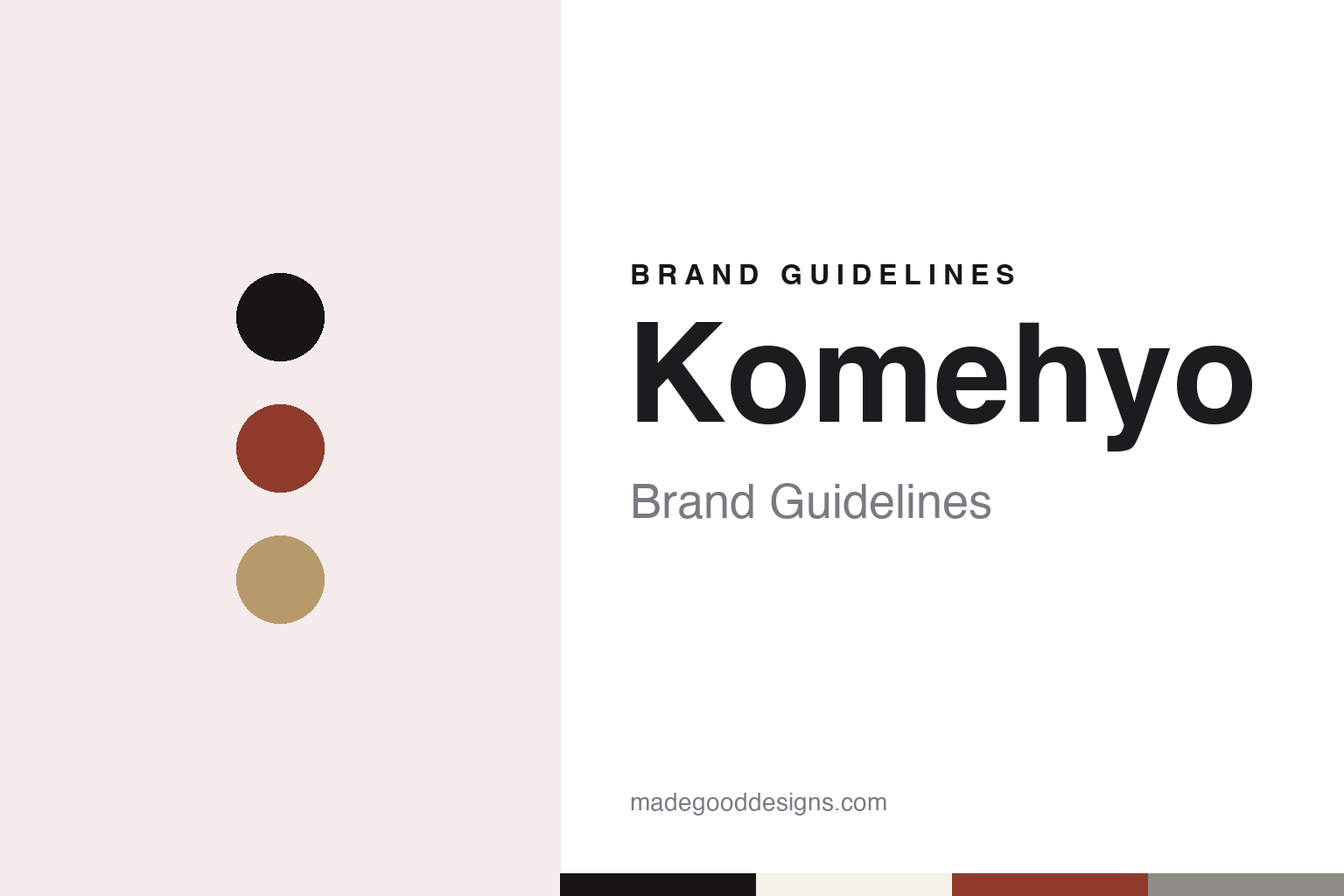
Komehyo Brand Guidelines
A 1947 Osu used-clothing shop, five-second ads and KOMEHYO SHIBUYA.
Aa
Two constants: a black, red, grey and oak palette and a Mincho serif register. Abstract homage — not a Komehyo product or mark; no sign, logo or shopfront is reproduced.
Osu, 1947
A used-clothing shop that became a Nagoya name.
Komehyo dates its start to 1947, when its founder, Daiji Ishihara, opened a small used-clothing shop called Komehyo Shoten in Osu, the shopping district of central Nagoya. The company’s history says he had first raised money by peddling clothes door to door around Handa in Aichi prefecture, by handcart and bicycle, buying used garments and selling them on. Japanese Wikipedia gives the same 1947 start in Osu and says the name comes from the shop’s old trading name, written 米兵, which it shares with a rice dealer in Handa that Japanese Wikipedia describes as the main family line.
The business became a limited partnership in April 1951 and a joint-stock company in May 1979. In the meantime it widened its range, the company says, from clothing to jewellery, cameras and watches, and from the 1960s to household goods of all kinds, appliances included. The main store moved in 1970 to the Osu site that is still the head office, and a second shop for audio and other electrical goods opened on Osu Kannon-dori in 1977; it is now the KOMEHYO kimono store.
In September 1987, as part of a corporate-identity programme, the company changed its trade name from the kanji 米兵 to コメ兵, with the first half written in katakana. A mail-in buying service for goods from across Japan began in 1988, buying centres opened in Tokyo from 1996 and in Osaka in 2000, and online sales started in May 2000.
Colour
Five-second spots and a department store of used goods.
Much of Komehyo’s early identity was built on air. From 1973, the company says, it ran radio and television spots with the line “sell unwanted things to Komehyo,” and kept the catchphrase for about 15 years. Japanese Wikipedia describes the original television spot as a very simple five-second film: the name 米兵 shown large on screen and a male voice reading the line, which made the shop widely known in the Tokai region. Later versions added a female voice and a jingle; in the 1990s the company used television personalities and a rock band; and in August 2010 a new series directed by the film director Yukihiko Tsutsumi brought the old catchphrase back, in separate versions for Nagoya, Tokyo and Osaka.
The flagship grew to match. In November 2000 the Nagoya main store was enlarged and reopened as a “recycle department store” of about 1,700 tsubo of floor space, selling jewellery and precious metals, watches, brand bags, clothing, kimono, cameras and musical instruments, the company says. In 2002 it opened Yen=g in Osu, a shop selling low-priced clothing by weight. The shop name changed to the Latin-letter KOMEHYO during the 2012–13 financial year, and the Nagoya main store reopened after a large renewal in April 2013.
A recent example of the brand in a building is KOMEHYO SHIBUYA, which opened on Inokashira-dori on 17 November 2023. Shibuya Keizai Shimbun reported that the four-floor store of about 733 square metres was art-directed by the video artist OSRIN, known for music videos for the band King Gnu, with “iro-nagashi” colour-marbling artwork inspired by suminagashi on every floor. Each level takes a theme in time: IMA (now) on the ground floor, with motifs from humans to dinosaurs painted across floors and walls; KAKO (past), a grey, industrial floor of pieces from around 1990 to 2000; MIRAI (future), a bright, woody floor; and RELAY, a park-like top floor with plants, sofas, a bar-counter buying desk instead of private rooms, and fitting rooms that include a tatami room with bonsai. The paper said the store aimed at shoppers in their twenties and thirties. For its third anniversary in November 2026 the store staged a pop-up of about 150 archive Fendi and Chanel pieces from Karl Lagerfeld’s years at both houses, with drawings by the illustrator KOTOKO in its windows, the same paper reported.
Typography
Signs, counters and families of shops.
Second-hand and resale chains present themselves in two broad ways. Some, such as Savers and its Value Village banner in North America, run large thrift stores stocked with donated goods that the company buys from charity partners; in Australia, Savers signs its larger shops as “thrift superstores” and has added a smaller inner-city “thrift boutique.” Others run buy-and-sell counters, where shoppers bring in their own clothes, games or equipment and are paid on the spot, as Plato’s Closet describes its stores.
Ownership shapes how these names look. Franchise systems such as Winmark’s resale brands, among them Plato’s Closet and Once Upon A Child, keep one name, one buying routine and one website across hundreds of shops that are each independently owned, as Plato’s Closet’s own pages state. Company-run chains can instead carry several regional names under one owner: Savers trades as Savers, Value Village, Village des Valeurs and Unique in different markets.
The companies in this group, in North America, the United Kingdom, Australia and Japan, range from family-founded businesses to franchisors and listed groups with private-equity owners. Their corporate pages usually tell a founding story, name the current owner and explain how the buy or donation counter works; logos, shop signs and colour schemes are shown as the companies publish them on their own sites and storefronts.
These guides set out what can be checked about each chain — who founded it, who owns it now, how its stores and counters are described, and which of those descriptions rest only on the company’s own word — and suggest an unofficial palette and a stand-in typeface for designers studying the category.
Aa
A Mincho serif for a name written three ways. (Specimen set in Shippori Mincho, a serif STAND-IN; NOT the Komehyo logo.)
KOMEHYO
A Nagoya listing and a reach across Asia.
Komehyo registered its shares on JASDAQ in September 2003 and listed on the second sections of the Tokyo and Nagoya stock exchanges in December 2004. In October 2020 it moved to a holding-company structure: the brand and fashion business passed to a new Komehyo Co., Ltd., and the listed parent became Komehyo Holdings, which Japanese Wikipedia says is listed on the Tokyo Stock Exchange Standard market and the Nagoya Stock Exchange Main market. Takuji Ishihara became the fourth president in the 2013–14 financial year, the company says. The group also runs a tyre and wheel business, Craft, which it bought in January 2012.
Acquisitions widened the group. In December 2019 a new subsidiary, K-Brand Off, took over the Kanazawa-based Brand Off business together with its Hong Kong and Taiwan companies, and the resale site RECLO joined in April 2024. In November 2017 Komehyo launched KANTE, a flea-market app for brand goods that Japanese Wikipedia says came with an authenticity check by Komehyo’s appraisers, and in 2020 it began bringing an in-house authentication AI into its stores, the company says.
Abroad, Komehyo set up a Hong Kong company in 2013. In November 2019 the Bangkok Post reported the opening of its flagship in Bangkok, on the second floor of Central@CentralWorld, run by Saha Komehyo, a joint venture set up in December 2018 with Saha Pathana Inter-Holding of Thailand’s Saha Group, which held 51 per cent. The paper said the store carried more than 400 second-hand watches, bags and accessories, also bought goods from customers, and that Komehyo then had 39 branches in Japan. Companies in Singapore in 2022 and in Malaysia and the US in 2024 followed, according to the group’s company list. Store numbers rose with the acquisitions: 81 in the 2021 financial year and 114 in 2022, the company told Shibuya Keizai Shimbun in 2023, and a group total of 300 in 2025, its history page says.
For a design guide, Komehyo shows how a retailer’s name can be rewritten as the business changes, from kanji to katakana to Latin capitals, while one plain catchphrase carried the brand for years. Compare Treasure Factory, the Tokyo reuse chain, and The RealReal, another reseller of designer goods. For this guide we use a lacquer black, a deep red, a grey and an oak tone with a serif, an unofficial interpretation; no product or logo is reproduced.
Explore & save
Keep Komehyo’s identity on hand — save it to a board in the Made Good inspiration library.
Komehyo identity set
Pin the Komehyo black, red, grey and oak palette and the Mincho serif register to your own board.
Source & notes
Frequently Asked Questions
What font can I use to match the Komehyo look?
This guide describes Komehyo’s type as “A Mincho serif for a name written three ways”. Its type specimen is set in Shippori Mincho from Google Fonts as a stand-in; Shippori Mincho is not Komehyo’s own lettering.
What colours are in the Komehyo palette?
This guide’s Komehyo palette is Lacquer black #171615, Osu red #8E3B2C, Kako grey #8F8D88, Mirai oak #B79A6C and Paper #F4F1EA. The tones are the guide’s own unofficial interpretation, not official Komehyo hex codes.
When was Komehyo founded?
Komehyo was founded in 1947, in Osu, Nagoya, Japan. Komehyo is known for Nagoya main store, KOMEHYO SHIBUYA, KANTE.
Who founded Komehyo?
Komehyo was founded by Daiji Ishihara in 1947. Komehyo is known for Nagoya main store, KOMEHYO SHIBUYA, KANTE.