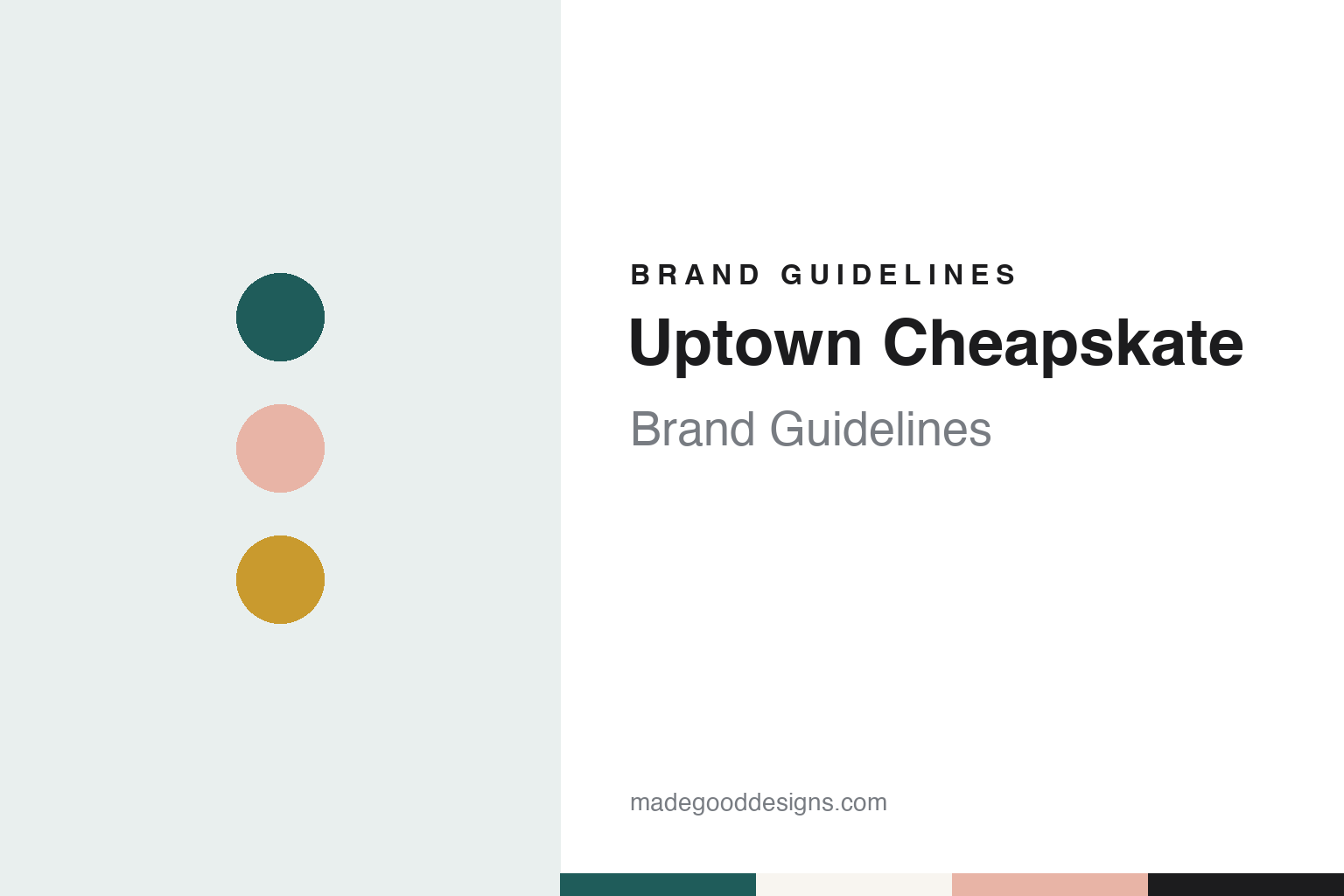
Uptown Cheapskate Brand Guidelines
A Salt Lake City resale chain from the Kid to Kid family.
Aa
Two constants: a deep teal, blush and mustard palette and a Boutique sans register. Abstract homage — not an Uptown Cheapskate product or mark; no logo, sign or shop fitting is reproduced.
Salt Lake City
A second resale brand from a resale family.
Uptown Cheapskate is a franchised chain of resale clothing stores that buy and sell on-trend secondhand clothing for teens and young adults. It belongs to BaseCamp Franchising of Salt Lake City, Utah, which also franchises the children’s resale chain Kid to Kid.
The brand grew out of a family resale business. Business View Magazine reported in March 2015 that the siblings Chelsea and Scott Sloan grew up in the stores of Kid to Kid, the children’s resale franchise their parents had created, and began laying the groundwork for a concept of their own after 2006, while they were of college age. Utah Business reported in January 2026 that the first Kid to Kid opened in 1992, and named Brent and Shauna Sloan as the co-founders of BaseCamp. In 2015, the magazine said, Kid to Kid had more than 100 stores across the United States and Portugal.
The first Uptown Cheapskate opened in Salt Lake City, but the sources give different years. Business View Magazine dated the opening to 2009 and said the concept became a franchise offering within months; Entrepreneur’s franchise directory gives 2008 for both the founding and the start of franchising. The 2015 profile described a brand aimed at college-age shoppers, with the hope that younger customers would follow, and said the two family businesses shared a Salt Lake City headquarters and support teams while keeping separate executive management.
By then the chain had more than 40 locations in 17 states, the magazine reported, and all but two were owned by franchisees: the exceptions were the original store in downtown Salt Lake City and one in the city’s Sugar House neighborhood. It described a typical store as a space of about 4,000 square feet in a strip center anchored by a large retailer, near a mall or university, with a staff of ten to twelve.
Colour
The Gordon brothers, 2022.
Ownership changed in 2022. That year the brothers Zach and Tyler Gordon acquired a majority stake in Uptown Cheapskate and Kid to Kid from the founding Sloan family, the U.S. Chamber of Commerce’s CO— reported in August 2026; Utah Business described the deal as the purchase of a controlling share in BaseCamp, the parent of both brands. The Gordons lead BaseCamp as co-chief executives. Zach Gordon came from Restaurant Brands International, the franchisor of Burger King, and Tyler Gordon from private-equity investing, both publications reported. Brent and Shauna Sloan remained involved as franchisees and board members, according to Utah Business.
The store count has risen since. As of 2025, Utah Business reported, Uptown Cheapskate and Kid to Kid together had more than 280 operating stores across the United States, with more than 50 in development. In July 2026 Shopping Center Business reported that BaseCamp had opened its 300th store, in Weatherford, Texas, and that the two brands had 300 stores in 33 U.S. states and several international markets. CO— reported in August 2026 that the stores spanned 32 states plus Portugal and Spain, and that the first Uptown Cheapskate in the Northeast had opened in Weymouth, Massachusetts, in March 2026. Those figures cover both brands. As of November 2026, the Uptown Cheapskate franchise website listed more than 180 of its own stores open.
The stores buy as well as sell. Customers bring clothes in to sell, and CO— reported that items the stores do not accept can be donated to Goodwill through the store if the customer chooses. Pricing is driven by software: the franchise website describes proprietary tools that combine appraisal, inventory, point of sale and real-time reporting, and CO— described the same system as taking the guesswork out of pricing used clothing.
Typography
Design and documentation.
Second-hand and resale chains present themselves in two broad ways. Some, such as Savers and its Value Village banner in North America, run large thrift stores stocked with donated goods that the company buys from charity partners; in Australia, Savers signs its larger shops as “thrift superstores” and has added a smaller inner-city “thrift boutique.” Others run buy-and-sell counters, where shoppers bring in their own clothes, games or equipment and are paid on the spot, as Plato’s Closet describes its stores.
Ownership shapes how these names look. Franchise systems such as Winmark’s resale brands, among them Plato’s Closet and Once Upon A Child, keep one name, one buying routine and one website across hundreds of shops that are each independently owned, as Plato’s Closet’s own pages state. Company-run chains can instead carry several regional names under one owner: Savers trades as Savers, Value Village, Village des Valeurs and Unique in different markets.
The companies in this group, in North America, the United Kingdom, Australia and Japan, range from family-founded businesses to franchisors and listed groups with private-equity owners. Their corporate pages usually tell a founding story, name the current owner and explain how the buy or donation counter works; logos, shop signs and colour schemes are shown as the companies publish them on their own sites and storefronts.
These guides set out what can be checked about each chain — who founded it, who owns it now, how its stores and counters are described, and which of those descriptions rest only on the company’s own word — and suggest an unofficial palette and a stand-in typeface for designers studying the category.
Aa
A clean boutique sans — thrift presented as a shop, not a jumble. (Specimen set in Josefin Sans, a sans STAND-IN; NOT the Uptown Cheapskate logo.)
Uptown Cheapskate
Thrift dressed as a boutique.
The brand’s visual pitch is that a resale store need not look like one. CO— reported that the stores are designed to feel more like boutiques than chain stores, and that the Gordons set out early to change a lingering view of secondhand shops as dusty and untidy. In the 2015 Business View Magazine profile, Scott Sloan said the aim was for a customer arriving to buy or sell to feel the store did not look like a resale operation at all.
The look is applied through a central process. Utah Business reported in January 2026 that BaseCamp had built a team of about ten people dedicated to opening new stores, covering operations, store design and construction, and marketing, working from a written new-store playbook for franchisees. CO— reported that BaseCamp opened 20 stores in 2025. The franchise website’s own shorthand for the brand is simply “Uptown.”
For a design guide, Uptown Cheapskate shows how a resale chain can borrow the look of a boutique while keeping a buy-counter at its heart. Compare Plato’s Closet, the Winmark franchise that also buys and sells clothing for teens and young adults, and Goodwill, which CO— reported receives the clothes Uptown Cheapskate does not take, when customers choose to donate them. For this guide we use a deep teal, a blush and a mustard with a sans, an unofficial interpretation; no product or logo is reproduced.
Explore & save
Keep Uptown Cheapskate’s identity on hand — save it to a board in the Made Good inspiration library.
Uptown Cheapskate identity set
Pin the Uptown Cheapskate deep teal, blush and mustard palette and the Boutique sans register to your own board.
Source & notes
Frequently Asked Questions
What font can I use to match the Uptown Cheapskate look?
This guide describes Uptown Cheapskate’s type as “A clean boutique sans — thrift presented as a shop, not a jumble”. Its type specimen is set in Josefin Sans from Google Fonts as a stand-in; Josefin Sans is not Uptown Cheapskate’s own lettering.
What colours are in the Uptown Cheapskate palette?
This guide’s Uptown Cheapskate palette is Deep teal #1F5C5A, Charcoal #1C1C1E, Blush #E8B4A6, Mustard #C99A2E and Paper #F8F5F0. The tones are the guide’s own unofficial interpretation, not official Uptown Cheapskate hex codes.
When was Uptown Cheapskate founded?
Uptown Cheapskate was founded in 2008 or 2009 (sources differ), in Salt Lake City, Utah.
Who founded Uptown Cheapskate?
Uptown Cheapskate was founded by Chelsea and Scott Sloan in 2008 or 2009 (sources differ).