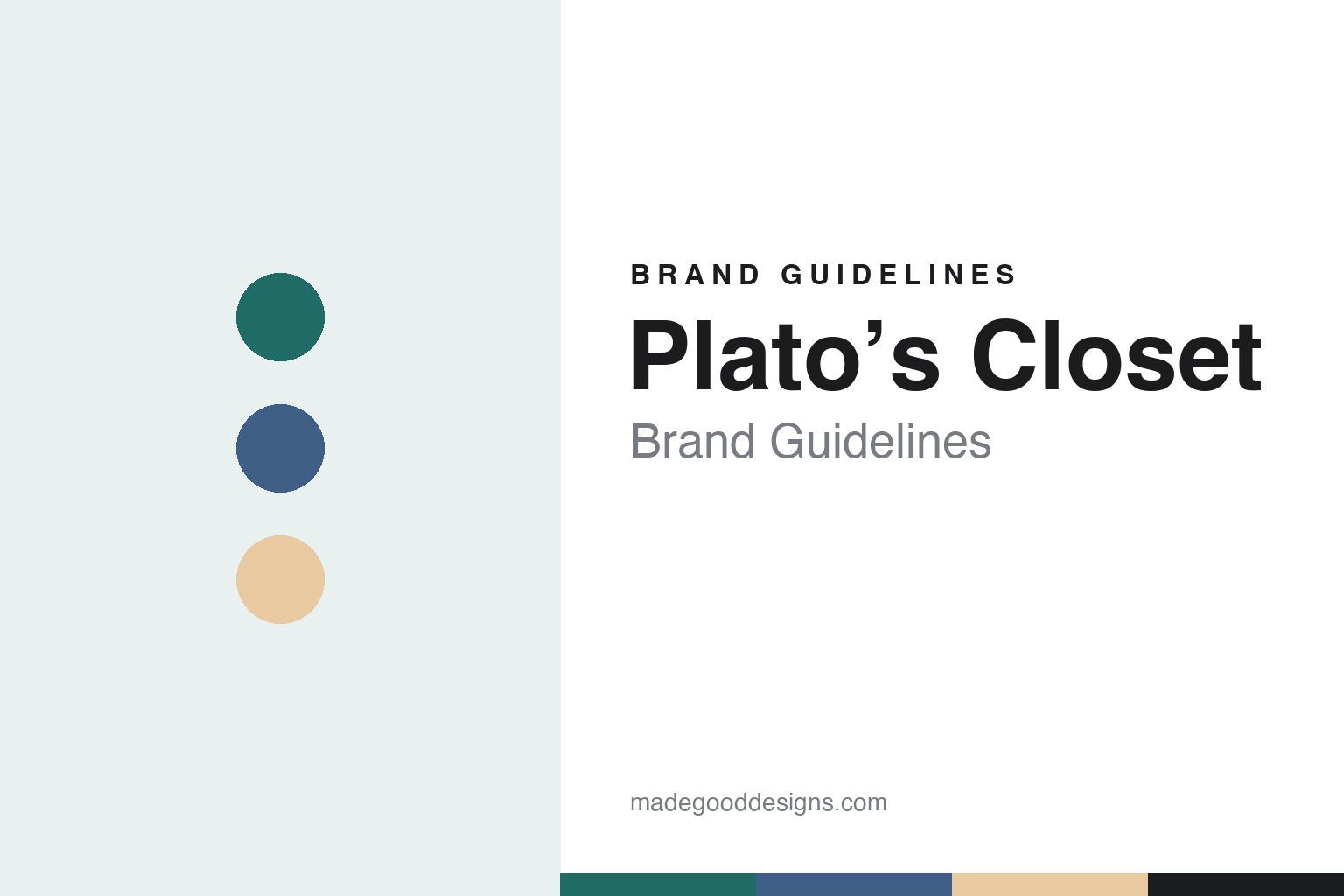
Plato’s Closet Brand Guidelines
A Columbus resale shop for teen wardrobes, run as hundreds of separate franchises.
Aa
Two constants: a deep teal, denim blue and warm ink palette and a rounded sans register. Abstract homage — not a Plato’s Closet product or mark; no sign, logo or store fascia is reproduced.
A Columbus closet
Once Upon A Child’s founders try a second store.
Plato’s Closet is a chain of second-hand clothing stores aimed at teenagers and young adults. The company says the first store was opened in Columbus, Ohio, by Lynn and Dennis Blum. The couple had already built one resale business: English Wikipedia says they opened the first Once Upon A Child store, for children’s clothes and toys, in Perrysburg, Ohio, in 1985, after seeing used baby clothes sell at Goodwill, and sold that company to the franchisor now called Winmark in 1992.
The name came from the family. According to the company, the Blums asked their teenage son to help name the business; a school project had given him an interest in the Greek philosopher Plato, whose ideas about reuse seemed to the family to suit a shop that buys and resells clothes. “Closet” was chosen, the company says, because it pointed to a teenager’s bedroom and wardrobe.
Winmark Corporation bought Plato’s Closet from the Blums in 1998, English Wikipedia says, and has franchised it since. A store page for Dublin, Ohio, still tells the founding story and calls the Blums “our owners.”
Colour
Buy counters, no appointments.
The format is a buy-and-sell shop rather than a consignment store. Plato’s Closet says it buys gently used clothes, shoes and accessories for all seasons, every day, with no appointment, and pays sellers on the spot. English Wikipedia draws the same line between the chain and consignment shops, and says the stores concentrate on clothing for shoppers aged roughly 12 to 24.
The trade press has described how the counter works. Sellers drop off their clothes and can shop the racks while staff sort through what they brought; they then leave with cash and with any items the store did not take, or put the money towards new outfits, a Winmark operations executive told Franchise Times in September 2022. The same report said Plato’s Closet did not have an online sales platform, unlike some of Winmark’s other brands, because shipping low-priced clothing across the country was not cost-effective; the business stayed in the shops. It also reported that, when many retailers were cutting their opening days and hours in the preceding years, some Plato’s Closet locations extended theirs. The same executive likened a visit to a treasure hunt, with shoppers going from store to store in search of particular labels and styles.
The stock is branded casual fashion. English Wikipedia, citing a 2001 Star Tribune report, lists labels the stores then carried, including Abercrombie & Fitch, Gap, Express and Dr. Martens. On the company website today the main sections are “Sell To Us,” “Find Your Fit” and a store finder that covers the United States and Canada, and every page footer states that each franchise is independently owned and operated.
Typography
Signs, counters and owners.
Second-hand and resale chains present themselves in two broad ways. Some, such as Savers and its Value Village banner in North America, run large thrift stores stocked with donated goods that the company buys from charity partners; in Australia, Savers signs its larger shops as “thrift superstores” and has added a smaller inner-city “thrift boutique.” Others run buy-and-sell counters, where shoppers bring in their own clothes, games or equipment and are paid on the spot, as Plato’s Closet describes its stores.
Ownership shapes how these names look. Franchise systems such as Winmark’s resale brands, among them Plato’s Closet and Once Upon A Child, keep one name, one buying routine and one website across hundreds of shops that are each independently owned, as Plato’s Closet’s own pages state. Company-run chains can instead carry several regional names under one owner: Savers trades as Savers, Value Village, Village des Valeurs and Unique in different markets.
The companies in this group, in North America, the United Kingdom, Australia and Japan, range from family-founded businesses to franchisors and listed groups with private-equity owners. Their corporate pages usually tell a founding story, name the current owner and explain how the buy or donation counter works; logos, shop signs and colour schemes are shown as the companies publish them on their own sites and storefronts.
These guides set out what can be checked about each chain — who founded it, who owns it now, how its stores and counters are described, and which of those descriptions rest only on the company’s own word — and suggest an unofficial palette and a stand-in typeface for designers studying the category.
Aa
A friendly rounded sans for rack cards and counter signs. (Specimen set in Nunito, a rounded sans STAND-IN; NOT the Plato’s Closet logo.)
Winmark
A Minneapolis franchisor of resale brands.
Winmark’s own history begins with another resale idea. English Wikipedia says the company was incorporated in 1988 as Play It Again Sports Franchise Corporation, after its founders, Ron Olson and Jeffrey Dahlberg, bought the franchise rights to Martha Morris’s used sporting-goods shops in Minneapolis. It was renamed Grow Biz International in June 1993, went public on NASDAQ in August 1993 and became Winmark Corporation in 2001. Its own website dates the company to 1988 and lists the purchase of Once Upon A Child in 1992 and Music Go Round in 1993, followed by Plato’s Closet; around 2002, English Wikipedia says, it sold off several other concepts, including Computer Renaissance and Disc Go Round.
In 2022 Franchise Times described Plato’s Closet as a subsidiary of Minneapolis-based Winmark, alongside the resale concepts Once Upon A Child, Music Go Round, Style Encore and Play It Again Sports. Style Encore, a women’s resale brand, was announced in January 2013 and opened its first store in Texas that August, English Wikipedia says. Franchisees sign on for one store at a time, the magazine reported, and after a year can buy further stores, often adding a different Winmark concept; it profiled a franchisee who had started at Once Upon A Child and later bought two Plato’s Closet stores in North Carolina. Each Plato’s Closet website notes that the name is a registered trademark of Winmark. The same report said Winmark had improved its online reporting so franchisees could follow trends across the system and in their own store, and had added virtual support alongside store visits.
The model is wholly franchised. English Wikipedia says that after a near-collapse around 2000, the company moved from owning stores itself to having franchisees own all of them, and that by 2013 it had more than 1,000 franchised stores, none of them owned by Winmark.
Store counts come as dated snapshots. English Wikipedia says there were more than 280 Plato’s Closet franchisees in the United States and Canada in 2011; as of November 2026 the Dublin, Ohio, store page refers to more than 480 locations in North America.
For a design guide, Plato’s Closet shows how a franchise brand can hold one name and one buying routine across hundreds of separately owned shops. Compare Once Upon A Child, its sister brand from the same founders, and Uptown Cheapskate, another franchised clothing-resale chain. For this guide we use a deep teal, a denim blue and a warm ink with a rounded sans, an unofficial interpretation; no product or logo is reproduced.
Explore & save
Keep Plato’s Closet’s identity on hand — save it to a board in the Made Good inspiration library.
Plato’s Closet identity set
Pin the Plato’s Closet deep teal, denim blue and warm ink palette and the rounded sans register to your own board.
Source & notes
Frequently Asked Questions
What font can I use to match the Plato’s Closet look?
This guide describes Plato’s Closet’s type as “A friendly rounded sans for rack cards and counter signs”. Its type specimen is set in Nunito from Google Fonts as a stand-in; Nunito is not Plato’s Closet’s own lettering.
What colours are in the Plato’s Closet palette?
This guide’s Plato’s Closet palette is Deep teal #1F6B66, Warm ink #1C1D20, Denim blue #3F5F86, Sand #E8C9A0 and Chalk #F6F3EE. The tones are the guide’s own unofficial interpretation, not official Plato’s Closet hex codes.
Who founded Plato’s Closet?
Plato’s Closet was founded by Lynn and Dennis Blum. This guide lists Winmark Corporation, Minneapolis (since 1998) as its owner.
Who owns Plato’s Closet?
Plato’s Closet is owned by Winmark Corporation, Minneapolis (since 1998).