2nd Street Brand Guidelines
A Kagawa recycle shop, labelled racks and a parent renamed after it.
Aa
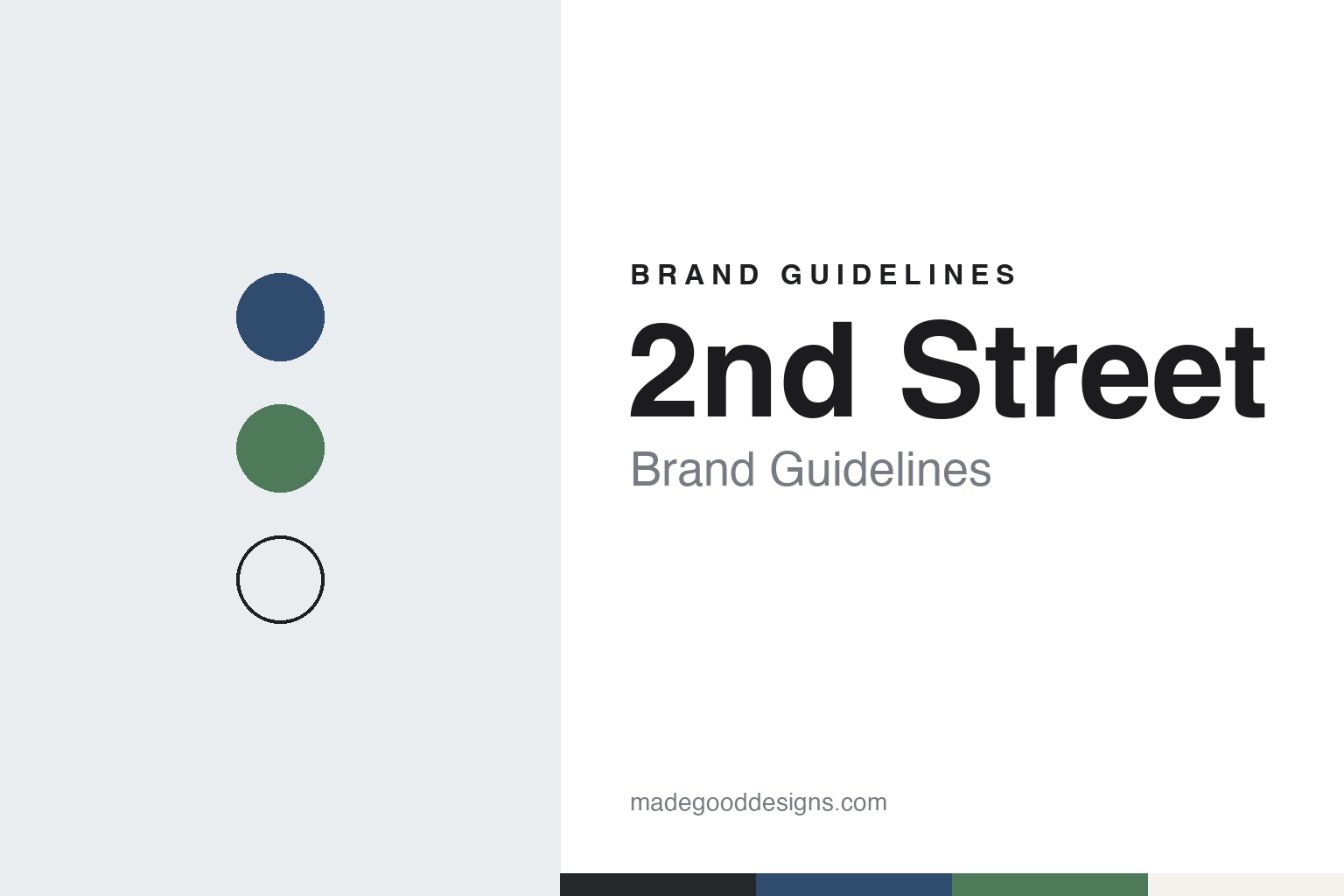
Two constants: a charcoal, denim blue and tag green palette and a plain grotesque register. Abstract homage — not a 2nd STREET product or mark; no logo, sign or store fitting is reproduced.
For-You, 1988
A Kagawa company behind the name.
2nd STREET began in Shikoku, not in Nagoya. Japanese Wikipedia, citing the company’s 2007 securities report and the regional newspaper Shikoku Shimbun, says the business was founded in June 1988 as For-You, a limited company in Kagawa Prefecture, and became a joint-stock company, Kabushiki Kaisha For-You, in November 1990. Its first chain was not 2nd STREET at all: in March 1995 it opened the first BOOK MARKET, a large used-book store, at Kita in Takamatsu.
The first store under the 2nd STREET name followed in March 1996: the Higashi Bypass store, which Japanese Wikipedia describes as a general recycling shop. Three months later For-You opened the first franchised BOOK MARKET, and in April 2000 its shares were listed on the second section of the Osaka Securities Exchange, the same article says. The Harvard Crimson, writing in September 2025, also gives 1996 as the year 2nd STREET was founded, the year of that first shop.
For-You tried other businesses along the way. Japanese Wikipedia records that in November 2001 it helped set up the Hanamaru udon company with a 40 percent stake, ended that tie-up in 2002, then ran its own Sanuki udon chain from 2002, and handed the udon business to the restaurant group Skylark in June 2004. In August 2005 it sold the BOOK MARKET trademark and head-office functions to A-Two, and in April 2006 agreed to transfer its directly run BOOK MARKET shops to the same company. From then on, the recycling shops were the core of the business.
Colour
Into the GEO group.
The rental chain GEO arrived in 2006. On 20 March 2006 For-You signed a capital and business tie-up with GEO, and in April GEO took about 34.3 percent through a new share issue, Japanese Wikipedia says. A tender offer in June 2008 made For-You a consolidated GEO subsidiary. On 1 January 2010 For-You took the name of its shops and became 2nd STREET Co., Ltd.; after a second tender offer it left the Osaka exchange on 19 June 2010 and became wholly owned by GEO on 24 June. Business Insider Japan, reporting in August 2025, also dates full ownership to 2010.
In February 2011 the head office moved from Saitama to Kasugai in Aichi, where GEO was then based. On 1 April 2013 the company was merged into GEO, and 2nd STREET carried on as a store name only. A new 2nd STREET Co., Ltd. was set up inside the GEO group on 2 December 2019 and took over the business on 1 April 2020; Japanese Wikipedia gives its head office as Naka-ku, Nagoya, and calls it a wholly owned GEO subsidiary.
The chain runs several formats. Japanese Wikipedia lists JUMBLE STORE, a clothing-only format mainly in city centres; 2nd OUTDOOR, for outdoor gear; and Super 2nd STREET, the large-store format, whose first branch opened at Kashiwa in Chiba in October 2013. Its own clothing label, ANTIQULOTHES, began in 2011 as a women’s line sold at JUMBLE STORE, the same article says. In Japanese the shops are often shortened to “Sekasuto,” and the chain has stores in all 47 prefectures; Japanese Wikipedia gives 508 stores in Japan as of March 2016.
What a 2nd STREET shop takes in depends on the country. In Japan, The Harvard Crimson reported in September 2025, customers can buy and sell almost anything, from refrigerators to office supplies, while the United States stores focus mainly on clothing. Staff check the brand and condition of each piece before making an offer, and decide what to accept by trend and season, the paper reported.
Typography
Design and documentation.
Japan’s second-hand, hobby, book and sports chains tend to present themselves through the store itself before any logo. Many of them grew from a single shop, and their corporate pages often open with that first branch, the town it stood in and the year it opened, followed by a timeline of new formats, franchise agreements and listings on the Tokyo Stock Exchange.
In second-hand retail, the buying counter is as much a part of the identity as the sales floor. Chains publish what they buy, how customers can bring goods in or send them by post, and which stores take which categories, from books and CDs to trading cards, toys, clothing and electronics. Some run separate buying-only centres or online services alongside their shops, and describe these on the same corporate pages as their stores.
Hobby and collector chains lean on display and naming. Shops are often split into small rooms or annexes, each with its own name and a single subject, such as manga for one readership, vinyl figures or vintage toys, so that a sign at the door tells a visitor what lies inside. Book chains, by contrast, describe long aisles, broad stock and space to browse, and some have used bright lighting and open layouts to make used books look like new retail. Mascots and capitalised store names appear on signs, bags and advertising.
Behind the shop fronts sit corporate structures that the companies set out in plain terms: founders, holding companies, parent groups, franchisees and shareholders, along with overseas stores that opened, moved or closed. The guides in this group follow those published histories, and treat colours and typefaces as an unofficial interpretation rather than an official brand standard.
Aa
A plain grotesque for labelled racks and store signs. (Specimen set in Archivo, a sans STAND-IN; NOT the 2nd STREET logo.)
Abroad
From Melrose Avenue to Harvard Square.
2nd STREET’s overseas expansion began in the United States. The GEO group set up 2nd STREET USA, Inc. in Delaware in November 2015, Japanese Wikipedia says, and the first store outside Japan opened on Melrose Avenue in Los Angeles on 12 January 2018. Malaysia followed in June 2018, Taiwan in August 2020 with a store in Taipei’s Ximending, Thailand in December 2023, and Singapore and Hong Kong in April 2025, according to Japanese Wikipedia’s history of the parent company.
The US stores have spread well beyond California. In 2025 the chain opened at Coolidge Corner in Brookline on 28 March and in Harvard Square on 20 June, The Harvard Crimson reported, describing the Cambridge store as spare and white-walled, “almost like a department store,” with racks labelled Y2K, Vintage, Designer and Contemporary Modern that rotate with the seasons, and the costliest pieces kept in glass cases. The paper put the chain at about 1,000 stores worldwide; Business Insider Japan reported in August 2025 that 2nd STREET had passed 1,000 stores around the world.
The parent then changed its own name. GEO Holdings became 2nd RETAILING Co., Ltd. on 1 October 2026, according to the Nagoya Stock Exchange’s new-listing summary of 24 September 2026, which lists the group’s business as stores buying and selling used clothing, accessories and appliances alongside its GEO media shops. The group’s president told Business Insider Japan that the “second” in the new name comes from “second-hand,” and that the growing recognition of 2nd STREET was part of the background to the change.
For a design guide, 2nd STREET shows how a resale chain can turn a mixed stream of goods into an orderly shop, with labelled racks, a short nickname and a store name that its parent group now echoes. Compare GEO, its sister chain in the same group, and Hard Off, another Japanese reuse chain. For this guide we use a charcoal, a denim blue and a tag green on off-white with a sans, an unofficial interpretation; no product or logo is reproduced.
Explore & save
Keep 2nd Street’s identity on hand — save it to a board in the Made Good inspiration library.
2nd Street identity set
Save the 2nd Street charcoal, denim blue and tag green palette and the plain grotesque register to your own board.