Bewakoof Brand Guidelines
The Mumbai t-shirt start-up now run under Aditya Birla’s TMRW.
Aa
Two constants: a Bewakoof marigold and charcoal palette and a Rounded sans register. Abstract homage — not a Bewakoof product or mark; no garment print, logo or label is reproduced.
A name that means “foolish”
Two IIT Bombay graduates and a t-shirt idea.
Bewakoof is a casual-wear brand from Mumbai. Its name is the Hindi word for “foolish,” as The Hindu BusinessLine explained in August 2016, and that self-mocking choice has been part of how the company presents itself from the start. It was founded by Prabhkiran Singh and Siddharth Munot, both graduates of IIT Bombay, according to Entrepreneur India, which in February 2026 described the business as beginning as a small t-shirt venture run from a single-room office in Mumbai.
Sources differ by a year on the start date. Inc42 in December 2022 and again in 2023, and Entrepreneur India in 2026, give 2012; Entrackr and People Matters, both writing in February 2026, give 2011, so both dates are given here. Entrackr describes the early business as bootstrapped.
The first outside money came from angel investors. The Hindu BusinessLine reported in 2016 that Bewakoof had raised equity from Kunal Bahl and Rohit Bansal, the founders of the e-commerce marketplace Snapdeal, and from Nikhil Vora of Sixth Sense Ventures. Later rounds came from investment firms: Inc42 named Investcorp, IvyCap Ventures and Spring Marketing Capital as participants in a 2021 round.
From the beginning the company sold through its own website, and it described its clothing as a private label that it designed and had made itself. Singh told The Hindu BusinessLine in 2016 that because Bewakoof designed and manufactured its own label it had kept healthy margins. The brand’s range had already grown by then from apparel into phone and mobile covers.
Colour
Online first, then shelves and stores.
What Bewakoof sells has stayed close to its first product. Entrepreneur India in 2026 listed t-shirts, joggers and hoodies, along with mobile covers and accessories; Inc42 in 2022 described theme-based clothing, notebooks and backpacks sold through the brand’s website. Entrackr in February 2026 added licensed merchandise to the list, sold mainly through Bewakoof’s own site and also through online marketplaces, and described the brand as youth-focused, aimed at Gen Z and millennial shoppers.
Physical retail took more than one attempt. The Hindu BusinessLine reported in August 2016 that the company had run a pilot in 2014 through about 150 to 200 boutique outlets, supplied through distributors, and had closed it after payment problems to concentrate on selling online. In that interview Singh described a return to the high street through larger flagship stores of its own, beginning in Mumbai.
A decade later the stores existed. By February 2026 Bewakoof operated more than 30 exclusive brand stores in cities across India, Entrepreneur India reported, and Inc42 described a brand that had started as a direct-to-consumer start-up and since moved into marketplaces and offline retail. The company’s own website and app remain its core channel in every account, with marketplaces and the stores added around them rather than replacing them.
For a design reader, the documented record is of a brand that has moved from a website to marketplaces and then to its own shops, with the same name, the same co-founder as chief executive until 2026 and the same core garments throughout. Entrackr described the range in 2026 as affordable and trend-driven, and Inc42 in 2022 used the word theme-based for its clothing; both describe printed casual wear rather than tailoring or formal clothes, which is the territory of the older labels in the same group.
Typography
Design and documentation.
Indian fashion and lifestyle brands tend to present themselves through what they make for particular moments. Ethnic-wear labels sort their ranges by garment, from kurtas, suit sets and sarees to sherwanis and lehengas, and by occasion, from festivals and office days to the separate ceremonies of a wedding. Western-wear and suiting labels lean instead on fabric, fit and the working week, and many companies now sell both kinds of clothing side by side.
Ownership is part of the story. Several names sit inside larger listed or private groups, such as Aditya Birla Fashion and Retail, Vedant Fashions, TCNS Clothing and Raymond, while others remain founder-run or family-run companies that have taken outside investors. Corporate and investor pages are usually the plainest record of this: they set out founders, subsidiaries, stock-exchange listings and the dates on which a label was launched, bought or merged, and those pages are a sensible place to start when tracing who owns a brand today.
Visual identity is mostly carried by the stores and the campaigns rather than by published brand manuals. Exclusive brand outlets in malls and high streets, shop-in-shops in department stores, cricket sponsorships, cinema spots and celebrity ambassadors do much of the work, and a company’s logo is often seen first on a shopping bag, a jersey or a billboard. Colour palettes and typefaces are seldom documented in public.
This guide follows that record. It sets out founding dates, owners and listings as the companies and dated press reports give them, names collections and campaigns only where a source names them, and treats the colours and type shown here as an unofficial interpretation rather than a brand standard.
Aa
A rounded, friendly sans for a brand with a joke in its name. (Specimen set in Baloo 2, a rounded sans STAND-IN; NOT the Bewakoof logo.)
Bewakoof under TMRW
From founder-run start-up to a group brand.
The ownership change came at the end of 2022. In June 2022 the Aditya Birla Group set up TMRW, a house-of-brands business for digital-first fashion labels, Inc42 reported; by December that year TMRW had invested in Bewakoof, alongside labels such as Berrylush, Nobero, Urbano and Veirdo in its portfolio. The same report said the investment came a few days after the group announced that it was backing eight digital-first lifestyle brands in India, Bewakoof among them. Entrepreneur India reported that the investment gave TMRW, part of Aditya Birla Fashion and Retail, a majority stake, and that the acquisition was completed in February 2023; Inc42 also gives February 2023 as the date the brand was acquired.
Since then Bewakoof has operated as part of TMRW’s portfolio, Entrackr and People Matters reported in February 2026. The same reports covered a leadership change: Prabhkiran Singh, co-founder and chief executive, announced in February 2026 that he would step away after about 14 years and lead the business until the end of March 2026. Entrepreneur India quoted TMRW’s chief executive, Prashanth Aluru, as saying that since 2023 the group had worked on strengthening the business while keeping the brand’s identity.
The brand’s look is not documented in any of these reports. The name is spelt as one word, and the company uses it on its website, app, stores and products alike. No public brand manual, logo history or colour specification has been published by the company, so the palette and type in this guide are an interpretation.
For a design guide, Bewakoof shows how a self-mocking name and a short list of printed basics can carry a brand from a website into a national chain of shops under group ownership. Compare The Souled Store, another Mumbai brand built on printed and licensed casual wear, and Allen Solly, a label in the same Aditya Birla fashion business. For this guide we use marigold, a mustard ink, pale butter and charcoal with a rounded sans, an unofficial interpretation; no product or logo is reproduced.
Explore & save
Keep Bewakoof’s identity on hand — save it to a board in the Made Good inspiration library.
Bewakoof identity set
Pin the Bewakoof marigold and charcoal palette and the Rounded sans register to your own board.
Source & notes
Frequently Asked Questions
What font can I use to match the Bewakoof look?
This guide describes Bewakoof’s type as “A rounded, friendly sans for a brand with a joke in its name”. Its type specimen is set in Baloo 2 from Google Fonts as a stand-in; Baloo 2 is not Bewakoof’s own lettering.
What colours are in the Bewakoof palette?
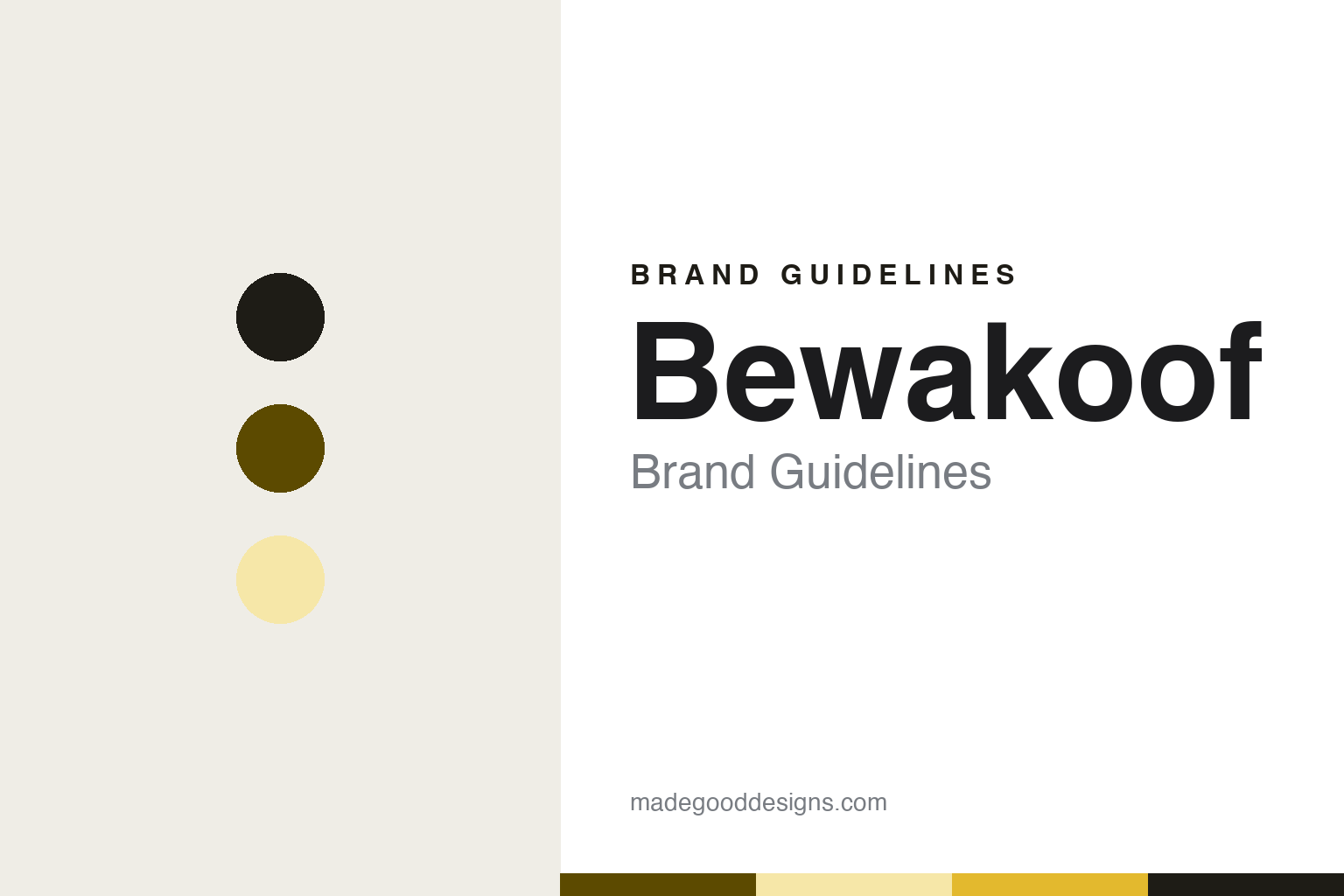
This guide’s Bewakoof palette is Mustard ink #5C4A00, Charcoal #1E1C16, Pale butter #F6E7A8, Marigold #E3B92E and Paper #FBF8EE. The tones are the guide’s own unofficial interpretation, not official Bewakoof hex codes.
When was Bewakoof founded?
Bewakoof was founded in 2011–2012, in Mumbai, India. Bewakoof is known for Printed t-shirts, joggers, hoodies, phone covers.
Who founded Bewakoof?
Bewakoof was founded by Prabhkiran Singh and Siddharth Munot in 2011–2012.
Who owns Bewakoof?
Bewakoof is owned by TMRW (Aditya Birla Fashion and Retail), majority since February 2023.